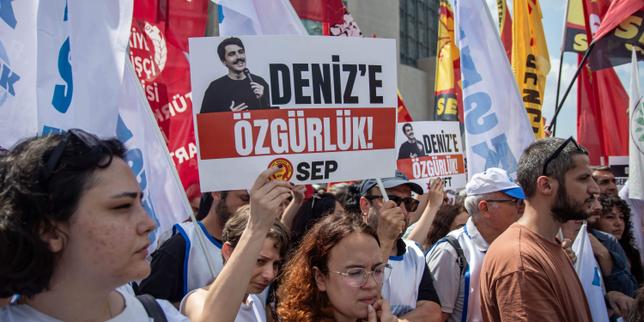
The microphone did not screech when it was left behind. It simply stood there, a thin stalk of chrome catching the dim house lights of a basement theater in Kadıköy. For months, that specific square meter of stage belonged to Deniz Göktaş. He was not a politician. He possessed no armies, no state budgets, and no decrees. He had a microphone, a glass of water, and a sharp, melancholic wit that could dissect the heavy absurdities of modern Turkish life in under thirty seconds.
Now, the room is quiet. The audience members have filtered out into the damp Istanbul night, their breath fogging in the cold air, talking in hushed tones about what they just witnessed. Or rather, what they will no longer be allowed to witness.
When a comedian is hauled away to a prison cell for a punchline, the crime is never truly about the words spoken. It is about the mirror held up to power. In Turkey, that mirror has become an illegal weapon. Göktaş, a rising star of the country’s vibrant underground stand-up scene, found himself trading the stage for a concrete room, charged with the dual sins of modern Turkish jurisprudence: insulting religious values and insulting President Recep Tayyip Erdoğan.
To understand how a joke becomes a state emergency, you have to sit in the smoky, crowded comedy clubs of Istanbul, where young people gather to find a temporary reprieve from an inflation rate that swallows their futures and a political atmosphere that suffocates their speech.
The Geography of a Shifting Punchline
Every comic knows the risk. You can feel it in the room before the first joke lands. There is a specific kind of laughter unique to countries sliding into authoritarianism—a nervous, explosive burst of air that says, I cannot believe he just said that out loud, and I pray no one is recording this.
For years, stand-up comedy in Turkey existed in a gray zone. It was a pressure valve. The government controlled the television networks, the newspapers, and the universities, but they could not easily police every tiny basement bar across the Bosporus. In those spaces, Göktaş thrived. He did not yell. He did not pace the stage like a theatrical provocateur. He spoke with the quiet, weary cadence of a philosophy student who had looked too closely at the gears of the machine.
He joked about the crushing weight of piety enforced by the state. He joked about the omnipresent face of the president looking down from every billboard, every news broadcast, every classroom wall. His comedy was a collective sigh of relief turned into art.
But the pressure valve has been welded shut.
The legal mechanism used to silence him is old, familiar, and devastatingly efficient. Article 299 of the Turkish Penal Code makes it a criminal offense to insult the president. It carries a sentence of up to four years in prison. Under Erdoğan’s tenure, this once-obscure statute has been transformed into a conveyor belt for political prosecutions. Tens of thousands of citizens—from journalists and lawyers to teenagers posting on TikTok—have been investigated or jailed under its parameters. Combine that with Article 216, which criminalizes the "degradation of religious values," and the state possesses a net fine enough to catch anyone who dares to smile at the wrong moment.
Consider how the trap springs. A performance is clipped. A ten-second video is uploaded to social media by an anonymous account. The digital mobs, whipped into a frenzy by pro-government commentators, demand justice for an insult they did not actually hear, within a context they do not care to understand. Within hours, the police are at the door.
The Anatomy of an Outrage
The official accusation claims Göktaş crossed the line from humor into "outrage." It is a word prosecutors love because it requires no objective definition. It is a feeling. It is an emotional state claimed by the powerful to justify the erasure of the powerless.
But look closer at what actually happened during the performance that sealed his fate. Göktaş was analyzing the strange, contradictory nature of forced orthodoxy. He was pointing out that when faith and state power become identical, both lose their souls. His observation was not theological heresy; it was a sociological truth.
The real offense was simpler, and far more dangerous to the ruling elite. He made them look small.
Despots can tolerate hatred. They can handle protests, because protests validate their strength and give them an excuse to deploy riot police and water cannons. What they cannot endure is ridicule. A dictator relies on an aura of terrifying, unassailable majesty. The moment an entire room of twenty-somethings begins to giggle at the absurdity of that majesty, the spell is broken. The fear evaporates, if only for an hour.
That is why the state cannot let the joke pass. The trial of a comedian is always a theatrical performance staged by the ministry of justice, designed to send a message to everyone else sitting in the dark: Watch your mouth. We are listening.
The Echo in the Empty Room
Sitting in those venues today, the atmosphere has fundamentally shifted. The air feels heavier. Fellow comedians look at the empty space where Göktaş used to stand, wondering if their own notebooks contain the sentence that will end their careers.
The psychological toll of this censorship is insidious. It creates an internal border patrol within the mind of the artist. Before a comic writes a word on paper, they begin to self-censor. They ask themselves if a bit about the price of bread will be interpreted as a critique of economic policy, which leads to a critique of the palace, which leads to a dawn raid on their apartment.
The state does not need to jail every citizen to achieve total control. It only needs to jail the loudest, the bravest, or the funniest, and let the resulting silence do the rest of the work.
Yet, this strategy contains a fatal flaw that history demonstrates time and again. You can imprison the man, but you cannot arrest the memory of the laugh. The digital recordings of Göktaş's sets continue to circulate through encrypted messaging apps and private viewings. His words have grown sharper in his absence. Deprived of his physical presence, his audience has turned his punchlines into a form of quiet resistance.
The trial will proceed. There will be solemn judges in black robes, stacks of dry legal briefs, and a verdict that was decided long before the police ever arrived at the theater. Göktaş will likely spend months, perhaps years, looking at the sky through a grid of iron bars because he refused to pretend that the emperor was wearing clothes.
But the real verdict has already been delivered by the people who populated those small, dark rooms.
On a recent night in Kadıköy, another young comedian took the stage. The crowd was tense, the silence awkward. The performer looked at the microphone, looked at the audience, and made a subtle, fleeting reference to an absent friend. No names were mentioned. No laws were broken.
But the room erupted. It was a loud, defiant, collective roar that echoed off the concrete walls and bled through the floorboards into the street outside. It was the sound of a city refusing to forget how to breathe. They have taken Deniz Göktaş away, but the joke is out in the wild now, and the state has no idea how to catch it.


