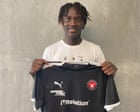
The grass at the MCH Arena in Herning is kept in a state of unnatural perfection. It is a stage where twenty-two men perform a weekly ballet of precision, speed, and calculated aggression. For a young man like Alamara Djabi, that emerald rectangle represented more than a career. It was a sanctuary. It was the place where the world finally made sense.
But the world outside the stadium doesn't always play by the rules of the game. It doesn't respect the offside line. It doesn't care about a promising career or the dreams of a nineteen-year-old who moved across borders to chase a ball.
Late on a Tuesday night in Ikast, the lights didn't go out on a scoreboard. They went out in an alleyway.
Djabi, a rising talent for FC Midtjylland, wasn't facing a defender. He wasn't tracking a cross or looking for a gap in the defense. He was walking through the quiet streets of a Danish town that usually feels like one of the safest places on earth. Then, the steel found him.
The Anatomy of a Moment
Violence is rarely cinematic. It is messy, confusing, and terrifyingly brief. In a single, jagged instant, the narrative of a professional athlete shifts from "player to watch" to "patient in critical condition."
Reports from the Midt- og Vestjyllands Politi describe a scene that feels alien to the calm, orderly life of central Jutland. An eighteen-year-old suspect has been apprehended. A life has been upended. The cold facts of the police report tell us the where and the when, but they fail to capture the why that haunts every locker room in the country.
Why him? Why now?
Consider the physical reality of a footballer. Their body is their capital. Every muscle fiber is tuned like a high-performance engine. When a blade enters that equation, it isn't just a wound; it’s a systematic dismantling of a future. A deep puncture in the thigh or torso doesn't just damage skin; it severs the connection between a young man’s hard work and his ultimate reward.
The Invisible Stakes of the Academy Life
We often view young footballers as lucky. We see the jerseys, the social media followers, and the potential for million-euro contracts. We forget that they are often teenagers living thousands of miles from home, navigating foreign cultures in a high-pressure environment where their value is reassessed every Saturday morning.
Alamara Djabi was part of the prestigious FCM academy, a literal factory of dreams that has produced stars like Simon Kjær and Pione Sisto. In this ecosystem, the players are protected. They are fed, coached, and monitored. But the bubble is translucent.
When Djabi was rushed to Aarhus University Hospital, the entire structure of the club felt the vibration. This wasn't a hamstring tear. This wasn't an ACL surgery with a predictable six-month recovery timeline. This was a confrontation with mortality.
The club’s official statement was brief, as these things must be. They asked for peace. They asked for respect for the family. But between the lines of that corporate prose was a scream of disbelief. Denmark is a country where you are supposed to be able to walk home at night without looking over your shoulder. For the international players at Midtjylland, that sense of security is part of the draw. It is the silent promise the club makes to the parents back home: Your son will be safe here.
That promise was broken in Ikast.
The Recovery Beyond the Operating Room
Surgery can stitch a wound. Modern medicine is a miracle of precision, and early reports suggest that while the injuries were grave, the medical team worked with the kind of urgent efficiency that saves lives.
The real challenge begins when the anesthesia wears off.
Imagine a hypothetical player—let's call him Jonas—who shares a dorm with Djabi. Jonas watches his friend’s empty bed. He sees the boots still sitting by the door, caked in the dried mud of the last training session. Suddenly, the game feels small. The tactical meetings about "high-pressing" and "transitional play" feel like children’s theater.
The psychological trauma of such an event ripples through a squad. It introduces a variable that coaches are never trained to manage: fear. Every time a teammate walks to their car after dark, or heads to the grocery store alone, that night in Ikast will sit in the back of their minds like a cold stone.
Football is a game of confidence. You have to believe you are invincible to dive into a header or challenge a goalkeeper. When that belief is shattered by a senseless act of violence on a sidewalk, the road back to the pitch becomes twice as long. It’s not just about regaining the strength to run; it’s about regaining the courage to be seen.
A Community in the Crosshairs
The town of Ikast is not a place where "serious stabbings" happen. It is a town defined by industry, textiles, and sports. It is a place of modest houses and grey skies.
When an eighteen-year-old is arrested for attempted murder in a community this size, it suggests a fracture in the social fabric that goes deeper than a single incident. The police have been tight-lipped about the motive. Was it a random act of cruelty? Was it a dispute that spiraled out of control?
In the absence of answers, rumors fill the vacuum. But for the fans of FC Midtjylland—the "Ultras" who chant Djabi’s name—the details of the investigation are secondary to the survival of the boy. They didn't fall in love with a crime statistic. They fell in love with a kid who could turn a game on its head with a single touch.
The vulnerability of the athlete is a strange thing to contemplate. We treat them like gladiators, yet they are fragile. They are susceptible to the same darkness that plagues the rest of humanity.
The Long Walk Back
There is a specific kind of silence that hangs over a training ground when a tragedy occurs. The whistles sound different. The laughter is forced.
The path for Alamara Djabi is now obscured by the fog of recovery. He is no longer fighting for a spot in the starting eleven; he is fighting for the normalcy he possessed just seconds before that blade appeared.
The world will move on. The transfer windows will open and close. New wonderkids will be signed from West Africa or South America, and the highlights will continue to roll across our screens. But in a hospital room in Aarhus, the clock has stopped.
Success in sport is usually measured in trophies and statistics. In the coming months, success for Djabi will be measured in the ability to stand without pain. It will be measured in the first time he feels the sun on his face without the shadow of that night looming over him.
We want our athletes to be heroes, but events like this remind us they are simply humans. They are sons, brothers, and friends who happen to be gifted with a ball. When the lights go out on the pitch, and the stadium empties, they are just as vulnerable as anyone else walking home through the dark.
The grass in Herning will be mowed. The lines will be painted white. The game will resume. But the echo of that night in Ikast will remain, a haunting reminder that the most important battles aren't always fought between the whistles.
He was just a boy walking home. He should have made it.