The Screen in the Dark
Elena used to have a voice that anchored a city. For twenty-two years, her face appeared on the 6:00 PM local broadcast in households across three counties. When the water mains broke, people listened to Elena. When the school board debated budgets, people looked to her expressions to gauge if the town was going broke.
Last night, Elena sat in a studio that smelled faintly of static and floor wax, reading a script about a massive regional data breach. She gave it everything—the precise modulation of her voice, the deliberate pauses, the steady eye contact with a cold glass lens.
When the red light flickered off, she walked back to her desk and opened her laptop. She checked the station’s analytics dashboard.
The segment had generated exactly forty-two views.
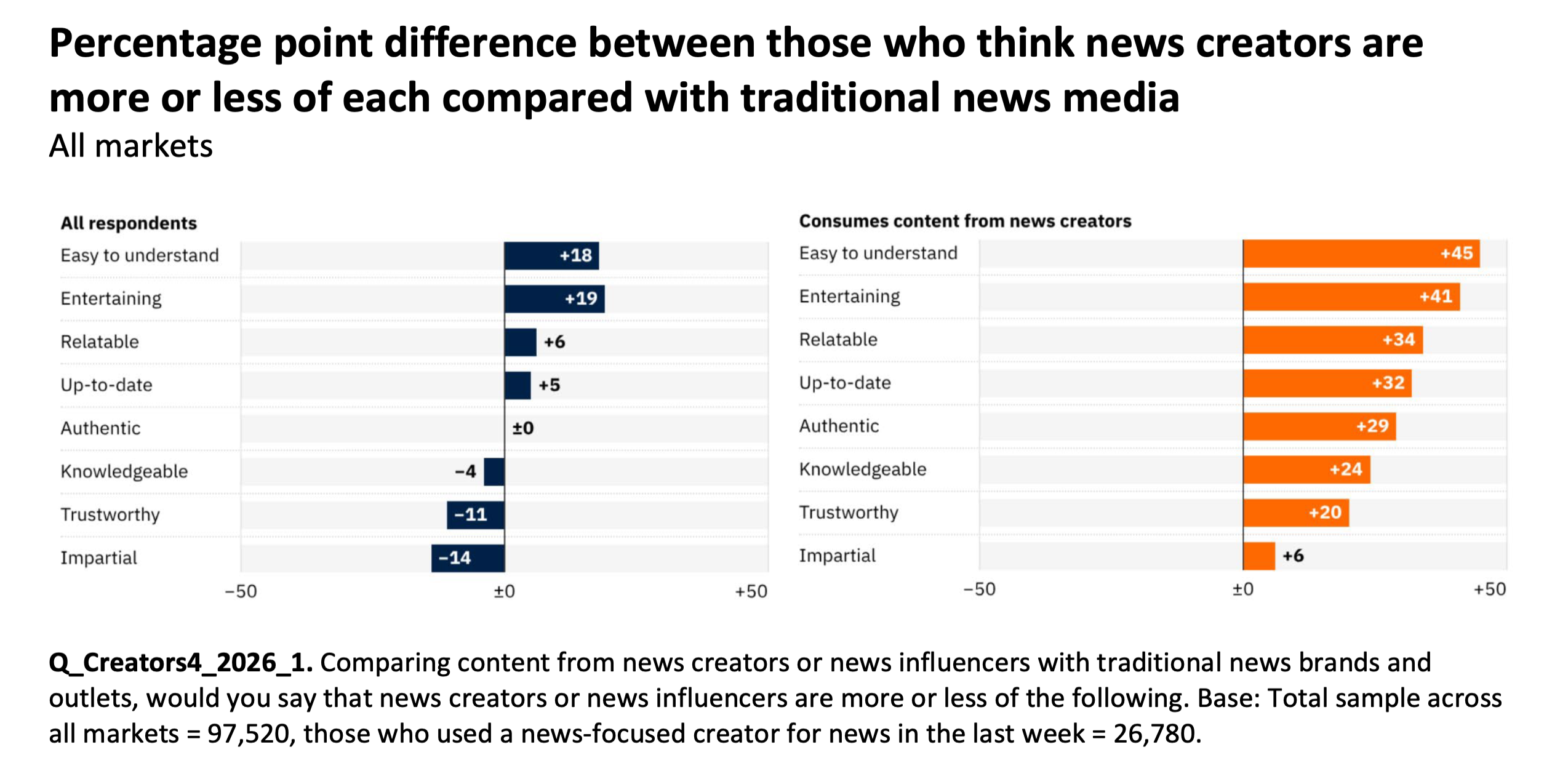
Then she opened her phone. On an entertainment app, a twenty-one-year-old creator in a backward baseball cap was talking about the exact same data breach. He didn't check sources. He didn't interview the utility company. He just screamed into his front-facing camera while a computerized voiceover read text across his chest.
His video had 1.4 million views.
Elena stared at the blue light reflecting in her reading glasses. The room around her was completely quiet, save for the hum of the air conditioning. It wasn't just that she was losing her audience. It was the sudden, sickening realization that the architecture of human trust had shifted beneath her feet while she was busy checking her facts.
This is not a story about one local journalist losing her grip on a career. It is the reality of our current year, 2026, documented in terrifying clarity by the latest Digital News Report. We have officially crossed a threshold. The traditional newsroom is no longer the gatekeeper of reality.
The platforms have won. And the truth is stranded in the aftermath.
The Migration of the Mind
Think back to how information used to travel. It was a physical, deliberate act. You unbanded a crisp newspaper on a porch. You turned a dial to a specific frequency at a specific hour. There was a conscious appointment made between the citizen and the institution.
Now, information is atmospheric. It behaves like humidity. You do not go looking for the news; the news hits you while you are trying to buy shoes, watch a friend’s vacation video, or look up a recipe for sourdough bread.
The data from this year’s report shows a stark, undeniable flip in human behavior. For the first time in history, social media platforms and algorithmic feeds have soundly defeated direct access to news websites and apps as the primary source of information.
Let's ground this abstract shift in a simple analogy. Imagine you need to buy groceries. In the old world, you walked into a supermarket. You knew the layout. You knew the butcher’s name. You knew that if the milk was sour, you could return it to a manager who lived in your neighborhood.
In the new world, you stand on your balcony, open your mouth, and wait for a drone to drop random food particles into your throat. Some of it is steak. Some of it is flavored cardboard. Some of it is literal poison. But it is fast, it requires no walking, and it tastes precisely like what your brain chemistry craves at that exact microsecond.
Consider what happens next. When we stop choosing our information and instead let algorithms curate our reality based on what keeps our eyes glued to the glass, the very definition of "news" mutates.
It stops being what is important. It becomes what is irresistible.
The Great Disconnect
Here is the profound paradox at the center of modern life: we are consuming more information than any generation of humans to ever walk the earth, yet our trust in that information has plummeted to a record, historic low.
We are gorging ourselves at a buffet we are convinced is contaminated.
According to the 2026 data, less than a third of the global population trusts the news they consume. Think about that fraction. If you walk down a busy city street, two out of every three people you pass believe the stories shaping their worldview are either manipulated, incomplete, or outright lies.
This creates a exhausting psychological friction. We feel it every time we open our phones. We scroll through a headline about a geopolitical crisis, followed immediately by a video of a cat jumping into a box, followed by an angry political diatribe from a stranger in Ohio, followed by an advertisement for hair thinning cream.
Our brains were never wired to process the tragic, the trivial, and the commercial in a seamless, continuous scroll. It breaks our internal calibration for importance.
When everything is loud, nothing is significant.
The result is a condition that psychologists are now tracking with deep concern: news avoidance. Millions of people are simply opting out. They are pulling the shades down. They look at the chaotic, screaming ecosystem of modern information and decide that ignorance is the only path to sanity. They aren't turning away because they don't care about the world. They are turning away because caring has become too expensive for their mental health.
The Algorithm Doesn't Have an Editor
Let us look closely at the new rulers of the information kingdom. The platforms that have usurped traditional journalism do not operate on the ethics of public service. They operate on the mechanics of engagement optimization.
An editor in a traditional newsroom asks: "Is this story accurate, and does the public need to know it?"
An algorithm asks: "Will this piece of content make the user stay on this screen for four seconds longer?"
That difference in programming changes everything. Anger keeps people on screens. Fear keeps people on screens. Righteous indignation is the most profitable commodity in the digital economy.
When you strip away the sleek user interfaces and the friendly branding of these tech giants, you are left with a massive, automated sorting machine designed to feed your biases back to you in an echo chamber. It doesn't matter if the video you are watching is true. It matters that you didn't swipe away.
The traditional journalists, bound by defamation laws, editorial oversight, and the tedious process of verifying claims with multiple sources, are playing a game of chess against a machine that plays by the rules of a demolition derby. They cannot compete with the speed or the spectacular nature of unverified rumor.
But the real problem lies elsewhere. It isn't just that the tech companies are eating the lunch of traditional media. It is that they have dismantled the shared vocabulary of society. When two neighbors look at their phones, they are no longer looking at different opinions on the same set of facts. They are looking at entirely different realities.
The Cost of the Silent Room
Elena left the studio at 7:30 PM. She drove home through the suburbs, watching the blue glow of television screens through living room windows fading away, replaced by the smaller, sharper white glints of smartphones held six inches from people's faces on porches and in parked cars.
She felt a quiet, persistent grief. Not for her name on a marquee or her salary, but for the loss of a shared town square. She remembered when a story she broke could cause the city council to change a policy by the following morning because everyone in the community had witnessed the same evidence simultaneously.
Now, that collective leverage is gone, fragmented into millions of personalized data streams.
We are living through a massive, unconsented experiment in human attention and societal trust. The institutions that helped us navigate the complexities of modern history are crumbling, not because they failed to tell the truth, but because the delivery system for truth became obsolete in the face of algorithmic addiction.
We cannot simply wish ourselves back to the era of the evening broadcast or the morning paper. The digital current is too strong. But we can change how we swim in it.
The next time you open an app and feel that sudden, sharp spike of adrenaline—that urge to share a headline before you’ve even read the article, that instant flash of fury at a fifteen-second clip—pause. Recognize that your attention is being harvested. Understand that the truth is rarely designed to make you feel comfortable or instantly vindicated.
The future of a functional society depends entirely on our willingness to slow down, look past the screen, and demand an accounting from the machines that feed our minds. If we don't, we will find ourselves living in a world perfectly tailored to our worst impulses, wondering why the rooms around us have grown so terribly dark and silent.