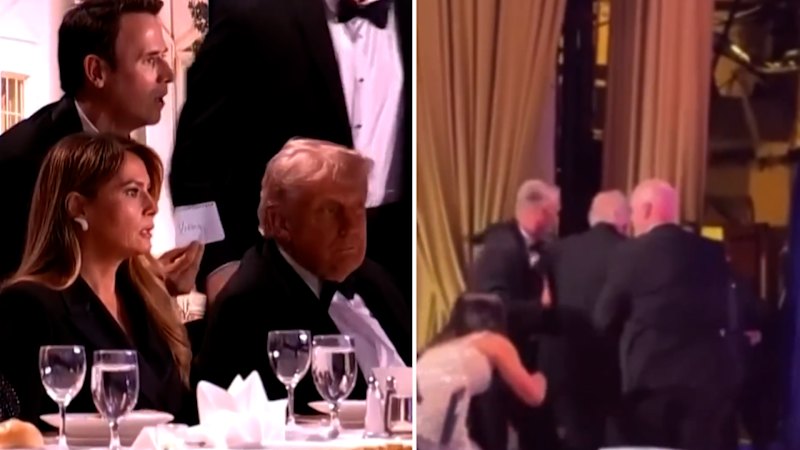
The humidity in Washington D.C. usually waits until July to turn the air into a wet wool blanket, but inside the Washington Hilton, the heat is always artificial. It’s the heat of a thousand camera flashes, the friction of power rubbing against celebrity, and the heavy, expensive scent of lilies and hairspray. This is the "Nerd Prom." It is the one night a year where the people who write the laws and the people who write the headlines pretend they are all on the same team.
Everything is rhythmic. The clink of silver on china. The rehearsed laughter at a politician’s self-deprecating joke. The frantic tap-tap-tap of a reporter filing a lead from a cramped table in the back. Then, the rhythm broke.
It didn't sound like a movie. There was no cinematic explosion or orchestral swell. It was a sequence of sharp, metallic pops that tore through the ambient hum of the ballroom like a jagged blade through silk. In a room filled with the most powerful people on earth, the first reaction wasn't fear. It was confusion. We are conditioned to believe that certain spaces are impenetrable. We believe that a high-priced ticket and a Secret Service perimeter create a bubble where the outside world cannot intrude.
That bubble popped at 8:42 PM.
The Anatomy of a Second
Consider a veteran photographer we will call Elias. He has spent thirty years capturing the smiles of presidents and the scowls of dictators. His finger was hovering over the shutter when the first round hit. In that moment, Elias didn't think about his Pulitzer or his deadline. He thought about the trajectory of the glass shards.
He saw a water pitcher on a nearby table disintegrate. The water didn't just spill; it atomized, turning into a fine mist that caught the overhead spotlights, looking like a cloud of diamonds before it settled onto a senator’s lapel. Elias dropped. Not because of bravery, but because of instinct. The floor of the Hilton is hard, cold, and smells faintly of industrial carpet cleaner. It is a long way down from the ego of a gala.
The chaos that followed was a masterclass in the breakdown of social hierarchy. When the lead flies, a Cabinet Secretary and a catering waiter look exactly the same as they scramble for the cover of a draped table. The "invisible stakes" of the evening—political capital, social standing, the seating chart—evaporated instantly. They were replaced by the only stake that has ever truly mattered: the next breath.
The Illusion of the Perimeter
We tell ourselves stories about security to help us sleep. We look at the magnetometers, the stone-faced men with earpieces, and the snipers on the roof, and we convince ourselves that violence is something that happens "out there." We treat safety as a static thing, a wall that is either up or down.
The reality is that safety is a liquid. It has leaks. It has ripples.
The investigation would later focus on the service entrance, a gap in the choreography of the evening that allowed a shadow to slip through the light. But for those huddled under tables, the "how" was irrelevant. The "now" was everything. There is a specific sound a human being makes when the veneer of civilization is stripped away. It is a low, guttural whimpering that ignores partisan lines.
I saw a journalist who had spent the last decade tearing down the administration reach out and grab the hand of a White House staffer she had lambasted in print just that morning. Their fingers locked together, white-knuckled and trembling. In the dark under the table, the rhetoric was dead. The story was gone. There was only the heat of another person's palm and the prayer that the door would hold.
The Cost of the Spectacle
For years, critics have argued that the White House Correspondents' Dinner has become too bloated, too cozy, and too much of a target. They spoke in terms of "optics" and "ethics." No one spoke in terms of ballistics.
The tragedy of the evening wasn't just the physical injury—the shattered bone and the spilled wine that looked too much like blood in the dim light. The tragedy was the permanent fracturing of a tradition. You can patch a wall. You can replace a window. You cannot easily repair the collective psyche of a city that realizes its most guarded sanctums are porous.
As the Secret Service surged forward, a wall of dark suits and drawn weapons, the transition from "party" to "crime scene" was absolute. The music stopped. The teleprompters went black. The jokes that had seemed so biting moments ago now felt like relics from a distant, more innocent civilization.
One hypothetical observer—let’s call her Sarah, a young aide on her first big assignment—found herself staring at a single high-heeled shoe left in the middle of the aisle. It was silver, sparkling, and utterly absurd. It represented the vanity of the evening, abandoned in the rush for survival. Sarah realized then that she would never look at a red carpet the same way again. To her, every camera flash would now sound like a gunshot. Every sudden movement would feel like a threat.
Beyond the Briefing Room
The news cycle moved with its usual, predatory speed. Within an hour, the "dry facts" were being beamed to every screen in the world. Suspect apprehended. Number of rounds fired. Condition of the wounded. But the facts don't tell you about the smell of ozone and gunpowder that lingered in the vents. They don't tell you about the way the silence felt afterward—a heavy, ringing vacuum that made your ears ache. They don't tell you about the long walk home in a tuxedo that felt like a costume, or the way the cool night air felt against skin that was still humming with adrenaline.
We are obsessed with the "why." We want to know the motive, the manifesto, the political leaning of the hand on the trigger. We want to categorize the horror so we can put it in a box and file it away. If we can blame a person or a movement, we can pretend we have solved the problem.
But the problem isn't just the shooter. The problem is the fragility of the peace we take for granted. We live our lives on a thin crust of order, dancing and dining above a magma of chaos that we usually manage to ignore.
The Aftermath of the Echo
The following morning, Washington was draped in a grey, persistent drizzle. The police tape around the Hilton flapped in the wind, a bright yellow reminder of the night the music died.
In the newsrooms, the coffee was bitter. The reporters weren't writing about policy or polling data. They were staring at their screens, trying to find the words for a feeling they hadn't been trained to describe. How do you report on the death of an illusion?
The dinner will likely continue in the years to come. There will be more metal detectors, more dogs, more distance between the stage and the seats. The jokes will be more cautious. The laughter will be thinner.
But for those who were in the room, the sound of the pop will never truly fade. It will remain in the back of the throat, a metallic tang that resurfaces whenever a room gets too crowded or a door slams too hard. We learned that power doesn't protect you. We learned that the stories we tell ourselves are just that—stories.
The most terrifying truth of the night wasn't that someone tried to break the world. It was how easily it broke.
The silver shoe sat in the evidence locker, its glitter dulled by a layer of grey dust, a silent witness to the moment the gala became a ghost story.



