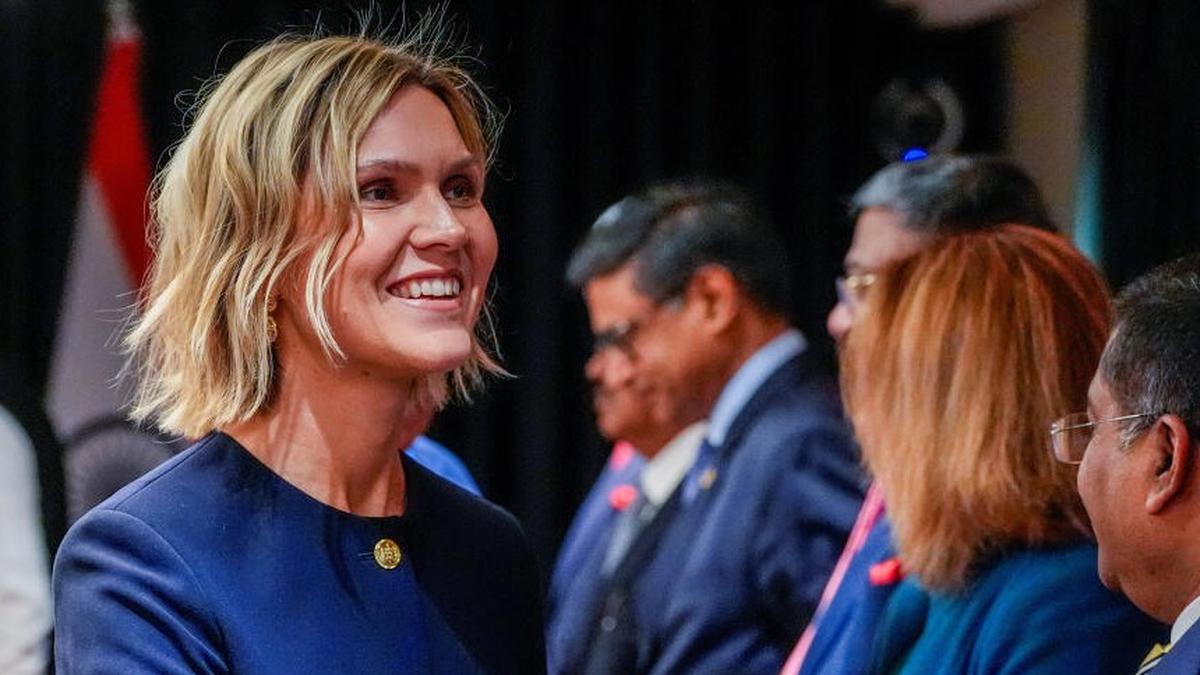
Western diplomacy is stuck in a loop of polite exasperation. The recent diplomatic dance between Nordic leaders and New Delhi follows a tired script: European leaders fly into India, deliver a lecture wrapped in the language of "shared democratic values," nod politely at India’s boilerplate commitment to peace, and fly home pretending a breakthrough occurred. Iceland’s leadership recently epitomized this routine, acknowledging that while India and the Nordics have "different views" on Russia, they share a "common cause with peace."
This is a fundamental misreading of global power dynamics.
Framing India’s stance on the Russia-Ukraine war as a mere difference of opinion—or worse, a misunderstanding that can be corrected with enough European persuasion—is wishful thinking. India isn't suffering from a lack of moral clarity. New Delhi is executing a calculated, cold-blooded strategy rooted in national survival and regional hegemony. European leaders who treat strategic divergence as a debate club disagreement are failing to grasp the tectonic shifts in global geopolitics.
The Myth of the Neutral Global Citizen
Western commentators love to clean up international relations with comforting euphemisms. We hear terms like "strategic autonomy" or "non-aligned balancing" used to describe India's foreign policy. Let’s strip away the diplomatic paint.
India’s position on Russia is driven by two brutal necessities: cheap energy and military hardware.
When the West imposed sanctions on Russian oil, Europe assumed the world would fall in line out of moral solidarity. Instead, India stepped in, scaled up its imports of discounted Russian crude, refined it, and sold it right back to Europe at a premium. It was a masterclass in economic opportunism. Western leaders call for peace while quietly buying Russian molecules laundered through Indian refineries.
[Russian Crude] ➔ [Indian Refineries] ➔ [European Fuel Markets]
To expect India to abandon this position because of Nordic appeals to international law is absurd. For a country managing a massive population and intense economic pressures, securing energy at a discount isn't a luxury; it is a domestic imperative.
The China Factor the Elephant in the European Room
The most glaring flaw in the Western approach to India is the failure to recognize New Delhi's primary existential threat. For Iceland, Norway, or Sweden, Russia represents the immediate geopolitical menace. For India, Russia is a secondary concern. The real threat sits across a disputed 2,100-mile border in the Himalayas.
China is India's geopolitical obsession.
Every move New Delhi makes on the chessboard is designed to counter Beijing’s expansionism. India’s relationship with Moscow is not built on shared cultural values or ideological alignment; it is a structural mechanism to prevent a total Sino-Russian axis. If India abandons Russia, it pushes Moscow entirely into the arms of Beijing, leaving India strategically isolated in Asia.
Consider the military reality. Over half of India’s conventional military hardware—from fighter jets to submarine components—is of Russian or Soviet origin. Decoupling a military apparatus from its primary supplier cannot happen overnight through a series of polite bilateral summits. It takes decades of defense industrial overhauls. When Nordic leaders ask India to take a harder line on Ukraine, they are inadvertently asking India to compromise its readiness along the Line of Actual Control with China. New Delhi will never make that trade.
Dismantling the "Shared Values" Rhetoric
The European diplomatic strategy relies heavily on the appeal to shared democratic norms. The logic goes: We are democracies, they are a democracy, therefore we must agree on global order.
This premise is broken. Democracy is a domestic governance framework, not a foreign policy objective.
History shows that democracies routinely clash when their national interests diverge. The United States and India spent decades on opposite sides of the Cold War divide despite their shared democratic systems. Aligning foreign policy with domestic political systems is a luxury for nations insulated by geography.
When European leaders express hope that India will use its "influence" to bring Russia to the negotiating table, they mistake access for leverage. Russia tolerates India's balancing act because Moscow needs buyers for its commodities. The moment India attempts to dictate terms to the Kremlin regarding its territorial ambitions, that leverage evaporates.
The Failure of Western Carrots
If the West wants to shift India's strategic calculus, it must stop relying on rhetorical appeals and start offering superior material alternatives. Currently, the Western toolkit is severely lacking.
- Defense Technology: The West wants India to buy less Russian gear, yet it restricts the transfer of core intellectual property and high-end military tech, fearing leaks or misuse.
- Trade Access: While European nations talk about deepening economic ties, their domestic markets remain heavily protected by regulatory hurdles and environmental standards that act as non-tariff barriers for developing economies.
- Energy Alternatives: The West champions the green transition but fails to provide the capital or tech transfers required for an economy of India’s scale to skip the fossil-fuel development phase.
Until the West can match Russian defense cooperation and outpace the economic benefits of discounted crude, lecturing India on its moral obligations is screaming into a void.
Stop Asking the Wrong Question
Global analysts constantly ask: When will India finally pick a side?
This is the wrong question. It assumes the unipolar world of the 1990s still exists, where nations had to choose between the Western camp or isolation. We have entered an era of aggressive multi-alignment. India is not looking to join a Western bloc, nor is it forming an anti-Western alliance with Russia and China. It is building an Indian bloc.
India sits in the Quad with the US, Japan, and Australia to counter China in the Indo-Pacific. Simultaneously, it sits in BRICS and the Shanghai Cooperation Organisation (SCO) alongside China and Russia to ensure it has a seat at the table where the non-Western world reshapes global finance and security.
This is not contradiction; it is competence. It is a highly sophisticated, pragmatic foreign policy designed for a fragmented world.
European states, particularly smaller ones like the Nordics, rely on a rules-based international order because they lack the raw power to enforce their will. They need international law to work. Large, civilizational states like India, the US, and China view the rules-based order as something to be negotiated, shaped, and occasionally ignored when vital interests are on the line.
The West needs to drop the patronizing tone. Stop traveling to New Delhi expecting to find a long-lost cousin who just needs to be reminded of family values. Accept India as a cynical, self-interested superpower that measures diplomatic success not in moral victories, but in barrels of oil and border security. Treat them as a transactional partner, or prepare to be perpetually disappointed.