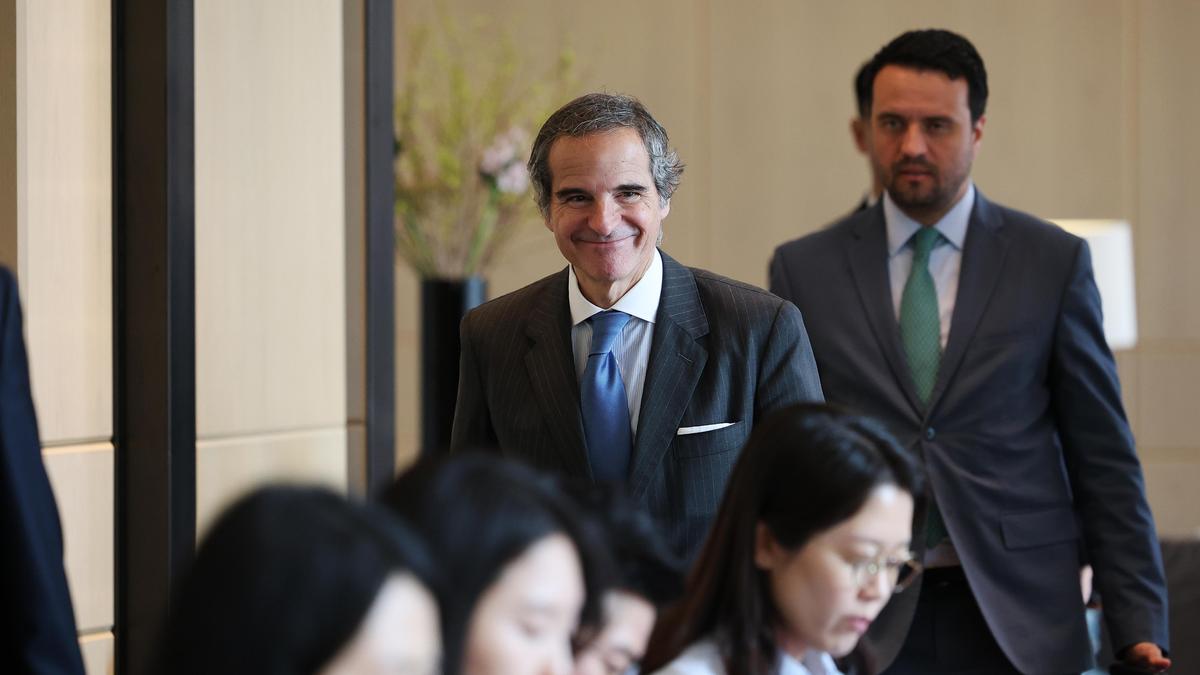
The warning from the UN's top nuclear watchdog didn't just drop out of thin air. It’s a wake-up call that most of the world seems too busy to hear. On April 15, 2026, IAEA chief Rafael Grossi stood in Seoul and confirmed what satellite images and intelligence reports have been whispering for months. North Korea isn’t just tinkering with its nuclear program; it’s aggressively scaling up.
Grossi described the situation as a "very serious increase" in production capacity. We’re talking about more than just a few extra centrifuges. The Democratic People's Republic of Korea (DPRK) has essentially flipped the switch on multiple fronts, moving from a slow-burn strategy to a full-throttle expansion of its atomic arsenal.
The Yongbyon expansion and the ghost of Kangson
For years, the Yongbyon nuclear site was the primary focus of international observers. It was the "known" variable. But that’s changed. Recent assessments show a rapid rise in operations at the five-megawatt reactor and the reprocessing unit. More alarming is the light-water reactor, which is now fully active.
But the real kicker is the new construction. Grossi confirmed the completion of a massive new facility at Yongbyon that looks suspiciously like the uranium enrichment plant at Kangson. Why does that matter? Because uranium enrichment gives Pyongyang a second, more stealthy path to making bombs. Plutonium is hard to hide—you need a big, hot reactor. Uranium centrifuges, however, can be tucked away in warehouses or underground bunkers.
By mirroring the Kangson facility at Yongbyon, Kim Jong Un’s regime is effectively doubling down on its ability to produce weapons-grade material. The IAEA estimates the North's current inventory at a "few dozen" warheads. If these new facilities reach full capacity, that number could jump significantly in a very short window.
Reading between the lines of satellite data
You don't need to be a spy to see the changes. Recent satellite imagery from early April 2026, analyzed by groups like the Center for Strategic and International Studies (CSIS), shows the finishing touches on several key buildings. We're seeing new standby generators, administration blocks, and specialized cooling systems.
The timeline is what’s really jarring. Construction on the new Yongbyon wing started in late 2024. By mid-2025, it was externally finished. Now, in early 2026, the internal "fitting" is done. They’re moving fast because they know the international community is distracted by other global conflicts. It's a calculated sprint.
It isn't just Yongbyon, either. There are signs of increased activity at the Pyongsan uranium mine and concentration plant. You can't make fuel without the raw ore, and the blue-roofed facilities at Pyongsan suggest the supply chain for nuclear material is being modernized and expanded to keep up with the new reactors.
Why this shift in 2026 is different
I’ve watched this cycle for a long time, and this feels different. In the past, North Korea used its nuclear program as a bargaining chip—a way to get food aid or sanctions relief. That's not the vibe anymore. Since the 9th Party Congress, the rhetoric has shifted from "nuclear defense" to "nuclear mass production."
They aren't looking to talk. They're looking to build a stockpile so large and diverse that denuclearization becomes a physical impossibility. We’re seeing a push to put these warheads on everything from short-range tactical missiles to sea-launched cruise missiles on their new Choe Hyon-class destroyers.
The goal is clear. By dispersing the "deterrent" across land and sea, they make it impossible for any adversary to take out their arsenal in a single strike. It’s the ultimate insurance policy.
The reality of the IAEA's blind spot
Here’s the part that really bugs me. The IAEA hasn't had boots on the ground in North Korea since 2009. Everything Grossi is telling us is based on "remote sensing"—satellites and open-source intelligence. He admitted in Seoul that it's "not easy to calculate" exact production without being there.
This means the "very serious increase" might actually be worse than we think. If the IAEA can see this much from space, imagine what’s happening in the tunnels and basement levels we can’t see. We’re essentially trying to solve a puzzle while someone keeps moving the pieces under the table.
What happens next
Don't expect a sudden diplomatic breakthrough. The current trajectory suggests Pyongyang will continue to ignore UN sanctions and push toward an operational fleet of tactical nuclear weapons. If you're looking for a silver lining, there isn't much of one, but there are clear indicators of what to watch for in the coming months.
- Watch the light-water reactor. If it stays consistently active, it means they’ve solved the technical hurdles that plagued it for years.
- Monitor the missile tests. Look for "tactical" drills. These are the tests that prove they can actually miniaturize those warheads to fit on smaller, more mobile rockets.
- Observe the South Korean response. With the US redeploying some missile defense assets to other regions, Seoul is under immense pressure to accelerate its own indigenous defense systems.
The era of "strategic patience" is long gone. We’re now in an era of strategic reality, where the nuclear capability of North Korea is a permanent, growing fixture of the geopolitical landscape.