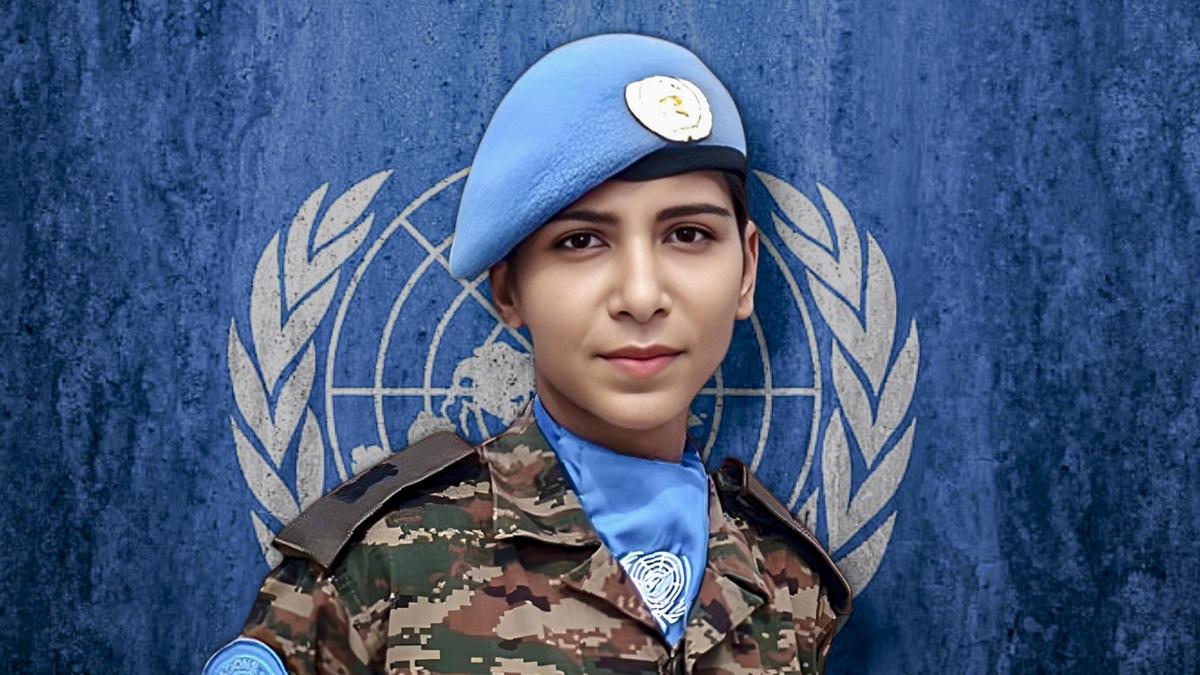
The dry heat of the Democratic Republic of the Congo (DRC) does not just sit on your skin; it weights your lungs. In the eastern provinces, where the soil is rich with minerals and scarred by decades of conflict, silence is rarely peaceful. It is usually a symptom of fear. For the women living in these villages, the sound of an approaching engine can mean many things. Often, it means a threat. But lately, it has meant the arrival of a woman who understands that security is not just about the weight of a rifle, but the strength of a conversation.
Major Abhilasha Barak did not arrive in the DRC to simply occupy space. As she prepares to accept the 2025 United Nations Military Gender Advocate of the Year Award, the headlines will focus on the ceremony, the medals, and the prestige. They will miss the dust. They will miss the grueling hours spent in the back of armored vehicles, navigating roads that are less paths and more suggestions, all to reach the people who are usually left out of the peace process entirely.
Her journey began long before she set foot in Africa. In 2022, she made history as the first woman combat aviator in the Indian Army. It was a feat of technical skill and bureaucratic persistence. Yet, moving from the cockpit of a helicopter to the front lines of global peacekeeping required a different kind of bravery. It required the ability to look at a tactical map and see the human lives hidden beneath the topographical lines.
Beyond the Checkpoint
Consider a hypothetical village named Kibua. In Kibua, the arrival of a traditional military patrol is a formal affair. The men of the village meet the commanders. They discuss logistics, troop movements, and security perimeters. The women stay back. They are the ones fetching water, the ones tilling the fields, and the ones most vulnerable to the shadows that linger after the sun sets. When the soldiers leave, the women are still there, and their specific fears—of sexual violence, of kidnapped children, of lack of medical access—remain unspoken.
Major Barak changed that dynamic.
As a Gender Field Officer with the Indian Rapid Deployment Battalion, her mission was to bridge the gap between "security" as a concept and "safety" as a lived reality. She didn't just stand at the checkpoint. She walked past it. She sought out the women who had been conditioned to keep their heads down. By integrating gender perspectives into every patrol, she ensured that the United Nations Organization Stabilization Mission in the DRC (MONUSCO) wasn't just a force of observation, but a force of protection for 100% of the population, not just the half that holds the meetings.
The statistics of conflict are often numbing. We read about thousands displaced or hundreds of incidents of gender-based violence. But Barak’s work is about the individual. It is about the one mother who finally felt safe enough to walk to the market because a female peacekeeper had mapped the route. It is about the girl who saw a woman in uniform and realized that authority doesn't have to look like an aggressor.
The Mathematics of Peace
There is a logical, cold-blooded reason why Barak’s work is so effective: peace is more durable when women are involved. This isn't sentiment; it’s data. When women participate in peace processes, the resulting agreements are 35% more likely to last at least fifteen years.
Why? Because women often prioritize different stability factors than men. They focus on education, community reintegration, and long-term social health. Major Barak acted as the conduit for these priorities. She advocated for the inclusion of women in local security committees, turning them from victims of war into architects of peace.
She recognized that a military unit is blind if it only listens to one demographic. If you don't know where the women are being harassed, you don't know where the security failure is. If you don't know which water sources are contested by local militias, you can’t protect the community’s lifeblood. Barak provided the eyes and ears that the mission lacked.
Breaking the Aviator Mold
The transition from a combat aviator to a gender advocate might seem like a pivot, but it is actually a progression. Flying a helicopter requires a high-level understanding of systems, balance, and environmental variables. Peacekeeping is no different. It is a system of delicate balances. One wrong move can trigger a cascade of consequences.
Barak’s presence in the Indian Army was already a statement. The Indian military, a massive and historically traditional institution, has been undergoing a seismic shift in how it utilizes its female officers. Barak became the face of that shift. When she was posted to the DRC, she brought that same pioneering spirit to the UN.
She faced skepticism. In many regions where she worked, the idea of a woman in a position of military authority was not just rare; it was revolutionary. She had to earn trust in two directions: from the local communities who had seen too many uniforms bring only trouble, and from a global military structure that is still learning how to value "soft" security as much as hard power.
The Invisible Stakes
What happens if women like Abhilasha Barak stay home?
The stakes are invisible until they are catastrophic. Without gender-sensitive peacekeeping, the cycle of violence in places like the DRC remains unbreakable. Displacement camps become hunting grounds. The trauma of a generation is codified into the soil. Peace remains something that happens on paper in New York or Geneva, while the reality on the ground remains a state of perpetual, low-boil terror.
Barak’s work isn't just about "helping" people. It’s about professionalizing the approach to war. It’s about acknowledging that if you ignore the needs of half the population, you are failing half your mission. Her 2025 award is a recognition that her approach is the future of international intervention.
She spent her days organizing workshops, facilitating dialogues between local leaders, and ensuring that her battalion's operations were informed by the actual threats faced by civilians. She lived in the same conditions as her troops, breathing the same dust, facing the same risks. There was no ivory tower. There was only the red earth of the DRC and the relentless pursuit of a better way to hold a line.
A Legacy in the Red Earth
When the cameras flash at the UN headquarters and the speeches are read, the world will see a decorated officer in a crisp uniform. They will see a trailblazer from Haryana who broke the glass ceiling of the Indian Army’s aviation corps. They will see a symbol of international cooperation.
But the real story isn't in the medal.
The real story is in the villages where the engine of a UN vehicle no longer causes a panic. It is in the quiet confidence of a local woman leader who finally has a seat at the table because an Indian Major insisted it be placed there. It is in the subtle, tectonic shift of a culture that begins to see women as protectors rather than just the protected.
Major Abhilasha Barak doesn't just fly over the landscape; she changes the ground itself. As the 2025 UN Military Gender Advocate of the Year, she stands as a reminder that the most effective weapon in any arsenal isn't a missile or a jet. It is the ability to walk into a room of strangers and convince them that peace is possible, provided everyone—every mother, every daughter, every sister—is part of the plan.
In the long, cooling shadows of the Congolese evening, the dust eventually settles. Because of her, it settles on a world that is just a little bit more stable than it was when the sun rose.