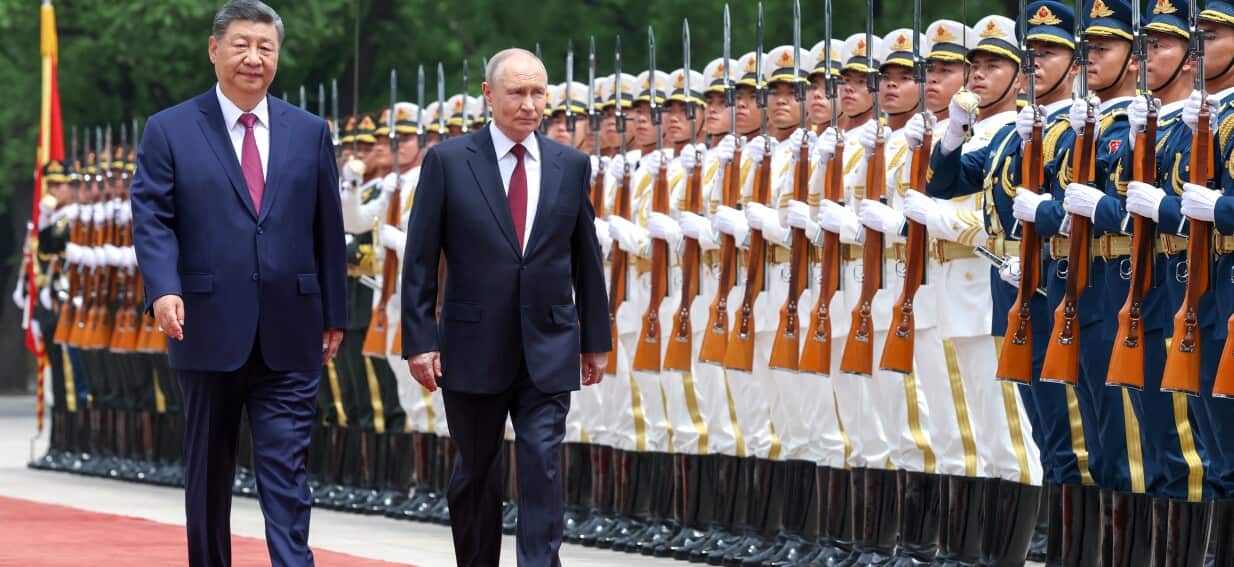
The red carpet at the Great Hall of the People in Beijing didn't just welcome a foreign leader this week. It set the stage for a carefully managed piece of geopolitical theater. Russian President Vladimir Putin stepped off his plane to the sight of an honor guard, a gun salute, and children waving national flags. Minutes later, he faced Chinese President Xi Jinping and used a familiar phrase: "My dear friend."
Western observers look at these optics and see an unshakeable axis. They assume the "no limits" partnership announced back in 2022 is a seamless, permanent alliance. That is a mistake.
While the public displays of camaraderie are real, the relationship between Beijing and Moscow is driven by cold, transactional calculus. Putin needs an economic lifeline to survive Western sanctions over Ukraine. Xi wants a reliable energy supplier and a buffer against Washington, especially right after hosting U.S. President Donald Trump in Beijing just days ago. Beijing is playing the middleman, positioning itself as the true center of the new global order by hosting two bitter rivals back-to-back.
Understanding the reality of this partnership requires looking past the "dear friend" rhetoric and examining the actual friction points under the surface.
The Reality Behind the Tea Diplomacy
Xi Jinping has perfected the art of using informal hospitality to signal diplomatic status. The informal tea session planned for Putin is a deliberate tool. When the two met in May 2024, they ditched their ties and drank tea outdoors in the Zhongnanhai imperial gardens. It conveyed deep, personal comfort.
Compare that to Trump's recent visit to the exact same compound. Trump walked through a secret garden and toured the Temple of Heaven, but the events felt highly managed and rigid. Chinese state media plastered both visits across national television, using the back-to-back spectacles to show domestic audiences that Beijing is now the diplomatic capital of the world.
Xi is capitalizing on the distinct personalities of both men. He manages Trump's appetite for grand pageantry while feeding Putin's need for public solidarity. For China, this isn't about genuine affection for either leader. It is about establishing China as an indispensable superpower that dictates the terms of global governance.
The Energy Asymmetry and the Pipeline Problem
Nothing exposes the uneven nature of this partnership quite like the ongoing saga of the Power of Siberia 2 gas pipeline.
Russia desperately wants this project to move forward. With European markets largely cut off, Moscow needs to redirect its massive natural gas reserves to the East. Putin explicitly praised Russia's role as a stable energy provider, pointing out that Russian oil exports to China jumped by 35% in the first quarter of this year. Amid current Middle East supply disruptions linked to conflicts involving Iran, Russia is pitching itself as the ultimate safe bet for Chinese factories.
China-Russia Trade Performance (2025-2026)
• 2025 Total Trade: 1.63 trillion yuan ($240 billion) — a 6.5% drop from 2024.
• Jan-Apr 2026 Rebound: Two-way trade value rose 16.1% compared to early 2025.
• Q1 2026 Oil Surge: Russian oil exports to China increased by 35%.
But look at what Beijing is doing, not what it is saying. Despite the Kremlin claiming "serious expectations" and preparing a massive 47-page joint statement alongside 40 signed agreements, the pipeline deal remains stuck in limbo.
China holds all the cards, and they know it. Beijing refuses to commit to Moscow's terms on gas pricing. Xi is intentionally dragging out negotiations because China does not want to depend too heavily on a single supplier. While Russia views the pipeline as an urgent economic necessity, China treats it as a long-term option to be picked up only when the price is bottom-of-the-barrel cheap.
The Shared Goal of Displacing the West
The glue holding this relationship together is a mutual desire to rewrite international rules. During their bilateral talks, Xi stated that both nations must focus on long-term strategy to build a "more just and reasonable" global governance system. Putin echoed this, calling their strategic cooperation a primary stabilizing factor on the world stage.
Both leaders detest the U.S.-led international order, but they approach the problem differently:
- Russia acts as the disruptor. Moscow is willing to break international norms directly, using military force and aggressive rhetoric to shatter the existing system.
- China acts as the builder. Beijing prefers to build alternative institutions, like the BRICS bloc and the Belt and Road Initiative, to slowly bypass Western influence while keeping its economy integrated with global markets.
This division of labor works for now. China provides diplomatic cover and continues buying Russian commodities, ignoring Western demands to halt the flow of dual-use technology that aids Russia's military production. Yet, China maintains a strict line. It claims neutrality in the Ukraine conflict and avoids direct military involvement, ensuring its own banks and corporations don't trigger secondary Western sanctions that could cripple the Chinese economy.
Actionable Takeaways for Analyzing Global Trade
The Beijing summit proves that geopolitical alliances are shifting toward hard pragmatism. For businesses, investors, and supply chain analysts, the ongoing alignment between China and Russia offers clear lessons on managing international risk.
Diversify Supply Lines Away from Geopolitical Chokepoints
Do not assume trade routes will remain stable. As China locks down long-term commodity agreements with Russia, Western supply chains must seek alternative sourcing in Southeast Asia, India, and Latin America to mitigate sudden political decoupling.
Monitor Dual-Use Export Restrictions
Watch the specific items included in the 40 new agreements signed in Beijing. Companies handling logistics, electronics, or advanced manufacturing must tighten their compliance audits, as Western regulators will likely target any firm suspected of feeding the China-Russia trade pipeline.
Track Currency Shifts in Commodity Markets
Pay close attention to how these energy deals are settled. The push to bypass the U.S. dollar is accelerating. Settlement of Russian oil and gas purchases in Chinese yuan is no longer an experiment; it is the baseline standard for bilateral trade between these two giants.