You know an art exhibition is a big deal when the online queue rivals a Glastonbury ticket drop. That's exactly what happened this morning. The British Museum opened public ticket sales for the legendary Bayeux Tapestry, and within minutes, the digital waiting line exploded.
Tens of thousands of history nerds and curious onlookers piled onto the website, facing estimated wait times of up to nine hours. By mid-afternoon, the virtual queue swelled past 80,000 people. If you tried to grab a slot today, you already know the panic. If you didn't, you're probably wondering why a 70-meter-long piece of embroidered linen has the entire country acting like Taylor Swift just announced an intimate club show.
This isn't just another museum loan. It's a massive, highly controversial geopolitical event that hasn't happened in nearly a millennium.
The Logistics of a 1000 Year Old Homecoming
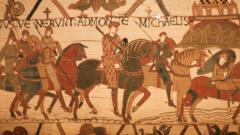
Let's clear something up right away. Despite the name, the Bayeux Tapestry isn't actually a tapestry. It's a massive work of wool embroidery stitched onto bleached linen. Most historians agree it was actually created in England, likely by Anglo-Saxon women in Canterbury during the 11th century.
When it lands at the British Museum this September, it marks the first time the artwork has been on British soil since the Norman Conquest. For France to let this go is unprecedented. The relic has barely left Normandy in 950 years. Napoleon dragged it to Paris in 1804 for wartime propaganda, and the Gestapo seized it in 1944. That's it.
The British Museum secured the loan after intense diplomatic maneuvering and a direct agreement with French President Emmanuel Macron. The French art community is completely furious about it. Critics across the Channel slammed the move as a "crime against heritage," arguing that the fragile fabric could disintegrate during transport.
To stop it from turning to dust, the artwork will travel in a custom-built, shock-absorbing container designed to neutralize British potholes, with internal climate sensors tracking every micro-change in humidity.
What You Get for a 33 Pound Ticket
If you managed to survive the nine-hour virtual queue, your wallet is probably feeling a bit lighter. The pricing has raised more than a few eyebrows.
- Peak Tickets: £33
- Off-Peak Tickets: £25 to £27
- Students & Jobseekers: £25
- Under 16s: Free
Compare that to the permanent Bayeux Museum in France, where you pay a flat €12 (around £10) to see it. The British Museum's new director, Dr. Nicholas Cullinan, defended the steep price tag, stating the institution needs to recoup the massive costs of transporting and insuring an object valued at £800 million.
Here's the kicker. Your ticket buys you exactly a 40-minute time slot inside the gallery.
Because the embroidery is a staggering 70 meters long, you can't just stand there and contemplate life. The British Museum is displaying it flat and in one continuous straight line for the first time ever. To keep crowds moving, you'll have roughly 34 seconds of viewing time for every 7-centimeter interval of the cloth. It's a high-speed march through medieval warfare.
The Smart Way to Actually See It
Didn't get a ticket today? Don't panic, and definitely don't pay extortionate prices to third-party scalpers. The British Museum is releasing tickets in distinct phases to prevent total chaos. Today's bloodbath was only for the first block of dates between September and December.
Two more major ticket drops are already locked in. The next batch goes live in October, covering dates from January to March 2027. The final release drops in January for the spring and summer slots leading up to the exhibition's closing date on July 11, 2027.
If you want to beat the system next time, buy a museum membership for £82. Members got priority access two weeks ago and get two guaranteed entries without fighting the general public queue.
Alternatively, if you want the history without the London crowds or the hefty price tag, take a train to the Reading Museum. They hold Britain's full-scale Victorian replica of the tapestry, hand-stitched by 35 women in 1885. It's historically accurate down to the exact color dye, it costs absolutely nothing to enter, and there's no nine-hour queue in sight.