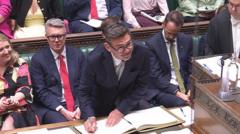
The camera pans. The crowd falls silent. A politician steps up to the dispatch box, raises a hand or holds a holy book, and recites a string of words written centuries ago. The media covers it as a historic milestone. The commentators analyze the body language. The public treats it as the official birth of a new era.
When Andy Burnham was sworn in as an MP, the media treated the footage like a sacred ritual. They framed it as the exact moment power shifted, the precise second public service began.
It is a comforting fiction. It is also entirely wrong.
We have a collective obsession with the pageantry of governance. We treat the swearing-in ceremony as the defining moment of a political career when, in reality, it is the least consequential thing an elected official will do all year. The lazy consensus in political journalism treats these orchestrated media events as substantive news. They are not news. They are performance art designed to mistake compliance for capability.
The Myth of the Day One Transformation
The traditional news cycle treats the oath of allegiance as a transformative metaphysical event. One minute an individual is a candidate; the next, they are an avatar of state power.
I have spent two decades watching political machines from the inside, sitting in backrooms where policy is actually negotiated, and I can tell you exactly what happens the day after a highly publicized swearing-in. Nothing changes. The bureaucracy keeps grinding. The pre-existing backroom deals remain active. The structural limitations of the office do not vanish because someone said a pledge without tripping over their words.
The swearing-in is an onboarding process masquerading as a coronation.
To understand why this matters, look at how the media covers these events. They focus on the optics—the grip on the book, the tone of voice, the specific wording chosen by Republican or Nationalist members to signal subtle defiance. This focus on symbolic friction creates a massive blind spot. While the public debates whether a politician looked sufficiently solemn, the actual mechanics of governance—the committee assignments, the civil service briefings, the budgetary constraints—are completely ignored.
We ask whether the politician respects the tradition. We should be asking whether the tradition has any remaining utility.
Dismantling the Premise of Political Accountability
The underlying theory of the public oath is accountability. The narrative suggests that by binding an individual to a formal vow, we establish a moral guardrail.
This premise is completely flawed. If a piece of paper or a spoken sentence could guarantee integrity, political history would be empty of scandal. The oath does not create accountability; it creates a shield. It allows a politician to claim institutional legitimacy before they have cast a single vote or passed a single piece of legislation. It substitutes future performance with immediate compliance.
Consider the questions people routinely ask during an election cycle:
- When does a newly elected official officially gain power?
- What happens if an MP refuses to take the oath?
- How does the swearing-in process bind a politician to their constituents?
The honest, brutal answer to that final question is that it does not bind them at all. The oath is taken to the Crown or the State, not to the voters of a specific constituency. The entire ceremony is structurally designed to pull the individual away from local accountability and integrate them into the centralized apparatus of power. When you celebrate the ritual, you are celebrating the moment your representative officially joins the elite club.
The Operational Reality of Regional Power
Let us look at the actual trajectory of regional governance, moving past the symbolic theater of Parliament. True political leverage in modern governance does not come from fitting into Westminster rituals; it comes from breaking them.
The real work of a regional leader happens when they are actively fighting the centralized system, not when they are taking oaths within it. Look at the balance sheet of devolution. Power is negotiated through treasury allocations, transport infrastructure control, and local tax retention. None of those variables are altered by a ceremony in the House of Commons.
The contrarian truth is that the most effective political actors use these national ceremonies merely as a branding exercise. They show up, perform the necessary choreography to satisfy the legal minimums, and immediately leave the room to build parallel power bases elsewhere. The media coverage focuses on their presence in the capital, while their actual efficacy is determined by their absence from it.
The Cost of Symbolic Obsession
The downside of focusing on these institutional rituals is steep. It drains attention away from metrics that matter. Every hour a news network spends looping footage of an MP taking an oath is an hour not spent analyzing their funding sources, their legislative track record, or the viability of their manifesto promises.
We have built a system that rewards theatrical competence over administrative capability. A politician can be utterly useless at policy formation, disastrous at economic management, and completely disconnected from their electorate—but if they look stately during a ceremony, they pass the initial media test.
Stop looking at the dispatch box. Stop analyzing the posture of individuals holding religious texts under historic rafters.
The oath is a administrative formality dressed up as a cultural touchstone. The real swearing-in happens in the dark, during the late-night budget negotiations, when the high-minded rhetoric of the public vow is traded away piece by piece for raw political survival. Measure the compromise, not the ceremony.