The international press corps loves a predictable script. For years, the narrative surrounding political expression in Hong Kong has been reduced to a simple, binary melodrama: a lone, tragic artist attempts a brave act of defiance, and the heavy-handed state apparatus immediately crushes them.
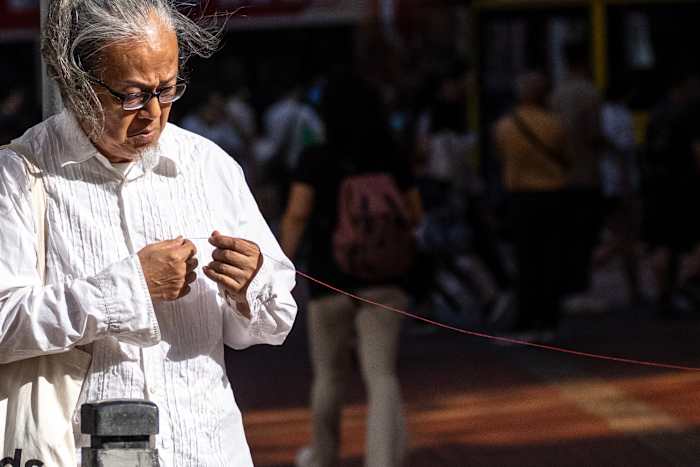
We saw this exact formula play out recently when a local performance artist was detained after making gestures mimicking a historical date in the middle of Causeway Bay. The headlines practically wrote themselves. They decried the death of free expression, lamented the tightening grip of authorities, and painted the artist as a martyr for western democratic ideals.
It is a comforting, simplistic story. It is also completely wrong.
By focusing entirely on the surface-level clash between authority and the individual, mainstream commentators are missing the actual mechanics at play. This is no longer a battle over free speech in the traditional sense. It is something far more complex: a highly calculated, transactional game of digital engagement, political theater, and weaponized algorithmic reach.
The Myth of the Spontaneous Dissident
Western media consistently frames these street performances as spontaneous outbursts of raw, unmediated political grief. They treat the artist as an isolated soul compelled by pure conscience to stand against the machine.
Let us inject some reality into this romanticized fantasy.
Modern political art in highly monitored spaces is rarely, if ever, spontaneous. It is a highly engineered product optimized for the global attention economy. The performance is not actually designed for the few confused shoppers walking past a department store in downtown Hong Kong. It is designed for the high-resolution smartphone cameras positioned exactly across the street. It is designed for the immediate, inevitable viral distribution on global social platforms.
In the attention economy, getting arrested is not a failure of the performance; it is the climax of the piece.
The artist understands the precise threshold of local law enforcement. They know exactly which ambiguous gestures, silent counts, or symbolic props will trigger a predictable intervention. The police, bound by rigid operational protocols and intense political pressure to maintain public order, act exactly as choreographed.
The Transactional Dissident Loop: Artist deploys ambiguous symbolism $\rightarrow$ Media amplifies anticipation $\rightarrow$ Police execute predictable intervention $\rightarrow$ Global algorithms monetize the outrage.
This is a symbiotic relationship disguised as a conflict. The artist receives international visibility, professional martyrdom, and elevated status within global cultural institutions. The Western press receives easy, high-engagement content that fits their established geopolitical framing. The local authorities demonstrate their vigilance to their superiors. Everyone wins, except for the nuance of truth.
Dismantling the Freedom of Expression Fallacy
When commentators scream about the erosion of art, they base their outrage on a flawed premise: that art in a politically contested space operates under the rules of a mid-1990s liberal democracy.
It does not. To evaluate Hong Kong's current cultural output through the lens of Western First Amendment absolutism is an exercise in intellectual laziness.
I have watched cultural organizations and independent creators navigate shifting political boundaries across Asia for more than a decade. The ones who survive and actually impact their communities do not engage in overt, loud street theater designed to get them thrown into the back of a van within ninety seconds. They understand that when direct confrontation becomes impossible, the nature of subversion must change.
True artistic subversion under strict governance requires hyper-subtlety, deep historical metaphor, and layered irony. It lives in the spaces between what is said and what is understood by the local population.
When an artist chooses instead to stage a blunt, obvious provocation that guarantees immediate detention, they are choosing spectacle over substance. They are trading deep, long-term cultural resonance for short-term global virality. It is the creative equivalent of clickbait. It tells the audience exactly what they already believe, challenges no one, and changes absolutely nothing on the ground.
The Algorithmic Colonization of Local Struggles
The most insidious aspect of this phenomenon is how Western technology platforms distort local political realities.
When a piece of performance art hits the internet, it is immediately stripped of its hyper-local context. The complex history of Hong Kong, the specific legal mechanics of the National Security Law, and the internal anxieties of its citizens are flattened. The event is repackaged into a bite-sized piece of content designed to trigger maximum emotional outrage from users sitting thousands of miles away in London, New York, or San Francisco.
[Local Event] ──> [Algorithmic Flattening] ──> [Global Outrage Economy]
     │                                                    │
     └──> Context, Nuance, and Local Impact are Lost <────┘
This is algorithmic colonization. The genuine, complicated anxieties of Hong Kongers are weaponized to feed the engagement metrics of Silicon Valley tech giants. The user likes, shares, leaves a furious comment, and moves on to the next video in their feed.
Meanwhile, back on the ground, the consequences of these performative provocations are borne entirely by the local community. Every loud, empty spectacle justifies further security crackdowns. Every viral video strengthens the argument of hardliners who claim that the city is under constant threat of foreign-instigated instability.
The Western observer gets a dopamine hit of moral superiority. The local resident gets a more heavily policed neighborhood.
Redefining the Right Questions
If you want to understand the reality of Hong Kong, you have to stop asking the superficial questions popularized by mainstream news outlets.
Flawed Question: "Why won't the government allow this artist to express themselves?"
Real Question: "What does this artist gain from a guaranteed, predictable arrest that a local underground exhibition could not achieve?"
Flawed Question: "Is creative freedom completely dead in the city?"
Real Question: "How are resilient local creators shifting to anonymous digital spaces, decentralized networks, and hyper-abstract mediums to bypass state surveillance entirely?"
The obsession with public street arrests blinds us to the real, quiet, and far more interesting ways creativity is adapting to survival. While the international press focuses on the loud sacrificial lambs, hundreds of writers, digital artists, and independent publishers are quietly restructuring how they communicate, using encrypted channels, self-hosted platforms, and coded language that algorithms cannot easily parse.
The Cost of the Spectacle
Let us be brutally honest about the downside of the contrarian view. Rejecting the romantic narrative of the heroic dissident feels cynical. It strips away the emotional satisfaction of rooting for an obvious underdog. It forces us to admit that some actions labeled as principled resistance are actually calculated career moves or hollow theatrical displays.
But clinging to the naive consensus is far more dangerous. It blinds us to the reality of power. It tricks us into believing that a few minutes of silent street performance can meaningfully counter a highly sophisticated, technologically advanced state apparatus.
It cannot.
Stop applauding the theater. Stop pretending that a viral video clip is a victory for human rights. If the global community genuinely cares about the preservation of unique cultures under pressure, it must stop incentivizing the spectacles that accelerate their containment.
Turn off the cameras. Put down the smartphones. The real struggle for cultural survival is happening in the shadows, completely out of sight of your feed, and it has no interest in your likes.