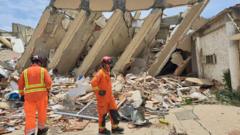
Sending localized emergency responders halfway across the world to high-profile disaster zones feels good. It makes for incredible local headlines. It creates heartwarming photo opportunities of firefighters boarding planes or pulling survivors from rubble. But if we measure success by lives saved per dollar spent rather than emotional satisfaction, this dominant model of international disaster response is fundamentally broken.
The recent deployment of specialized Scottish firefighters to assist with earthquake rescue efforts in Venezuela is a textbook example of what disaster economists call the "misallocation of altruism." When a major geopolitical or natural catastrophe hits, the immediate reflex of Western media and local governments is to dispatch physical assets. They send personnel, search dogs, and heavy gear across oceans. For another look, see: this related article.
It is a logistical nightmare masquerading as solidarity.
The harsh reality of urban search and rescue (USAR) is dictated by a brutal mathematical clock. In the wake of a structural collapse caused by an earthquake, the probability of finding trapped survivors drops exponentially after the first 24 hours. By 72 hours, the survival rate plummets toward zero. Similar insight on this matter has been shared by The Guardian.
Consider the timeline of an international deployment. A team in Europe must be mobilized, equipped, briefed, and flown across the Atlantic. They must pass through customs, navigate disrupted local infrastructure, and establish a base of operations. By the time foreign boots hit the actual rubble in a South American disaster zone, the golden hour has not just passed; it is ancient history.
Local responders and immediate neighbors always save the overwhelming majority of lives in the acute phase of a crisis. They are on the ground when the shaking stops. They understand the terrain, the language, and the local structural engineering.
When international teams arrive days later, they frequently shift from active rescue to body recovery. Or worse, they become a secondary burden on an already collapsing local infrastructure. They require food, clean water, fuel, and security—the exact resources that are already in critically short supply for the local population.
The true barrier to effective disaster response in developing nations is rarely a lack of brave personnel. It is a lack of localized funding, pre-positioned equipment, and systemic structural resilience.
Imagine a scenario where the hundreds of thousands of dollars spent on flights, specialized transport, logistics, and overtime for a handful of European responders were instead diverted directly to training and equipping regional municipal teams within Latin America years before the fault line slips. The return on investment, measured strictly in human survival, would be orders of magnitude higher.
But structural mitigation and regional capacity building do not make the evening news. A photograph of a local building inspector reinforcing a concrete pillar in Caracas does not generate political capital in Edinburgh.
This creates a perverse incentive structure. Western governments and municipal departments are rewarded for highly visible, reactive interventions rather than invisible, proactive prevention. We have commodified disaster response into a form of geopolitical public relations.
There is a distinct air of institutional arrogance embedded in the assumption that Western personnel must fly in to manage a crisis. Developing nations possess highly capable, deeply resilient engineering and emergency services networks. What they lack is capital liquidity and access to high-grade supply chains.
When we export personnel instead of wealth, we create a cycle of dependency. We treat the symptoms of a disaster rather than building the systemic immunity of the region. True international aid means writing checks to local organizations and then getting out of the way, not sending a highly paid Western logistics team to manage the optics.
If the goal is truly to maximize global human welfare during a crisis, we must dismantle the current paradigm of disaster optics.
Stop funding the photo-op. Fund the foundation.