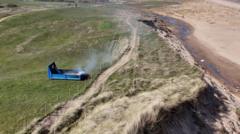
The discovery of approximately 150 World War II-era phosphorus grenades on a public beach is not a localized curiosity but a case study in the persistent kinetic and chemical risks posed by degrading legacy munitions. These artifacts, specifically the No. 76 Special Incendiary Grenade, represent a specific failure mode of 20th-century chemical engineering when exposed to 21st-century environmental shifts. The primary threat is not a conventional explosion, but rather the spontaneous re-ignition of white phosphorus (WP) upon exposure to atmospheric oxygen—a process dictated by the breakdown of glass containment vessels and the evaporation of protective water seals.
The Chemistry of Spontaneous Combustion
White phosphorus is an allotrope of phosphorus that remains stable only when completely submerged in water or kept in an anaerobic environment. The No. 76 grenade, colloquially known as the "SIP" (Self-Igniting Phosphorus) grenade, was designed with a simple but volatile trigger mechanism: a glass bottle containing a mixture of WP, benzene, and a strip of rubber, topped with a small amount of water to keep the phosphorus inert.
The combustion cycle follows a rigid chemical progression:
$$P_4 + 5O_2 \rightarrow P_4O_{10}$$
This reaction is highly exothermic, producing temperatures reaching $2,800^\circ\text{C}$ ($5,000^\circ\text{F}$). The inclusion of benzene in the original mixture serves as a solvent that facilitates a more rapid spread of the fire, while the dissolved rubber creates a thickened, adhesive "sticky" flame similar to early iterations of napalm. In a maritime environment, the salt water acts as a temporary stabilizer, but as the tide recedes and the glass casings—thinned by decades of sand abrasion—fracture, the phosphorus dries. Once the moisture content drops below a critical threshold, the oxidation begins immediately.
Structural Vulnerabilities of the No. 76 Grenade
To understand the risk profile of a cache of 150 units, one must analyze the physical degradation of the ordnance. Unlike modern metallic munitions that may fail through rust and fuse neutralization, the SIP grenade relies on a glass-to-stopper seal.
- Glass Embrittlement and Abrasion: Decades of "tumbling" in the surf zone reduce the wall thickness of the glass bottles. Micro-fractures allow the benzene and water to leak out slowly.
- Stopper Degradation: The original seals were often made of crown corks or rubber bungs. Over 80 years, these organic materials perish, allowing sea water to enter and displace the internal chemical balance or, conversely, allowing the protective liquid to escape.
- Sediment Entrapment: Phosphorus often settles into the "shoulder" of the bottle. Even if the bottle appears empty or filled with sand, residual WP trapped in the sediment can ignite if disturbed.
The danger to the public is exacerbated by the visual profile of these items. To an untrained eye, a weathered SIP grenade often resembles a fossil, a piece of amber, or a common discarded bottle. This leads to "pocketing," where beachcombers unknowingly provide the friction and warmth necessary to catalyze a dormant chemical reaction.
The Triad of Tactical Risk
The management of a mass-discovery site requires a tri-fold assessment of the immediate environment to prevent a chain-reaction ignition event.
Thermal Transfer and Mass Ignition
White phosphorus fires are difficult to extinguish because the material re-ignites as soon as it is re-exposed to air. In a cache of 150 grenades, the ignition of a single unit provides sufficient thermal energy to shatter the glass of adjacent units. This creates a localized firestorm that cannot be suppressed by standard water-based firefighting methods, as the water simply evaporates, leaving the remaining phosphorus to continue burning.
Toxicological Byproducts
The combustion of WP produces a dense, white smoke composed of phosphorus pentoxide ($P_4O_{10}$). While not classified as a nerve agent, this smoke is highly caustic. Upon contact with the moisture in the human respiratory tract, it converts to phosphoric acid, causing severe internal chemical burns. In a high-density discovery, the concentration of these fumes creates an immediate exclusion zone requirement of at least 200 to 500 meters, depending on wind velocity.
Environmental Vectoring
The phosphorus does not disappear after the initial fire. Residual P4 can remain in the soil or sand, buried just deep enough to stay anaerobic. Future construction, beach grooming, or even heavy foot traffic can unearth these "hot spots," leading to injuries months after the primary cache has been cleared.
Procedural Protocol for Maritime Ordnance Disposal
The disposal of 150 incendiary devices is an exercise in controlled destruction rather than recovery. The Royal Navy’s Explosive Ordnance Disposal (EOD) teams or civilian equivalents follow a rigid hierarchy of intervention.
- In-Situ Neutralization: Given the instability of 80-year-old glass, moving the items is the highest-risk phase. The preferred method is a controlled explosion at the discovery site.
- The Use of "Sausage" Charges: EOD teams typically place small plastic explosive charges (PE8) in a perimeter around the cache. The goal is not just to break the bottles, but to ensure that all white phosphorus is consumed in a single, high-temperature event.
- Submerged Transport: If the cache must be moved due to proximity to critical infrastructure, it must be transported in water-filled, heavy-gauge steel containers. This maintains the anaerobic state required to prevent ignition during transit.
The Scale of the Submerged Legacy
The presence of 150 grenades at a single site indicates a historical "dump" rather than a stray loss. During the transition from World War II to the post-war era, vast quantities of Home Guard munitions were disposed of in coastal waters under the assumption that the sea would provide permanent "burial."
The failure of this assumption is driven by two variables:
- Coastal Erosion: Rising sea levels and increased storm frequency are stripping away protective layers of silt and sand that previously capped these dump sites.
- Long-shore Drift: Munitions dumped miles offshore are being mechanically transported toward public beaches by underwater currents.
This creates a recurring liability for local authorities. The discovery of 150 units suggests that a primary dump site has breached, and further units will likely emerge following subsequent storm surges.
Strategic Recommendation for Coastal Management
Municipalities and coastal agencies must move away from reactive "discovery-and-disposal" cycles and toward a proactive risk-mapping framework.
The first priority is the establishment of a Submerged Ordnance Heat Map, utilizing historical military records to identify former Home Guard cache points and offshore dumping zones. These areas should be cross-referenced with modern bathymetric data to predict where long-shore drift will deposit migrating munitions.
The second priority is the implementation of Chemical-Specific Emergency Training for first responders. Standard PPE is often insufficient for phosphorus fires; specialized training in the use of copper sulfate (which coats phosphorus in an inert layer of copper phosphide) or total immersion techniques is required to manage "pocketed" finds that ignite in transit or within medical facilities.
Finally, the public messaging must shift. Describing these finds as "historical artifacts" diminishes the perceived risk. They are active chemical threats. Warning signage at high-risk beaches should include visual aids showing the "amber-like" appearance of degraded phosphorus to discourage the physical handling of beach-combed materials. The long-term solution is not the removal of 150 grenades, but the systematic monitoring of the underwater "source terms" that continue to feed these hazards into the public domain.