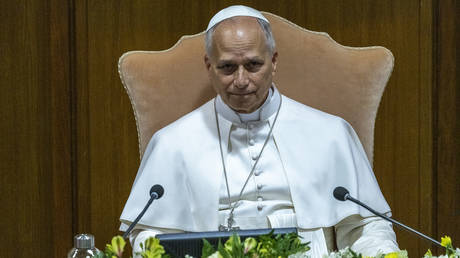
Pope Leo’s latest encyclical calls for the "disarmament" of artificial intelligence. It is a beautiful, deeply moral, and utterly naive piece of rhetoric. The Vatican is treating algorithmic development like a nuclear arms race, demanding international treaties, digital non-proliferation zones, and kill-switches built into neural networks.
It sounds noble. It feels safe. It is entirely detached from the reality of how compute, code, and human incentives actually function.
The narrative that AI is a weapon waiting to be defused is a fundamental misunderstanding of the technology. You cannot disarm an equation. You cannot sign a non-proliferation treaty for mathematics. By framing machine learning as an existential threat requiring top-down global prohibition, the tech elite and religious leaders are accidentally building the exact monopoly they claim to fear.
The Fallacy of the Algorithmic Kill-Switch
The central premise of the Vatican’s argument—and the lazy consensus shared by dozens of breathless op-eds this week—is that AI can be regulated like enriched uranium.
It cannot.
Nuclear proliferation requires massive physical infrastructure. You need centrifuges, heavy water reactors, and highly visible supply chains that satellite intelligence can track from orbit. AI requires consumer-grade silicon, electricity, and open-source repositories.
When Pope Leo demands "built-in governance mechanisms to render autonomous systems inert," he is asking for a backdoor in open-source software. History proves that every backdoor created for the "good guys" is inevitably exploited by the bad ones.
I have watched enterprise tech companies burn tens of millions of dollars trying to build "foolproof" guardrails into their proprietary models. The result? Total failure. Within forty-eight hours of deployment, open-source developers find a prompt injection attack or a fine-tuning workaround that bypasses the restrictions.
Look at the mechanics of quantized models. A 70-billion parameter model can be compressed to run on a high-end consumer laptop. Once that model is downloaded to a local drive, no central authority, no regulatory body, and no papal decree can force it to shut down. The infrastructure is decentralized by nature. To "disarm" AI, you would have to police every hard drive on earth.
The Proliferation Myth: Why Suppression Creates Monopolies
The tech industry loves when regulators and religious leaders panic.
Why? Because panic leads to heavy compliance costs. When the Vatican demands strict licensing frameworks and international oversight committees, the wealthiest tech companies in Silicon Valley smile behind closed doors. They are the only ones who can afford the compliance lawyers required to navigate those frameworks.
If you enforce strict, top-down disarmament policies, you do not stop the development of dangerous models. You merely drive them underground or concentrate them in the hands of two or three trillion-dollar conglomerates and authoritarian states.
Consider the "People Also Ask" questions dominating search engines today: How can we make AI safe for humanity?
The premise of the question is flawed. "Safety" is not a static line of code you insert into a matrix multiplication step. True safety comes from transparency, resilience, and democratization. When code is open, vulnerability discovery happens at scale. When code is locked away in a cleanroom under the guise of global security, a single exploit can bring down an entire ecosystem because nobody outside a select group of high-priests knew the vulnerability existed.
Power Asymmetry Is the Real Danger
The Vatican’s encyclical worries about autonomous weapons systems turning on humanity. Let’s dismantle that sci-fi fantasy. The immediate danger of AI is not a rogue drone swarm deciding to eliminate a village on its own whim.
The danger is asymmetric control.
When you restrict access to advanced models under the banner of ethical disarmament, you ensure that only institutional powers—governments, massive militaries, and monopoly corporations—possess the sharpest analytical tools. The average citizen is left with a lobotomized, corporate-approved version of the technology that can barely summarize a PDF without hallucinating.
The true defense against malicious AI is more AI.
If an adversarial actor deploys a deepfake campaign to destabilize an election, you do not defeat it with a Vatican committee or a government registry. You defeat it with decentralized verification networks running local detection models that can flag the manipulation in real-time. By disarming the public's access to raw, unthrottled compute, you leave the population entirely defenseless against the very entities that ignore international treaties anyway.
The Cost of the Moral High Ground
Let's be brutally honest about the trade-offs of this proposed disarmament.
If Western democracies agree to the Vatican's framework and slow down their deployment of autonomous systems, global development does not pause. State actors in nations with zero interest in papal encyclicals will accelerate their research. They will train models without ethical guardrails, without alignment research, and without remorse.
A self-imposed pause based on moral superiority is a strategic surrender.
We saw this play out in the early days of cryptography. In the 1990s, the US government classified strong encryption as a munition, attempting to restrict its export and usage. They failed miserably because mathematics does not care about customs borders. The only thing those restrictions accomplished was delaying the adoption of secure e-commerce and privacy tools for a decade, leaving millions vulnerable to cybercrime.
The current push for AI disarmament is the Crypto Wars 2.0, wrapped in the language of human dignity.
Build Armor, Not Bunkers
Stop asking how to disarm the technology. Start asking how to build societal resilience against its inevitable deployment.
This requires an uncomfortable shift in strategy. Instead of wasting diplomatic capital on unenforceable treaties, resources must flow into decentralization. We need open-source verification protocols. We need localized, air-gapped models that individuals can run without relying on a corporate cloud feed. We need to train people to operate in a world where digital reality is malleable, rather than pretending we can freeze reality in place.
The Vatican wants a world where the sword is permanently sheathed. But in the digital ecosystem, a sheathed sword simply means you get hacked by the person who kept theirs sharp.
Drop the regulatory illusions. Accept the friction. Equip the individual, open the source code, and stop trying to build a digital utopia that cannot exist.
Go download a local model today. Learn how to fine-tune it. Understand the math. The future belongs to those who know how to wield these tools, not those who pray for their disappearance.