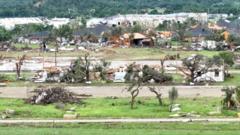
When the sirens finally stop and the dust settles over a flattened Texas town, the narrative follows a predictable, hollow script. News helicopters circle overhead, capturing the geometric scars left by a vortex that didn’t care about property lines or municipal budgets. The footage shows the same jagged wood, the same flipped SUVs, and the same weeping survivors standing amidst the ruins of what used to be a living room. We call these events "natural disasters," a term that suggests we are merely victims of an unpredictable sky. But the destruction of small-town America is becoming as much a failure of policy and predatory economics as it is a meteorological phenomenon.
The reality is that while we cannot stop a tornado, we have spent decades making our towns easier to destroy. As climate patterns shift and "Tornado Alley" migrates toward more densely populated regions, the gap between our engineering capabilities and our actual infrastructure has become a chasm. We are building faster, cheaper, and more precariously in the very places where the wind is most likely to tear our lives apart.
The Myth of the Unavoidable Catastrophe
There is a comforting lie in the "act of God" defense. If a disaster is truly unavoidable, no one is to blame. Yet, when you look at the aerial footage of a town like Perryton or Matador, you aren't just looking at the power of nature. You are looking at the failure of the American building code.
Most homes in these high-risk corridors are built to withstand winds of roughly 90 miles per hour. A mid-range tornado easily exceeds 130 miles per hour. We are essentially building houses of cards in a wind tunnel and acting surprised when they fall. The technology to keep these structures anchored to their foundations exists. Impact-resistant roofing, hurricane clips, and reinforced garage doors cost a fraction of the total build price. However, in the race to provide "affordable" housing in the Sun Belt, these life-saving measures are often treated as optional luxuries rather than baseline requirements.
The cost of a "hardened" home might be 5% to 10% higher than a standard build. In a market where every dollar is squeezed, developers lobby against stricter codes, claiming they will price out the middle class. The result is a cycle of disposable architecture. We build cheap, the wind destroys it, and federal tax dollars flow in to help people rebuild the exact same vulnerable structures in the exact same spots. It is a subsidy for instability.
The Dying Pulse of Rural Emergency Response
When a tornado hits a metropolitan area like Dallas or Oklahoma City, the response is a choreographed surge of resources. In the small towns that dot the Texas Panhandle, the story is different. These communities are often operating on a skeleton crew of volunteers and aging equipment.
The investigative truth is that rural emergency infrastructure is in a state of quiet collapse. Many of the towns featured in the latest viral drone footage have seen their local hospitals close or consolidate. When a mass-casualty event occurs, the "golden hour"—the critical window to save a life after traumatic injury—is spent in the back of an ambulance racing toward a city two counties away.
Infrastructure is not just roads and bridges; it is the capacity to survive the worst day of your life.
We see the aerial shots of the rubble, but we don't see the shuttered clinics or the 30-minute response times. We don't see the volunteer fire departments that are struggling to recruit members because the younger generation has fled to the cities for work. The footage gives us the "what" of the destruction, but it masks the "how" of the vulnerability. We have left these towns to fend for themselves, then we point a camera at their remains and call it news.
The Insurance Shell Game
If you want to understand why these towns stay broken, follow the money. The insurance industry is currently undergoing a radical contraction. Following a string of billion-dollar disasters, major carriers are quietly pulling out of high-risk zones or raising premiums to a level that functions as a de facto eviction notice.
For a family in a small Texas town, a 40% hike in homeowners' insurance isn't just an inconvenience. It’s a mortgage default waiting to happen. This creates a secondary disaster: the "uninsurable" town. When people cannot afford insurance, they cannot get bank loans. When they cannot get loans, property values crater. The town doesn't just die because a tornado hit it; it dies because the financial system decided it wasn't worth the risk to rebuild.
The Hidden Data of Displacement
- Recovery lag: Small towns take an average of three times longer to return to pre-disaster economic levels compared to urban centers.
- Population drain: After a major strike, roughly 15% of the impacted population never returns, usually the youngest and most mobile residents.
- Commercial erosion: Local businesses often lack the cash reserves to survive a six-month rebuild, leading to a permanent takeover by national chains.
The aerial video captures the physical debris, but it fails to capture the economic vacuum left behind. The local hardware store, the family-owned diner, and the community center are often the first things to go, replaced by a Dollar General and a gravel lot. The soul of the town is stripped away as surely as the shingles on the roofs.
The Engineering Gap and the Mobile Home Crisis
The most brutal truth of any tornado strike is the disproportionate toll on mobile home communities. It is a statistical certainty that if you live in a manufactured home, you are at a significantly higher risk of death during a storm. Yet, for millions of Americans, this is the only path to homeownership.
We treat this as a personal choice, but it is a systemic failure. There are no federal mandates requiring storm shelters in mobile home parks. In many states, it is perfectly legal to operate a park without a single square inch of reinforced concrete for residents to hide in. When we see the mangled metal of a trailer park from a drone, we are looking at the direct consequence of a housing policy that prioritizes cheap entry over human survival.
If we can mandate fire escapes for apartment buildings and life jackets for boats, we can mandate shelters for high-risk housing. The fact that we don't is a silent admission that some lives are viewed as more "expensive" to protect than others.
Weather Prediction is Not a Shield
There is a common misconception that better technology will save us. We have incredible radar systems and meteorologists who can spot a hook echo with terrifying precision. Warning times have increased from minutes to nearly half an hour in some cases.
But a warning is useless if you have nowhere to go.
If you are a shift worker in a warehouse with a sheet-metal roof, or if you are at home in a house with no basement and no interior "safe room," thirty minutes of warning is just thirty minutes of terror. We have invested billions in the "seeing" of the storm but pennies in the "surviving" of it. The gap between meteorological science and civil engineering is where the bodies are buried.
The Migration of the Alley
The geography of risk is changing. The traditional "Tornado Alley" of the Great Plains is shifting east and south into the "Dixie Alley" of the Mississippi Valley and the Deep Southeast. These areas are more densely populated, have more trees to obscure oncoming storms, and have a higher concentration of mobile homes.
Texas remains at the forefront, but the storms are getting more violent and less predictable. The "season" is stretching. We are seeing major outbreaks in December and January, times when people are least prepared. The aerial footage we see today is a preview of a broader, more frequent reality.
Moving Beyond the Footage
The "disaster porn" of aerial wreckage serves a purpose—it creates a momentary surge in donations and national sympathy. But it also creates a sense of finality. The camera moves on to the next storm, and the town is left to navigate a labyrinth of FEMA paperwork, predatory contractors, and rising interest rates.
True resilience isn't found in a "Texas Strong" hashtag. It is found in the unglamorous work of building codes, the funding of rural healthcare, and the mandatory installation of storm shelters. We need to stop treating these events as surprises. We know where the storms go. We know what they do to cheap wood and unanchored frames.
The next time you see a video of a town reduced to splinters, don't just look at the wind. Look at the decisions made months and years before the clouds turned gray. Look at the politicians who voted against infrastructure bills. Look at the developers who cut corners on structural ties. Look at the insurance giants that are abandoning the American heartland when it needs them most.
The destruction is a choice we make every day we refuse to build for the world as it actually is.
Demand that the "recovery" includes a mandate for safe rooms in every new residential build in high-risk zones. Stop subsidizing the construction of disposable homes in the path of known hazards. Force the integration of storm shelters into every mobile home park by law. Until the cost of safety is factored into the cost of doing business, the aerial footage will continue to look exactly the same.