Georgia Republicans failed to secure a clear nominee for governor or the U.S. Senate on Tuesday night, automatically triggering a costly four-week sprint to a June 16 runoff. Former Atlanta Mayor Keisha Lance Bottoms captured the Democratic gubernatorial nomination outright by clearing the 50 percent threshold, meaning Democrats can immediately conserve cash and focus their ground game on November. Meanwhile, the fractured Republican apparatus must spend the next month locked in an expensive, exhausting cycle of intraparty warfare to select their standard-bearers for the state's top two races.
This multi-million-dollar political hangover is not an accident of history. It is the direct consequence of election laws engineered by the Georgia GOP itself. By insistsing on a rigid 50 percent plus one majority threshold to secure a party nomination, the state's conservative establishment sought to ensure ideological purity. Instead, they have handed a massive strategic advantage to Democrats, who now get to watch their opponents deplete their bank accounts and tear each other apart in public.
The Self Inflicted June Meat Grinder
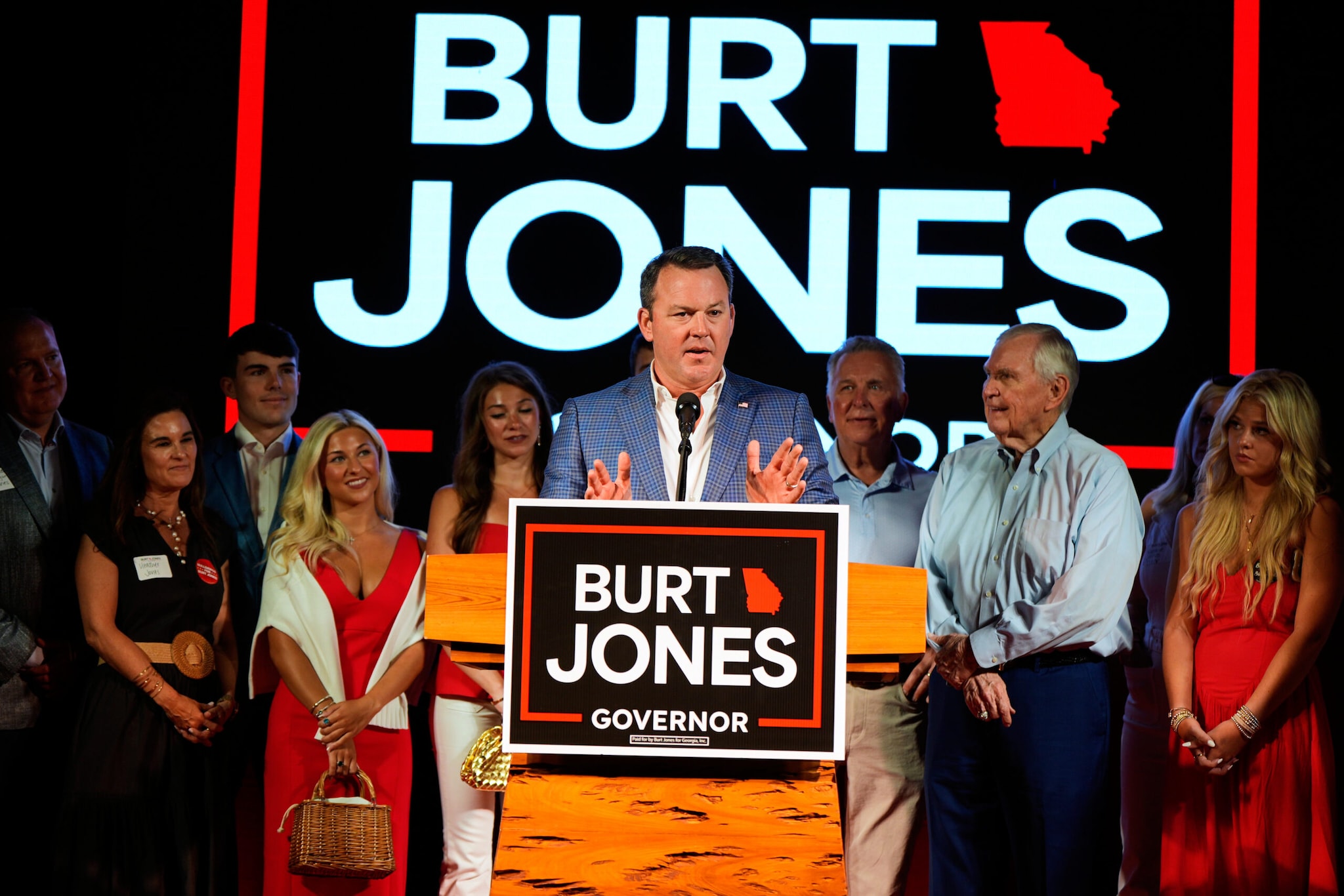
The math of the Tuesday primary told a story of deep division within the conservative ranks. In the gubernatorial race to succeed the term-limited Brian Kemp, healthcare executive Rick Jackson and Lieutenant Governor Burt Jones split the top of the ticket, leaving Secretary of State Brad Raffensperger out in the cold. In the Senate primary to challenge incumbent Democrat Jon Ossoff, Representative Mike Collins—a staunch ally of Donald Trump—was forced into a runoff against former college football coach Derek Dooley, who entered the race with Kemp’s backing.
Under Georgia law, because no candidate cleared the 50 percent mark, the top two finishers in each race must face each other again.
Georgia GOP Primary Results (May 19, 2026)
+-------------------------------------------------------+
| GUBERNATORIAL PRIMARY                                 |
| [Rick Jackson]  ======> Advanced to June 16 Runoff     |
| [Burt Jones]    ======> Advanced to June 16 Runoff     |
| [B. Raffensperger] ==> Eliminated                     |
+-------------------------------------------------------+
| U.S. SENATE PRIMARY                                   |
| [Mike Collins]  ======> Advanced to June 16 Runoff     |
| [Derek Dooley]   ======> Advanced to June 16 Runoff     |
| [Buddy Carter]   ======> Eliminated                     |
+-------------------------------------------------------+
Runoffs are notoriously volatile events. Turnout typically plummets, often by 40 percent or more compared to the initial primary. This means the upcoming June 16 vote will not be decided by the broad electorate, but by the highly motivated fringes of the party. Candidates cannot rely on general policy platforms. They must pivot to aggressive, negative attacks designed to disqualify their opponents in the eyes of hardcore partisans.
The immediate casualty of this system is cash. Jackson has already poured tens of millions of dollars of his own personal wealth into his campaign, while Jones has burned through millions from his donors. Over the next four weeks, both campaigns will be forced to buy up expensive television airtime in the Atlanta, Savannah, and Augusta media markets. Every dollar spent hitting a fellow Republican over the airwaves is a dollar that cannot be used against Bottoms or Ossoff in the fall.
The Ghost of Elections Past
Georgia's unique runoff system has its roots in a historical desire to prevent splinter candidates from winning office with a simple plurality. Following the political earthquakes of recent election cycles, state legislators compressed the runoff window from nine weeks down to just 28 days. The intent was to shorten the election cycle and reduce voter fatigue. The actual result has been a logistical nightmare for campaign strategists.
A four-week window leaves virtually no time for a reset. Campaigns must instantly transition from a multi-candidate field to a head-to-head cage match. Staffers cannot take a weekend off to re-evaluate their messaging. Television ad buys must be locked in within hours of the primary results being certified.
More importantly, this compressed timeline completely alters the dynamics of fundraising. National donors are hesitant to pour money into a primary runoff when a general election looms just months away. They prefer to save their resources for the ultimate matchup against the Democrats. Consequently, candidates are forced to rely on localized networks or personal wealth, giving self-funded outsiders an institutional leg up over career public servants.
A Gift to the Democratic Playbook
While Republicans prepare for a month of mudslinging, Georgia Democrats are executing a disciplined pivot toward November. Keisha Lance Bottoms avoided a runoff by consolidating her support early, earning the backing of national party figures and comfortably clearing her primary field. She can now spend the next month traveling the state, building out field offices in shifting suburban counties like Gwinnett and Cobb, and fundraising nationally without firing a single shot in self-defense.
Sen. Jon Ossoff enjoys a similar luxury. While Collins and Dooley litigate who is the truer conservative, Ossoff can run positive, policy-focused advertisements highlighting federal investments in Georgia infrastructure and manufacturing. He is effectively running unopposed for the next 30 days while his potential challengers destroy their own favorability ratings among moderate swing voters.
History shows that brutal primary runoffs leave lasting scars. When a candidate spends weeks calling their opponent corrupt, weak, or ideologically bankrupt, those attack lines do not vanish on June 17. The Democratic Congressional Campaign Committee and the Democratic National Committee are undoubtedly archiving every negative ad, press release, and debate clip generated by the Republican runoffs. The general election scripts are being written by Republicans themselves.
The Suburban Realignment Dilemma
The runoff system also exposes a structural vulnerability in the modern Georgia Republican coalition. To win a statewide general election in Georgia, a Republican must run up massive margins in rural areas while remaining competitive in the affluent, college-educated suburbs surrounding Atlanta.
A primary runoff forces candidates to do the exact opposite. To appeal to the low-turnout primary voters who show up in June, candidates must lean heavily into hardline rhetoric.
This creates a permanent record of positions and statements that can be toxic in a general election. The moderate suburban voters who decided the 2020 and 2022 elections in Georgia are highly sensitive to cultural grievances. By forcing Republican nominees to audition for the most conservative wing of their party for an extra month, the runoff law ensures that whoever emerges from the June meat grinder will enter the general election bruised, broke, and dangerously out of step with the political center of the state.
The system was built to guarantee that the strongest, most unified candidate would represent the party. Instead, it has become a mechanical trap that drains resources, deepens internal fractures, and hands the initiative to a waiting opposition. Georgia Republicans wanted a system that demanded a majority. They got exactly what they asked for, and the bill has just arrived.