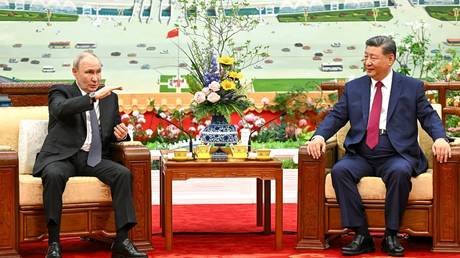
The red carpet was exactly what you would expect. When Vladimir Putin's plane touched down at Beijing Capital International Airport, the cameras captured the usual carefully choreographed theater. Chinese Foreign Minister Wang Yi was waiting on the tarmac. An honor guard stood perfectly at attention. Youths waved national flags, and the video of Putin bowing deeply before China’s guard of honor quickly made the rounds on social media.
But look past the grand welcome ceremonies and the 360-degree video footage plastered across state media. The timing tells the real story.
Putin arrived in Beijing just four days after U.S. President Donald Trump wrapped up his own high-profile visit to the Chinese capital. By hosting the leaders of both the United States and Russia back-to-back within a single week, Beijing is sending a clear message to the world. They aren't junior partners to anyone anymore. They are the center of gravity for global diplomacy.
While the Kremlin frames this relationship as an alliance of equals, the reality on the ground feels much more lopsided. Russia's growing economic isolation has forced it into a corner, making it deeply dependent on Chinese lifelines.
The Energy Lifeline and the Shadow of Regional Conflict
You can't understand the real driver behind this summit without looking at the global energy map. The ongoing war in Iran and the resulting instability in the Middle East have severely disrupted traditional shipping lanes. With the Strait of Hormuz crippled, Beijing faces a massive vulnerability regarding its maritime oil and gas imports.
That is where Russia steps in.
Putin brought a massive delegation to Beijing to push forward major infrastructure projects, most notably the Power of Siberia 2 gas pipeline. If completed, this overland route through Mongolia would pump up to 50 billion cubic meters of Russian natural gas to China annually. For Moscow, it's a desperate bid to replace the European export markets it lost after invading Ukraine. For Beijing, it's a way to secure its energy needs without worrying about U.S. naval blockades.
Experts point out that this isn't just about surviving current supply shocks. It's preparation for future friction points. Joseph Webster, a senior fellow at the Atlantic Council, noted that Taiwan is the unspoken subtext of these energy talks. By expanding overland pipeline capacity from Russia, Beijing significantly enhances its domestic energy security in the event of a future Western embargo or a military contingency in the Taiwan Strait.
De-Dollarization Is No Longer Just Rhetoric
For years, Western analysts dismissed the idea of a combined Chinese and Russian financial system as a pipe dream. This trip showed that the decoupling is well underway.
During the summit, Putin highlighted that bilateral trade has surged to record levels, but the real shocker is how that trade is settled. Transactions between the two nations are now conducted almost entirely in rubles and yuan. By ditching the U.S. dollar, both capitals are deliberately insulating their economies from the reach of Western banking sanctions.
The strategy has paid off handsomely for Moscow. Since 2022, China has purchased more than $367 billion worth of Russian fossil fuels, providing a steady flow of revenue directly to the Kremlin.
The Unequal Realities of a No Limits Friendship
Despite the smiles and the warm rhetoric about a "new era" partnership, the dynamic between the two leaders has fundamentally shifted. When Xi Jinping hosted Putin for an outdoor tea ceremony at the historic Zhongnanhai compound—a rare privilege Xi pointedly reminded Donald Trump about days earlier—the body language spoke volumes.
Russia's sluggish performance on the battlefield in Ukraine and its internal economic struggles have stripped Moscow of its leverage. China is buying Russian oil and gas at steep discounts. At the same time, Beijing is keeping its own economic goals balanced, careful not to trigger full-scale secondary sanctions from the West that could derail its domestic growth.
It is a transactional relationship masked as brotherhood. Xi wants a stable, compliant neighbor that can supply cheap resources and tie down Western military attention. Putin simply needs a lifeline to keep his regime afloat.
If you want to understand where global power is shifting, stop looking at the official joint declarations. Look at the economic dependency. Russia needs China to survive, but China only uses Russia to win.
To track how these shifting dynamics affect global markets and supply chains, your best next move is to monitor the official construction timelines for the Power of Siberia 2 pipeline and track the monthly volume of yuan-denominated oil settlements out of eastern Russian ports. These hard data points will tell you the truth long before the next diplomatic press release does.