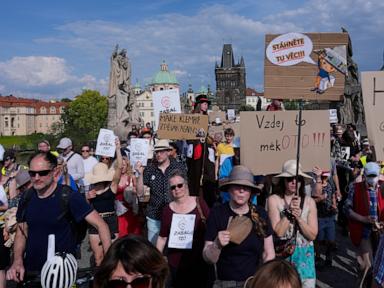
Hundreds of journalists and broadcasters formed a human chain around Czech Radio headquarters in Prague today, clad entirely in black. This 24-hour warning strike across Czech Television and Czech Radio marks the most severe media crisis in the country since the turn of the century. The immediate trigger is a cabinet-approved plan by Prime Minister Andrej Babiš to abolish the traditional public license fee system, replacing it with a direct annual appropriation from the state budget. By stripping the broadcasters of financial autonomy, the government secures an immediate financial chokehold over the press.
The proposed funding overhaul forces an immediate 15 percent funding cut, amounting to roughly 1.4 billion CZK ($60 million) slashed overnight. Media executives warn that this will instantly liquidate regional news bureaus, eliminate foreign correspondent desks, and result in up to 700 layoffs. The Babiš administration defends the bill as a necessary modernization to enforce corporate efficiency. However, the mechanism reveals a far more calculated political maneuver. Moving public media onto the state budget ledger dismantles the structural firewall that separates independent journalism from politicians who control the purse strings. Also making news in related news: The Anatomy of Middle Power Alignment: Quantifying the India Canada Strategic Equilibrium.
The Financial Mechanism of Political Capture
Public service broadcasting relies on economic isolation to ensure editorial independence. The current license fee system, collected directly from households and businesses, functions as a dedicated tax. Politicians cannot easily alter the rate or withhold funds based on critical coverage without passing explicit legislative amendments through lengthy parliamentary debates. It is an intentionally slow, public process designed to shield newsrooms from daily political pressure.
The new government plan replaces this insulated system with a line item in the annual state budget. Under this structure, the ruling coalition controls the total allocation every single year. The immediate impact is financial destabilization. Further information into this topic are explored by NPR.
Current Annual Funding Structure (Insulated Tax):
[Households/Businesses] ---> Direct License Fee ---> Czech TV / Radio (Stable)

Proposed Funding Structure (Political Control):
[State Budget Ledger] ---> Annual Parliament Vote ---> Czech TV / Radio (Variable)
Culture Minister Oto Klempíř claims this model follows a broader European trend, pointing to countries like Denmark and Sweden that fund public media via general taxation. This comparison ignores regional political realities. In Scandinavia, statutory minimums, multi-year funding pacts, and deeply entrenched institutional norms protect broadcasters from retaliatory budget cuts. Central Europe lacks these structural traditions. The moment a broadcaster’s operational survival depends on an annual vote by a parliamentary majority, self-censorship becomes an unwritten survival mechanism.
The Regional Playbook of Media Suffocation
The legislative shift in Prague mirrors strategies deployed across the Visegrád region over the past decade. The goal is rarely the outright shuttering of a network. Instead, the method centers on slow economic starvation followed by editorial realignment.
In neighboring Slovakia, Prime Minister Robert Fico’s administration systematically dismantled the public broadcaster RTVS, replacing it with an entity under tighter state oversight. In Hungary, Viktor Orbán’s government transformed MTVA into a state organ by centralizing its funding, procurement, and editorial direction under a single government-controlled council.
The Babiš administration is executing the exact same playbook, disguised as fiscal responsibility. By forcing Czech Television and Czech Radio back to nominal 2008 funding levels, the government engineers an artificial operational crisis. Broadcasters are forced to choose between scaling back aggressive investigative operations or requesting emergency budget injections from the state.
The bill also grants the Supreme Audit Office new powers to scrutinize public media finances retroactively. While transparency is standard in corporate governance, retroactive auditing in a highly polarized environment functions as a weaponized compliance check. It allows state auditors to tie up newsrooms in endless financial litigation, penalizing networks for historical management decisions made under different legislative frameworks.
Why Technical Efficiency Arguments Fail the Reality Test
The government maintains that public broadcasters must learn to do more with less. This perspective overlooks the specific statutory obligations tied to public media mandates. Unlike commercial networks, Czech Television and Czech Radio are legally required to maintain regional transmission infrastructure, provide minority-language programming, and archive national cultural assets.
These operations carry fixed structural costs that cannot be optimized through standard corporate downsizing.
- Regional Journalism: Local reporting bureaus across regions like Moravia-Silesia face immediate closure, centralizing news production inside the Prague capital.
- Investigative Units: High-risk investigative reporting teams, which require months of research and extensive legal defense funds, are the first programs to be cut when operational budgets shrink.
- Foreign Bureau Reductions: Closing international bureaus leaves the network reliant on international wire services, diminishing the distinct national perspective on global events.
The opposition, led by the Christian Democrats and the Pirate Party, has pledged to block the bill in parliament, calling it a direct regression to pre-1989 state-controlled media. They have referred the draft legislation to the European Commission, alleging violations of the European Media Freedom Act, which explicitly mandates that member states provide stable, predictable funding for public service media.
The Precarious Road to a Solution
Reverting to an unadjusted, stagnant license fee is not a viable long-term strategy either. The current fee has been eroded by inflation for over fifteen years, leaving public networks in a structural deficit even before this legislative attack. A sustainable framework requires a completely different approach to financial independence.
A genuine solution requires tying the public media budget to a fixed economic index, such as a set percentage of the country’s Gross Domestic Product (GDP), managed by an independent, non-partisan trust. This removes the funding mechanism entirely from the annual state budget negotiations while adjusting for inflation automatically. It strips politicians of the power to reward or punish networks based on the evening broadcast.
The warning strike today delayed World Cup broadcasts by a single minute and saw anchors presenting the news in black attire. It was a calculated demonstration designed to show audiences what a silenced network looks like. As the bill heads to the parliamentary floor, the fight in Prague is no longer a localized dispute over corporate accounting. It is a fundamental battle over who controls the flow of information in the Czech Republic.