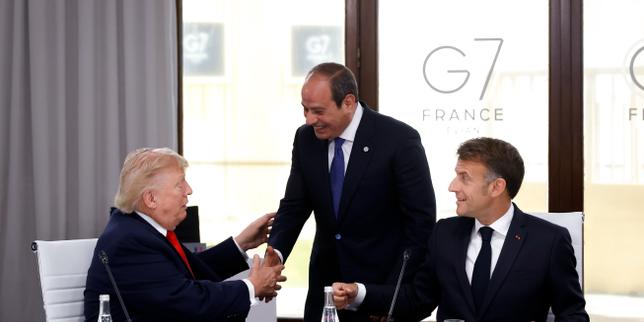
The white smoke rising from Washington, Tehran, and Islamabad has triggered a collective intake of breath across the Arab world. On paper, the interim protocol brokered by Pakistani mediation—promising an immediate halt to the 100-day regional war, the unfreezing of 24 billion dollars in Iranian assets, and the reopening of the Strait of Hormuz—looks like a textbook diplomatic triumph. For a White House eager to display a massive foreign policy victory on the eve of the G7 summit in France, it is a masterstroke. For the traditional Gulf allies of the United States, however, it feels like a sudden and deep betrayal.
Riyadh, Abu Dhabi, and Manama are not celebrating the sudden plunge in oil prices or the premature declarations of peace. Instead, senior diplomats and intelligence officials across the Gulf Cooperation Council are scrambling to dissect a text that was largely kept hidden from them until the final hour. The primary fear gripping these capitals is straightforward: Washington has traded long-term regional stability for a short-term pause in hostilities, leaving its oldest security partners completely exposed to an emboldened and newly enriched Islamic Republic. Learn more on a related subject: this related article.
By prioritizing the immediate flow of oil through the Strait of Hormuz and securing a vague, 60-day window to discuss technical nuclear limits, the current American administration has punted every critical security issue down the road. The regional architecture has not been stabilized. It has been destabilized under the guise of peace.
The 24 Billion Dollar Windfall
To understand why Gulf capitals are in a state of quiet panic, one must look at the immediate mechanics of the deal rather than its lofty rhetoric. The unfreezing of 24 billion dollars in restricted Iranian funds is intended to act as an economic bridge to long-term negotiations. To the cash-strapped government in Tehran, which has spent months under a tight naval blockade and crushing financial pressure, this liquidity is nothing short of a strategic lifeline. Further journalism by Associated Press delves into similar perspectives on the subject.
Arab intelligence agencies are under no illusions about where that money will go. While the American State Department maintains that these funds are earmarked for humanitarian goods and domestic economic relief, regional tracking of past sanctions relief tells a vastly different story. A massive cash injection into the Iranian central banking system instantly frees up domestic revenues to rebuild, resupply, and reorganize.
The proxy infrastructure that launched this war—spanning Yemen, Iraq, and Syria—will be the primary beneficiary. For years, the Gulf states have argued that Iran’s regional interference and its ballistic missile program are far more immediate threats to their daily survival than a hypothetical nuclear warhead. By decoupling these regional destabilization tactics from the immediate text of the deal, Washington has essentially signaled that it views the security of its regional allies as a secondary priority.
The Forgotten Fronts and the Mirage of a Sixty Day Window
The framework sets up a 60-day countdown to negotiate a definitive treaty covering the nuclear program, the lifting of remaining sanctions, and a tracking mechanism. In the eyes of seasoned Gulf analysts, this timeline is dangerously naive. Sixty days is barely enough time to settle the technical disputes regarding uranium enrichment percentages, let alone restructure the entire security matrix of the Middle East.
Negotiation Timeline: The 60-Day Vulnerability Window
|
+-- Day 1: Immediate cease-fire takes effect; U.S. naval blockade lifts.
|
+-- Day 15: Initial release of frozen assets begins flowing to Tehran.
|
+-- Day 30: Technical disputes emerge over IAEA inspection access.
|
+-- Day 45: Regional proxy networks complete logistical reorganization.
|
+-- Day 60: Deadline for "Definitive Agreement" with no enforcement mechanism.
The fundamental flaw in this structure is that it grants Iran immediate, front-loaded rewards—the removal of the naval blockade and a massive financial payout—in exchange for mere promises of future compliance. Once the Strait of Hormuz is fully operational and global energy markets stabilize, the American leverage required to force Tehran into genuine concessions completely evaporates.
Furthermore, the inclusion of the Lebanese front in the text, while completely bypassing the input of the states most affected by the Hezbollah-Israel conflict, has raised serious alarms. Gulf states see a recurring pattern where Washington treats the sovereignty of smaller Arab nations as chips on a poker table. By allowing Tehran to negotiate the terms of a cessation of hostilities in the Levant, the United States has inadvertently legitimized Iran's claim to be the official custodian of Lebanese sovereignty.
The Collapse of Deterrence
For decades, the bedrock of Gulf security was an unwritten pact: regional partners would ensure the steady flow of global energy, and in return, the United States would maintain an ironclad security umbrella. That umbrella has been showing signs of rust for years, but this current protocol threatens to fold it completely.
When the conflict broke out, the deployment of American naval assets to the region was viewed by regional capitals as a reassertion of that classic deterrence model. The rapid pivot toward a rushed, incomplete agreement demonstrates that the American presence was never about victory or long-term defense. It was about containment, risk management, and escaping an uncomfortable political corner before a major international summit.
The message received by the ruling families of the Gulf is loud and clear. Washington no longer possesses the political stomach for sustained deterrence in the Middle East. Faced with an aggressive adversary willing to close global shipping lanes, the American response was not to break that adversary’s resolve, but to buy them off with their own frozen capital.
This realization is already accelerating a massive, quiet shift in global alignments. Gulf capitals are concluding that reliance on American security guarantees is a high-risk gamble. If Washington can dismantle a multi-layered sanctions regime overnight to secure a temporary diplomatic photo-op, then regional states must find alternative ways to secure their borders.
This does not mean a sudden break with the West, but it does mean a permanent diversification of security partnerships. The diplomatic tracks connecting Riyadh and Abu Dhabi to Beijing and Moscow will deepen, not out of ideological affinity, but out of raw, transactional survival. China, as the primary consumer of Gulf hydrocarbons, has a vested interest in maritime stability that is no longer paired with the erratic shifts of the American electoral cycle.
The protocol signed this week may succeed in lowering global oil prices for a few months. It may allow Western leaders to toast a successful diplomatic intervention at Versailles. But beneath the surface, the foundations of the modern Middle Eastern alliance system are cracking, and the price of this rushed peace will ultimately be paid by the states left behind in the desert.