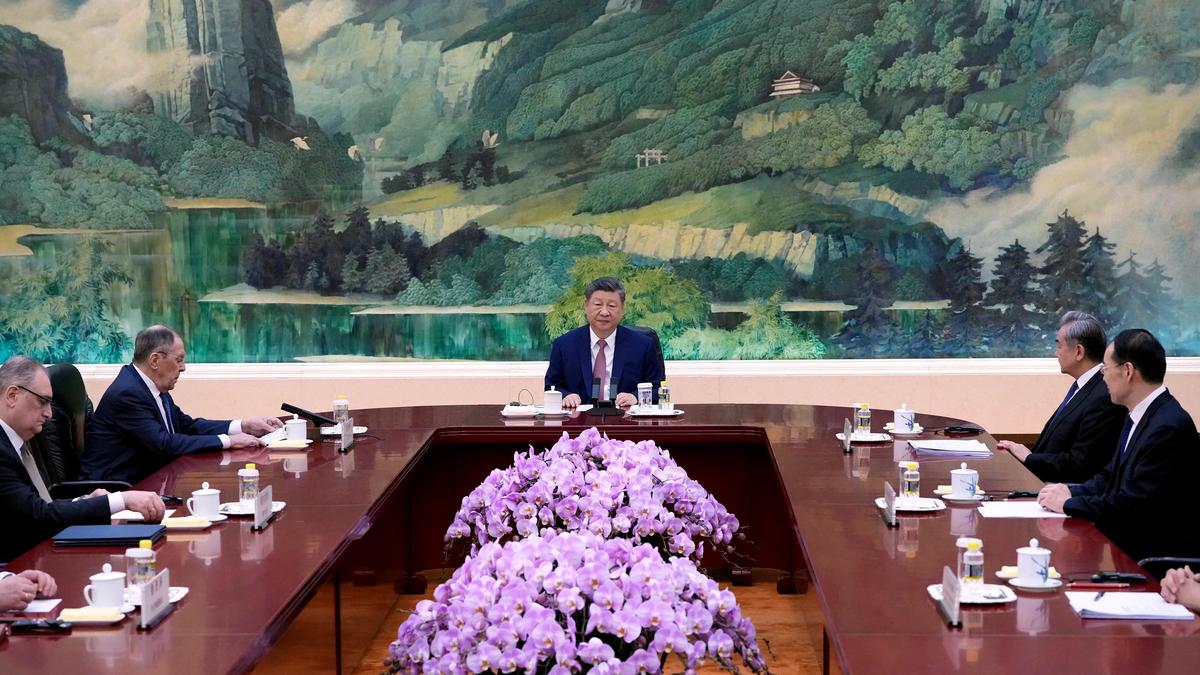
The Great Hall of the People in Beijing often serves as a stage for carefully choreographed geopolitical theater, but the rhetoric emerging from Wednesday's meeting between Xi Jinping and Russian Foreign Minister Sergey Lavrov carried a weight that transcends typical diplomatic pleasantries. By labeling the China-Russia partnership as "precious," Xi is not merely reciting a script of friendship. He is signaling a hardening of the "no-limits" alliance at a moment when the global order is fracturing under the weight of a prolonged conflict in Iran and a volatile American foreign policy.
This "precious" stability is the cornerstone of a Chinese strategy to insulate itself from Western pressure while securing the raw resources necessary for its long-term survival. As the war in Iran drags into 2026, creating a fresh vacuum of regional power and driving energy market volatility, Beijing views its tether to Moscow as its most reliable hedge against a world it describes as "intertwined with change and chaos."
The Resource Fortress and the Iran Factor
While the world’s attention has been focused on the shifting frontlines in the Middle East, the quiet integration of the Chinese and Russian economies has reached a point of no return. This is no longer just about trade; it is about building a Resource Fortress.
In 2025, the Power of Siberia-1 pipeline reached its full nominal capacity of 38 billion cubic meters per year. Despite the headline-grabbing 6.9% decline in total trade value last year—driven largely by sagging global oil prices and Moscow’s own measures to restrict car imports—the physical volume of energy moving East remains at record highs. China isn't just buying Russian oil; it is effectively underwriting the Russian state in exchange for a guaranteed energy floor that the West cannot touch.
The war in Iran has added a new layer of urgency. With traditional Middle Eastern shipping lanes under constant threat and insurance premiums for tankers skyrocketing, Russia’s land-based energy infrastructure provides Beijing with a security of supply that the Strait of Hormuz cannot guarantee. Xi’s use of the word "precious" refers to this geographic immunity.
The Dual Use Dilemma
The most sensitive part of this relationship remains the flow of "high priority" dual-use items. Throughout late 2025 and into early 2026, Chinese exports of specialized components have shifted from finished vehicles to the building blocks of a domestic Russian war machine.
- Optics and Surveillance: Exports of parts for drone optics and surveillance cameras increased fourfold.
- Aerospace and Radar: Shipments of parts for aerials and radar reflectors saw a fivefold increase.
- Ballistic Materials: Sales of fibers used in bulletproof vests and helmets jumped by 60% year-on-year.
Beijing maintains a stance of neutrality, yet the data shows a targeted effort to supply the specific technical gaps left by Western sanctions. This isn't accidental. It is a calculated "gray zone" strategy designed to keep Russia viable as a strategic partner without triggering the kind of secondary sanctions that would decapitate the Chinese banking system.
Multipolarity as a Survival Tactic
Xi Jinping told Lavrov that both nations must "resolutely defend the legitimate interests" of the Global South. This is the ideological glue of the partnership. By positioning the China-Russia axis as the vanguard of a "more just and reasonable" international order, Xi is attempting to build a coalition of the unaligned.
This isn't about abstract philosophy. It is a business plan for a post-dollar world. The share of the Chinese yuan in Russia’s international trade, which sat at less than 2% before the Ukraine invasion, now hovers near 40%. In late 2025, China began accepting LNG cargoes from the sanctioned Arctic LNG 2 facility, a move that signaled to Washington that Beijing is no longer afraid of the "sanctioned" label.
The Trump Variable
The shadow of the White House looms over every handshake in Beijing. The current U.S. administration’s unorthodox and often erratic approach to the Ukraine and Iran conflicts has created a level of unpredictability that the Chinese leadership finds abhorrent.
For Xi, Putin represents the "known." Despite the risks associated with being tied to a pariah state, the continuity of the Kremlin is preferable to the 180-degree policy shifts often seen in Washington. When Xi speaks of "stability and certainty," he is contrasting the Moscow relationship with the perceived decay of Western reliability.
This partnership is being battle-tested. It survived the initial shock of the 2022 invasion, the subsequent isolation of the Russian financial system, and the shifting dynamics of the 2024-2025 global elections. Each crisis has not weakened the bond; it has proved its utility to both sides.
The High Stakes of Strategic Collaboration
The directive given to the respective Foreign Ministries on Wednesday was clear: "stand higher, walk more steadily and go further." Translated from diplomatic-speak, this is an order to deepen the integration of military intelligence and long-term economic planning.
We are seeing the emergence of a parallel global system. One side utilizes the traditional SWIFT network, the U.S. dollar, and Western maritime security. The other, led by Beijing and fueled by Moscow, is building a terrestrial network of pipelines, yuan-clearing banks, and satellite-guided supply chains that operate entirely outside that sphere of influence.
The "precious" nature of the tie lies in the fact that for China, Russia is the only partner with the scale, the resources, and the shared grievance necessary to make this parallel system viable.
Don't look at the trade dips or the diplomatic fluff. Watch the movement of ballistic fibers, the capacity of the pipelines, and the frequency of high-level military coordination. The China-Russia alliance is no longer a marriage of convenience; it is a structural necessity for a regime that views the current global order as a crumbling relic of the past.
Secure your own supply chains. The bifurcation of the global economy is no longer a forecast; it is the current reality.