We trust the metal. Every afternoon, thousands of us slide into padded seats, prop laptops on plastic trays, and let the rhythmic click-of-the-track dissolve into background noise. We hand over our lives to a system of invisible permissions. Green means fly. Yellow means breathe. Red means life stops until it turns green again.
But on a Friday evening, just past five o’clock, the permissions broke down outside Bedford. Read more on a connected topic: this related article.
The 4:40 PM East Midlands Railway service from Corby was rushing south toward London St Pancras. Inside the cab was Shaun Burton. He was 60 years old, a veteran of the rails, a man his peers called a dedicated professional. He knew the Midland Main Line like the back of his hand. He knew the weight of the train under his hand, the way the late afternoon sun hit the glass, the precise distance between platforms.
A few miles ahead of him, sitting dead on the very same track at Elstow, was another train—the 3:50 PM from Nottingham. It shouldn't have been there. It was a brand-new Aurora class 810 model, a sleek piece of modern engineering brought into service barely six months prior. It had stopped unexpectedly because its own safety equipment developed a sudden fault, automatically locking its brakes and stranding its passengers in the middle of a Bedfordshire field. Further reporting by Associated Press explores similar perspectives on the subject.
Think of a modern railway as a series of invisible blocks. Only one train is supposed to occupy a block at any given time. Signals protect these blocks, acting as sentinels.
As Shaun Burton’s train pulled out of Bedford station, it passed a yellow caution light. That yellow light was a whisper: Slow down. Be prepared to stop at the next signal. It passed a second yellow light at Bedford South Junction. Then came the sentinel. Signal WH152.
It was glowing red.
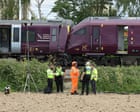
What happened inside that cab in the ensuing moments is a riddle that investigators are currently trying to piece together from crushed data recorders. The physical reality, captured on trackside CCTV, is stark. The Corby train did not stop. It kept hurtling forward, piercing the red signal, closing the gap between itself and the stationary Nottingham train at 76 miles per hour.
Our railways rely on something called the Automatic Warning System, a piece of mid-20th-century technology. When a train approaches a yellow or red signal, a loud horn sounds in the cab. The driver has a few seconds to press a button—a physical acknowledgment that says, I see it, I’m in control. If they don't press it, the train triggers the emergency brakes automatically.
It sounds foolproof. It isn't.
Decades of rail data tell us that human brains are vulnerable to habituation. When a driver hears the same warning horn for a yellow caution signal miles down the track, pressing that acknowledgment button becomes muscle memory. It becomes an involuntary twitch. Sometimes, a driver can acknowledge a warning without consciously processing that the light has changed from yellow to a lethal red.
Nine seconds before impact, the black box data shows that the brakes finally engaged. We do not yet know if it was Shaun Burton desperately throwing the lever or the machine itself realizing it was too late.
Nine seconds.
A train weighing hundreds of tons cannot simply pivot or swerve. It is bound to the steel beneath it. The speed dropped from 76 mph to 49 mph.
Then the world tore apart.
The impact twisted the steel of the new Aurora train, derailing its third carriage. The front of Shaun Burton’s cab was completely crushed. He died at the scene. Behind him, the violent deceleration threw passengers from their seats, breaking bones and shattering glass. More than a hundred people were rushed to hospitals. Dozens remain hospitalized, and eight are still fighting for their lives in critical care.
But the real problem lies elsewhere, buried in the infrastructure budgets and political compromises of the last twenty years.
This tragedy was entirely preventable.
In the wake of the horrific Ladbroke Grove disaster in 1999, which claimed 31 lives under terrifyingly similar circumstances, the UK rail network began installing a much more robust safety net: the Train Protection and Warning System. Unlike the old warning horns, this system doesn't just ask for a driver's acknowledgment. If a train approaches a red light too fast, or passes it entirely, trackside magnets interact with the train's computer and force it to a dead stop, regardless of what the human at the controls is doing.
It is a system designed specifically to catch us when we blink.
But it was never installed on this specific stretch of the Midland Main Line outside Bedford. It was deemed a lower-risk section, left to rely on technology from another era because fitting it everywhere faced tight financial constraints within the railway's budget.
Consider what happens next as engineers use heavy cranes to lift the mangled carriages from the Elstow tracks. Investigators will dissect the electronics, download the data from the crushed cabs, and map the wreckage with drones. They will try to find out exactly why a veteran driver missed a red light, and why the backup systems failed to save him.
But for the families of the injured, and for the colleagues of Shaun Burton, the technicalities matter less than the absence. The tragedy reminds us of the fragile, silent covenant we make every time we step onto a train. We trust that the system is watching over the human, and that the human is watching over the machine.
When that covenant breaks, the cost is measured in steel, seconds, and lives.