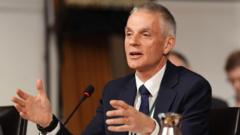
The room was quiet, which is the one thing a radio studio should never be. Outside the glass, the frantic energy of New Broadcasting House continued its usual pulse, but inside, the air felt heavy. Tim Davie, the man tasked with steering the BBC through the most turbulent cultural waters in its century-long history, sat across from a desk that had seen better days. He wasn’t looking at spreadsheets or demographic charts at that moment. He was thinking about the listener.
Specifically, he was thinking about the listener who wakes up at 6:30 AM in a semi-detached house in Leicester, or the one driving a delivery van through the rain in Glasgow. For these people, a radio presenter isn't a "content creator" or a "brand asset." They are a friend. They are the voice that bridges the gap between the warmth of the duvet and the cold reality of the Monday morning commute.
When the news broke that Scott Mills—a titan of Radio 1 for over two decades—was moving on, the reaction wasn't just a news cycle. It was a bereavement.
The High Wire Act of Public Service
The decision to let a legend walk away is never about the individual. It is about the terrifying, relentless clock of relevance. Tim Davie has been clear about the philosophy driving these seismic shifts: the BBC cannot afford to become a museum.
"It was very clear," Davie remarked during a recent industry summit, his voice carrying the weight of a man who knows he is often the villain in someone else's nostalgia. He wasn't talking about Mills' talent; no one disputes that. He was talking about the mathematical cruelty of time. Radio 1 is designed to be young. It is a station that must, by its very charter, remain in a state of perpetual puberty. If the presenters don't move on, the audience eventually does.
Imagine a hypothetical listener named Sarah. Sarah started listening to Scott Mills when she was fifteen. She’s thirty-five now. She still loves his humor, his "Innuendo Bingo," and that specific, chaotic energy he brought to the afternoon slot. But the BBC's mission for Radio 1 isn't to grow old with Sarah. It’s to capture the fifteen-year-old version of Sarah today—someone who spends more time on TikTok than tuning a dial.
To keep the station alive, the BBC has to break its own heart. It has to say goodbye to the people who made it great to make room for the people who will make it different.
The Invisible Stakes of the Schedule
Behind the scenes, the BBC is fighting a war on two fronts. On one side, there is the political pressure of the license fee, a sword of Damocles hanging over every budget meeting. On the other, there is the global dominance of streaming giants. Spotify doesn't have to worry about public service remits. It doesn't have to ensure regional representation or educational value. It just has to be "easy."
For Davie, the move to transition Scott Mills to Radio 2—the natural home for the "graduates" of Radio 1—wasn't a demotion. It was a strategic extraction. It was about preserving the BBC’s most valuable currency: trust.
The transition was messy in the way all public breakups are. Fans took to social media to vent. They accused the corporation of being ageist, of being out of touch, of fixing something that wasn't broken. But the "fix" wasn't about the present. It was about 2030. It was about ensuring that when the current crop of teenagers looks for a voice that understands them, that voice is actually there, rather than a legacy act trying to speak a language they no longer truly live.
The Weight of the Chair
Sitting in the Director-General’s chair requires a certain kind of emotional callousing. You have to be able to look at a person like Scott Mills—someone who has given their entire adult life to the institution—and decide that the institution matters more than the individual.
It is a cold calculation wrapped in the velvet of corporate speak, but the reality is deeply human. It’s about the fear of becoming irrelevant. It’s about the panic that sets in when you realize the world is changing faster than you can print the new schedules.
Davie’s insistence that the path was "very clear" suggests a level of certainty that few in his position truly feel. It is a mask of confidence. Underneath, there is the constant, gnawing question: what if we’re wrong? What if we push away the legends and the new generation never shows up?
The Echo in the Hallway
When Scott Mills finally packed up his headphones and moved his playlist down the hall to Radio 2, it signaled the end of an era. But for the BBC, eras are luxuries they can no longer afford. They are in a state of permanent evolution.
The hallways of New Broadcasting House are filled with the ghosts of voices past. You can almost hear them if you stand still long enough—the laughter, the slip-ups, the breaking news that stopped the nation. Every time a veteran leaves, a little bit of that history is archived.
We often talk about "the BBC" as if it’s a monolithic building or a set of rules. We forget it is a collection of people making impossible choices under the glare of a microscope. Tim Davie didn't just move a presenter; he recalibrated the emotional frequency of a nation.
He knew the backlash would come. He knew the headlines would be sharp. But he also knew that the red light on the studio wall has to keep turning on for someone new, or eventually, it won't turn on for anyone at all.
The true cost of progress is the feeling of loss we carry when the familiar changes. We want our favorite voices to stay forever, frozen in the amber of our own youth. But a station that never changes is a station that is already dead. The light flickers, the fader goes down, and for a moment, there is silence.
Then the next person speaks.