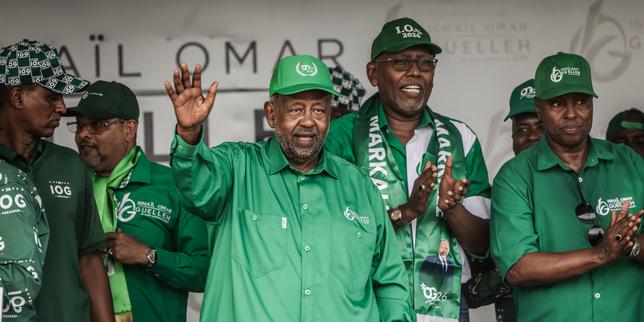
Ismaïl Omar Guelleh has turned a scorched patch of volcanic rock into the most expensive real estate in global geopolitics. While neighbors in the Horn of Africa succumb to civil war or ethnic fragmentation, Djibouti remains a strange, static gravity well for the world’s most powerful militaries. Guelleh does not just lead a nation; he manages a high-stakes storage facility for foreign interests. By leasing the same coastline to Americans, Chinese, French, and Japanese forces, he has created a state that is too interconnected to fail and too strategic to democratize. This is not a story of accidental geography but of a calculated, decades-long gamble that traded domestic liberty for international immunity.
The Sovereign Rentier Model
The economy of Djibouti operates on a logic that defies traditional developmental economics. Most nations strive for exports or manufacturing. Guelleh’s administration perfected the "rentier state" on a military scale. The country’s primary export is its soil—specifically, the rights to park MQ-9 Reaper drones and armored divisions upon it.
The United States pays roughly $63 million annually for Camp Lemonnier, its only permanent base in Africa. Across town, the Chinese People’s Liberation Army maintains its first overseas "support base," a fortified complex that cost nearly $600 million to build. France, the former colonial master, maintains a significant presence, as does Japan and Italy. These players are often direct rivals on the global stage, yet in Djibouti, they share the same airspace and utility grids. Guelleh sits at the center of this web, collecting checks from every side while ensuring that no single power can exert total dominance over his domestic policy.
This arrangement provides a unique form of regime security. If a grassroots uprising were to threaten the presidential palace, the international community faces a logistical nightmare. Who intervenes? If the Americans move to stabilize the situation, they risk the ire of the Chinese. If the French take the lead, they face accusations of neo-colonialism. By making the country a multilateral hub, Guelleh has ensured that the status quo is the only outcome every foreign power can agree upon.
The Chinese Debt Trap or a Strategic Handshake
Critics often point to Djibouti’s relationship with Beijing as the beginning of the end for its sovereignty. It is an easy narrative to sell. Between 2014 and 2020, Djibouti’s public debt-to-GDP ratio exploded, largely driven by massive infrastructure projects funded by the Export-Import Bank of China. These include a $3.5 billion free trade zone, a $4 billion railway to Addis Ababa, and a multi-million dollar water pipeline from Ethiopia.
The math looks grim on paper. When a country owes nearly 70 percent of its GDP to a single foreign creditor, the word "vassal" starts to appear in intelligence briefs. However, viewing Guelleh as a victim of debt-trap diplomacy ignores his agency. He understands that China needs the Doraleh Multi-Purpose Port as a vital node in its Maritime Silk Road.
In Guelleh’s view, debt is not a leash; it is a bond. By tying Djibouti’s financial survival to Chinese infrastructure, he has forced Beijing to become a stakeholder in his personal political longevity. If the government collapses, the loans go into default and the strategic corridor is compromised. He has effectively weaponized his own insolvency to ensure he has a superpower patron that will not ask questions about human rights or term limits.
The Silent Majority and the Desert Heat
Beyond the air-conditioned barracks of the foreign bases lies a reality that rarely makes it into the brochures for the Djibouti International Free Trade Zone. Outside the capital, the landscape is a harsh expanse of basalt and salt flats. The unemployment rate hovers around 40 percent. For the youth in the Balbala district, the sight of foreign fighter jets screaming overhead is a daily reminder of a wealth that never trickles down.
The political system is a closed loop. Since taking over from his uncle in 1999, Guelleh has mastered the art of the lopsided election. In 2021, he secured a fifth term with over 97 percent of the vote. The opposition is fragmented, often boycotted, or suppressed through a mix of legal maneuvering and police intervention. There is no vibrant independent press. There are no mass protests that last more than a few hours.
The social contract is simple but brutal. The state provides stability in a region of chaos. In exchange, the population accepts a standard of living that has stagnated while the elite profit from port fees and logistics contracts. The presence of foreign troops acts as a psychological deterrent to domestic unrest. It is difficult to organize a revolution when your neighborhood is effectively a high-security zone for the world's elite special forces.
The Logistics of the Horn
To understand why Guelleh is "unavoidable," one must look at the maritime chokepoint of the Bab al-Mandab Strait. Approximately 10 percent of global oil exports and 20 percent of all commercial goods pass through this narrow gap. To the north lies Yemen, embroiled in a catastrophic proxy war and home to Houthi rebels who regularly target shipping. To the west is Ethiopia, a landlocked giant that relies on Djibouti for 95 percent of its trade.
Djibouti is the only functional gateway for the region. Guelleh has used this monopoly to turn the country into a digital and physical hub. It is the landing point for over a dozen undersea fiber-optic cables that connect Africa to Europe and Asia. If Djibouti goes dark, the internet across East Africa slows to a crawl. If the ports close, the Ethiopian economy ceases to function within a week.
The Port of Doraleh Conflict
The 2018 seizure of the Doraleh Container Terminal from Dubai-based DP World remains a masterclass in aggressive sovereignty. Guelleh’s government canceled the contract, claiming it was contrary to national interests. Despite multiple rulings from the London Court of International Arbitration in favor of DP World, Djibouti refused to budge. They eventually nationalized the terminal and brought in Chinese partners. This move sent a chilling message to private investors, but a reassuring one to state-backed entities. It proved that Guelleh is willing to burn bridges with private capital if it means securing a more strategic, state-level alliance.
The Fragility of a One Man State
The central irony of Guelleh’s reign is that the very stability he sells to the world is incredibly fragile. The entire system is built around his personal relationships and his ability to balance the competing egos of global powers. He is now in his late 70s. There is no clear, publicly vetted succession plan that doesn't involve his immediate family or a very small circle of loyalists.
The risk for the Pentagon, the Kremlin, and the Great Hall of the People is the same. They have all placed their bets on a single man rather than a set of institutions. If the transition of power is anything less than perfect, the "oasis of peace" could quickly become a theater of competition.
Foreign powers aren't in Djibouti because they like the climate. They are there because they don't trust each other. Guelleh has flourished by being the landlord who doesn't take sides, but as the Cold War-style friction between Washington and Beijing intensifies, the middle ground is shrinking. The pressure to choose a side is mounting.
The Strategic Outlook for the Coastline
Military technology is shifting. Long-range precision strike capabilities and sea-based logistics are reducing the absolute necessity of permanent land bases. At the same time, neighboring Somaliland is aggressively courting international recognition by offering its own port at Berbera to the Emiratis and even the Americans. The monopoly is being challenged.
Guelleh’s response has been to double down on integration. He is moving toward a "total logistics" model where Djibouti isn't just a pier, but a processing center and a digital vault. He is betting that the sheer density of existing infrastructure—the rails, the cables, the bunkers—makes it too expensive for anyone to leave.
The price of entry to the Red Sea remains high, and Guelleh is the only one with the keys. He has successfully convinced the world that he is the only thing standing between the Bab al-Mandab and total anarchy. It is a bluff that has worked for a quarter-century. The danger for a rentier state is the moment the tenants realize they can find a better deal elsewhere, or when the landlord is no longer there to collect the rent.
Investors and diplomats should stop looking at Djibouti as a developing nation and start viewing it as a multinational corporate entity. Guelleh is the CEO, and his board of directors includes the Joint Chiefs of Staff and the Chinese Central Military Commission. The dividends are paid in security, not currency. As long as the world's superpowers fear a vacuum more than they dislike an autocrat, the rent will continue to be paid.