The transition from Level 2+ driver assistance to Level 5 full autonomy is frequently mischaracterized as a linear progression of software updates. In reality, achieving a "ChatGPT moment" for autonomous vehicles (AVs) requires solving a multidimensional optimization problem where the marginal cost of edge-case resolution approaches infinity. While Large Language Models (LLMs) benefited from a massive, accessible corpus of human-generated text, AV systems must navigate a physical world where data collection is expensive, safety-critical, and non-simulatable at the highest tail-end of the probability distribution.
The Architecture of Autonomy Scaling
The industry's current trajectory relies on three primary pillars of technical debt and development:
- Sensor Fusion and Redundancy Costs: Unlike a digital chatbot, an AV operates within a hardware-constrained environment. To move from L4 (geofenced) to L5 (unconstrained), the system must reconcile inputs from LiDAR, Radar, and Vision in real-time, often managing conflicting signals in sub-optimal weather conditions.
- The Long Tail of Disengagements: In AI training, an error in text generation results in a "hallucination." In autonomous driving, a hallucination is a high-velocity collision. The "ChatGPT moment" for text occurred because the cost of failure was near zero, allowing for rapid iteration in the wild.
- Onboard Compute vs. Latency: The transformer architectures that power modern AI require significant FLOPs. Migrating these models to an edge device—the vehicle's trunk—without introducing 100ms+ of latency creates a thermal and power-consumption bottleneck that current automotive architectures struggle to support.
The Dimensionality of the L5 Problem
Level 5 autonomy is defined by the removal of the operational design domain (ODD). While a Level 4 vehicle can operate flawlessly in a sunny, well-mapped district of Phoenix, Level 5 requires the system to handle a blizzard in a rural mountain pass with no cellular connectivity and faded lane markings.
The complexity of this task scales non-linearly. If $C$ represents the complexity of the environment and $P$ represents the probability of a fatal error, the relationship is governed by a power law where every incremental decimal of reliability (from 99.99% to 99.999%) requires a tenfold increase in diverse training data.
The Data Silo Constraint
Large Language Models scraped the internet. Autonomous vehicle companies cannot simply scrape the road. They rely on "shadow mode" fleets to identify "interesting" scenarios. However, most driving is mundane. The density of high-value training data—situations where a human would struggle—is extremely low. This creates a data-acquisition bottleneck. To reach an L5 "moment," the industry must move beyond supervised learning on labeled frames toward self-supervised world models that can predict physical outcomes with the same fluidity that GPT-4 predicts the next token.
The Cognitive Gap Between LLMs and World Models
The comparison to ChatGPT is useful for conceptualizing a "breakout" in capability, but it fails to account for the "Physicality Gap."
- Prediction vs. Interaction: A chatbot predicts words. An AV must predict the intent of a pedestrian making eye contact, the trajectory of a cyclist on a wet road, and the social cues of a four-way stop.
- Temporal Consistency: Text has a linear flow. Driving requires 360-degree temporal consistency. The system must remember that a ball rolled into the street three seconds ago, implying a child might follow, even if that child is currently occluded by a parked van.
Economic Realities of the 10-Year Horizon
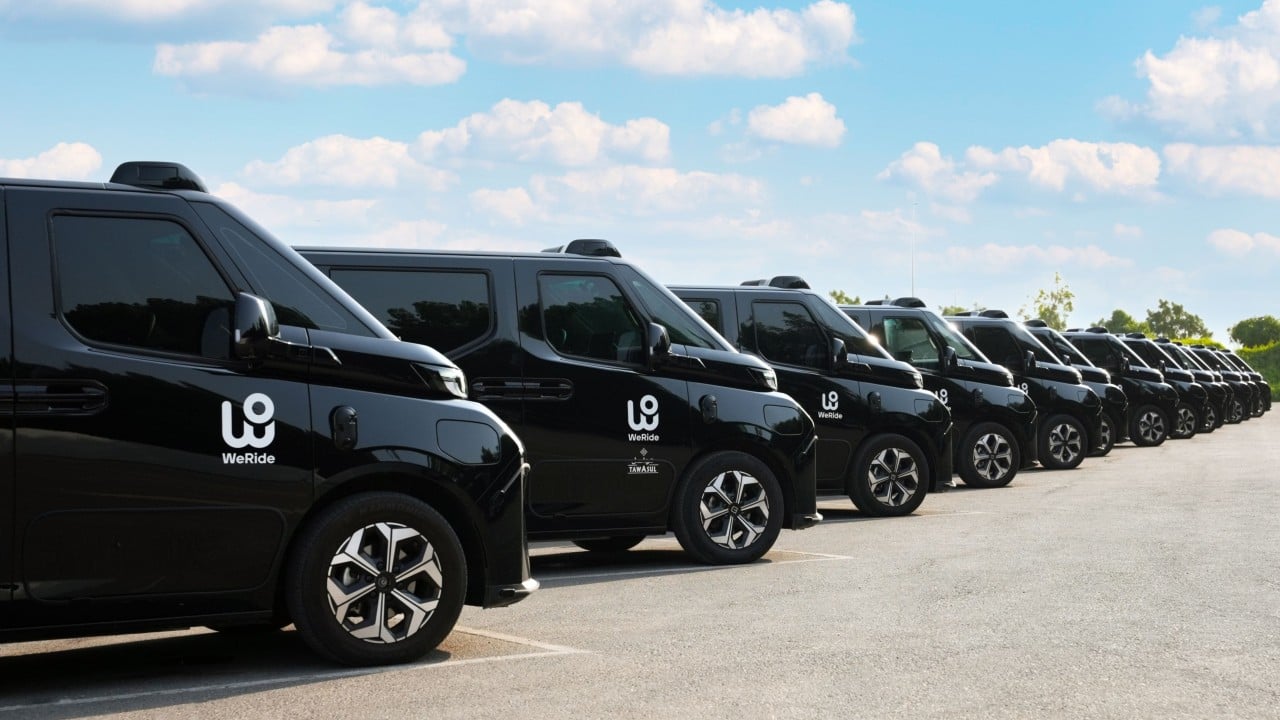
The CEO of WeRide posits a decade-long window for this shift. This timeline is not dictated by code, but by the replacement cycle of global vehicle fleets and the amortization of sensor hardware.
Hardware Deflation
For an L5 system to be commercially viable, the sensor suite (currently costing between $30,000 and $70,000 for high-end L4 rigs) must drop below $5,000. This requires a transition from mechanical LiDAR to solid-state solutions and the perfection of "vision-only" stacks that can match the depth-perception accuracy of lasers.
The Regulatory Buffer
Technology often outpaces policy, but in the case of AVs, policy is a fundamental component of the technology's deployment. The "moment" will likely be fragmented by jurisdiction.
- Urban High-Density Zones: High-definition mapping and V2X (Vehicle-to-Everything) infrastructure will enable L5-like behavior in specific cities first.
- The Rural Frontier: This remains the final boss of autonomy. Without high-speed 5G or updated road furniture, vehicles must rely entirely on internal "common sense" reasoning.
The Shift to End-to-End Neural Networks
The most significant technical shift toward an L5 breakthrough is the move away from hand-coded heuristics (the "if-then" statements of early robotics) toward end-to-end (E2E) neural networks.
In an E2E model, the raw sensor data enters one side of the network, and driving commands (steering, braking) exit the other. This mirrors the "black box" nature of LLMs. The benefit is a system that can generalize to new situations it has never seen. The drawback is the "Explainability Problem." If an E2E vehicle makes a mistake, engineers cannot easily point to a line of code to fix it. They must find similar data and re-train the model, hoping the bias is corrected without creating new ones.
Infrastructure as a Catalyst or Crutch
A common fallacy in the L5 debate is that the car must solve every problem in isolation. A more robust path to the "ChatGPT moment" involves "Smart Infrastructure."
The computational burden on the vehicle decreases significantly if the road itself "speaks." If traffic lights, intersections, and blind corners broadcast their state to the vehicle's mesh network, the probability of an edge-case collision drops by orders of magnitude. However, the capital expenditure required to outfit national highway systems with this tech is a multi-decade project, suggesting that the "moment" will be a software-heavy solution that compensates for "dumb" infrastructure.
Identifying the Inflection Point
We can quantify the approach of this "moment" by monitoring three key metrics:
- Miles per Disengagement in Unstructured Environments: When this metric reaches 100,000 miles in non-geofenced areas, L5 is viable.
- Simulation-to-Reality (Sim2Real) Fidelity: The ability to train a model entirely in a digital twin and have it perform perfectly on a physical road without fine-tuning.
- Inference Energy Efficiency: When a model capable of L5 logic can run on less than 500 watts of power.
The path to L5 is not a single discovery but the convergence of specialized silicon, self-supervised learning, and a massive reduction in the cost of photonic sensors. The "ChatGPT moment" for cars will not be a software update that appears overnight; it will be the quiet realization that for 365 consecutive days, in a specific region, a human has not had to touch a steering wheel in the snow.
Strategic investment should move away from companies solving "easy" highway autonomy and toward those building "World Models"—AI that understands the physics and social contracts of the road rather than just identifying boxes in a video frame. The winner of the L5 race will be the entity that solves the "Causal Inference" problem: not just what is happening, but why it is happening and what will happen next.