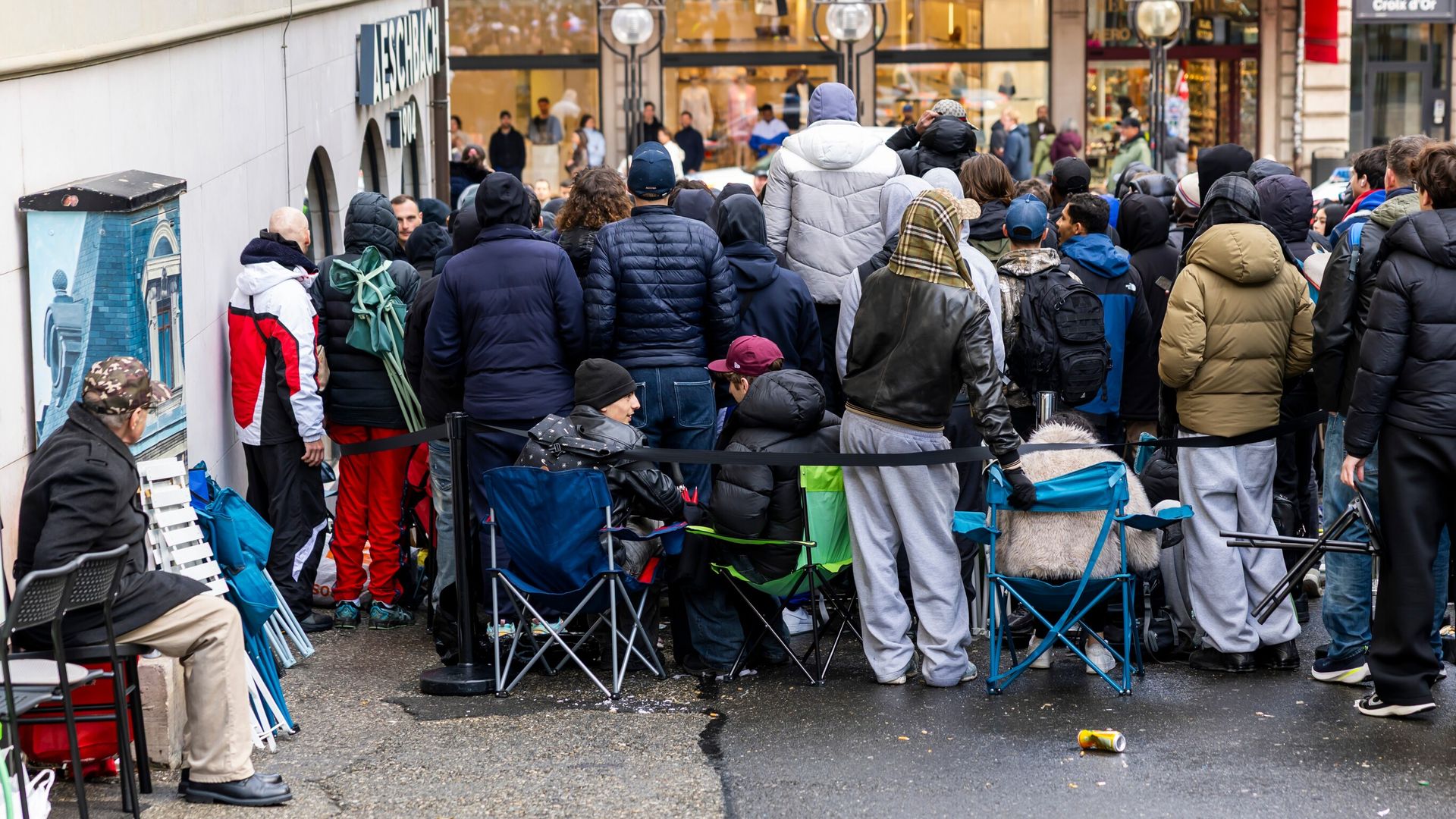
The chaotic crowd bottlenecks observed globally outside Swatch retail locations during the MoonSwatch launch represent a systemic failure in demand-supply calibration, not a spontaneous anomaly of consumer enthusiasm. When a manufactured scarcity model intersects with an asymmetric pricing structure, the resulting arbitrage opportunity guarantees a breakdown of traditional retail infrastructure. The structural failure occurs when the economic value of a product on the secondary market drastically exceeds its retail price point, effectively shifting the consumer demographic from brand enthusiasts to high-frequency flash-mob arbitrageurs.
The disruption was entirely predictable through classical supply-chain and game-theory frameworks. By examining the mechanics of this product launch, we can isolate three distinct operational vulnerabilities: asymmetric incentive mapping, physical infrastructure constraints, and the total absence of a friction-inducing allocation mechanism.
The Tri-Factor Architecture of Retail Arbitrage
To understand why localized retail infrastructure collapsed under the weight of this product launch, the phenomenon must be broken down into three distinct economic drivers.
1. The Asymmetric Value Spread
The MoonSwatch initiative was a strategic collaboration between Swatch and Omega, positioning a product mimicking the aesthetic of the USD 7,000 Omega Speedmaster Professional Moonwatch at a retail price point of USD 260. This created an immediate, massive divergence between the perceived value of the asset and its nominal acquisition cost.
The secondary market value of the product instantly spiked to multiples of its retail price upon launch, frequently clearing between USD 800 and USD 1,500 in the initial 48 hours. This created a net arbitrage spread of up to USD 1,240 per unit. When the financial reward for standing in a physical line for twelve hours yields an hourly return rate that surpasses median local wages by orders of magnitude, the line ceases to be composed of traditional consumers. It transforms into an informal labor force optimizing for immediate capital extraction.
2. The Failure of the Non-Communicated Non-Limited Designation
Swatch explicitly stated that the MoonSwatch collection was not a limited edition. In a frictionless market, this declaration should have mitigated immediate purchasing panic, as rational actors would choose to defer gratification to a period of stabilized supply. However, the manufacturer failed to quantify or communicate the rate of replenishment.
In the presence of high immediate demand and vague future supply timelines, consumers and scalpers treat a "non-limited" item with low current inventory exactly like a strictly limited product. The time-value of money, combined with the decay curve of secondary-market hype, dictated that immediate possession yielded maximum utility. Swatch’s failure to establish a predictable, high-volume rolling supply schedule created an artificial time compression, forcing months of consumer demand to attempt extraction through a single physical window simultaneously.
3. Spatial Miscalculation and Brick-and-Mortar Bottlenecks
The decision to restrict the initial launch exclusively to a highly curated selection of physical, company-owned retail boutiques introduced severe spatial limitations. Physical storefronts possess a hard ceiling on throughput, defined by total square footage, point-of-sale processing speeds, and regional sidewalk capacities.
A standard urban Swatch boutique is optimized for an average foot-traffic density of perhaps a dozen concurrent shoppers. Forcing thousands of individuals into a localized geographic point creates a structural bottleneck. When the velocity of arriving individuals exceeds the processing velocity of the retail staff, the queue transitions from a linear structure to an unmanaged, high-density crowd. At this threshold, public safety risks escalate exponentially due to spatial competition.
The Mechanics of Public Space Breakdown
The crowd volatility observed in major global commerce hubs—ranging from London and Singapore to New York and Tokyo—reveals a specific failure mode in municipal-retail coordination. A retail queue is fundamentally a cooperative social contract. This contract relies on the shared belief that resource allocation will remain equitable (first-come, first-served) and that the resource will be available when a participant reaches the terminal point.
The arbitrage spread fundamentally breaks this social contract via two specific mechanisms.
Structural Queue Infiltration
When the monetary value of a position in a queue exceeds a specific threshold, the risk-reward profile favors rule-breaking behaviors. Professional reselling syndicates deploy coordinated teams to cut lines, occupy space aggressively, or use physical intimidation to displace organic consumers. Because store personnel lack the legal authority or physical capacity to police public property outside their lease boundaries, a jurisdictional vacuum forms. The queue degenerates into a contested space where physical leverage dictates access.
Information Asymmetry and Abrupt Termination Panic
Throughout the weekend of the launch, the communication loop between boutique staff and the external crowd was non-existent or highly fragmented. Store managers frequently possessed no real-time data on exact inventory allocations per reference, or they failed to communicate when the inventory-to-queue ratio dropped below 1.0.
When a crowd senses that the available resource is exhausted but lacks definitive data, the psychological motivation shifts from patient waiting to aggressive positioning. The fear of missing out on a high-margin asset causes the physical compression of the crowd toward the storefront entrance. Individuals attempt to bypass the queue entirely before the doors close, triggering a cascade of structural failure in barriers and security lines.
Operational Redesign for Mass-Market Scarcity Launches
The operational errors of the MoonSwatch launch provide a clear blueprint for how multi-tiered luxury conglomerates must restructure high-demand physical drops to protect brand equity and human safety. Relying on organic crowd self-regulation during an active arbitrage event is negligent. Brand managers must introduce deliberate structural friction to disincentivize bad actors while smoothing out the physical demand curve.
Implementation of Non-Transferable Digital Queuing
Physical presence should never be the primary vector for product allocation in a hyper-demand scenario. Brands must mandate a digitized, geo-fenced lottery or reservation system through a centralized application 24 to 48 hours prior to store opening.
- Identity Verification: Tie each reservation to a verified national identity document or a unique, non-transferable payment token.
- Time-Slotted Allocation: Distribute specific, non-negotiable 15-minute pickup windows to successful applicants.
- Crowd Dispersion: If an individual arrives outside their designated window, their transaction capability is programmatically locked. This completely decouples product acquisition from physical queuing duration, vaporizing the crowd bottleneck entirely.
Dynamic Inventory Allocation Transparency
To eliminate the information asymmetry that drives crowd surges, real-time inventory counters must be displayed externally above the store entrance and updated dynamically on digital platforms. If a location receives only 150 units of a specific variation, an automated system should signal to the waiting crowd the exact moment the line size matches available stock.
By formalizing the cut-off point via transparent telemetry, the incentive for individuals to remain in a non-viable queue drops to zero. This neutralizes the uncertainty that directly causes crowd compression at the storefront.
Wholesale Mitigation of Reseller Margins
The root cause of retail disruption is the secondary market price delta. If a brand wants to retain a low retail price point for accessibility reasons but wishes to avoid riots, it must systematically destroy the short-term resale margin.
The most effective mechanism to accomplish this is a committed, public production schedule. If the manufacturer guarantees that an identical product will be available via unrestricted online ordering within 30 days of the physical launch, the secondary market valuation collapses immediately. Speculators will not risk capital or physical injury to hoard an asset that faces imminent, massive deflation. The remaining physical line then contracts naturally, reverting to genuine brand collectors who are highly likely to adhere to standard social contracts.
The Strategic Choice for Parent Portfolios
The long-term risk of unmanaged retail disruption is the severe erosion of the premium brand ecosystem. While the immediate sales metrics of the MoonSwatch drop indicated unprecedented volume for the Swatch brand, the negative externalities were borne entirely by the physical retail environments, local police forces, and the prestige of the partner brand, Omega.
When a luxury marque like Omega allows its iconic design language to be utilized as a high-velocity speculative instrument, it risks alienating its core affluent demographic. The spectacle of police intervention and physical altercations outside malls alters the consumer perception of the brand from one of exclusive curation to one of chaotic commoditization.
The ultimate strategic error was attempting to utilize an infrastructure built for low-velocity, high-margin luxury consumption to distribute a mass-market, high-velocity cultural phenomenon without modifying the operational mechanics. Future cross-tier collaborations within conglomerates must treat crowd logistics not as a marketing metric to be maximized for social media engagement, but as a critical operational vulnerability that requires strict, data-driven containment protocols. The value generated by initial brand buzz is rapidly neutralized by the liabilities of a compromised retail experience and localized civil disruption. Every future launch of this scale must prioritize digital gatekeeping and supply transparency over the optimization of raw storefront optics.