The desert at 3:00 AM does not care about human ambition. It is just cold, vast, and aggressively empty. On a restricted testing range in the American Southwest, a small team of engineers shifts from foot to foot, breath misting in the glare of utility lights. They are watching a small, off-the-shelf drone hover a few hundred yards away. It is the kind of quadcopter you can buy at a hobby shop for a few hundred dollars. Tonight, however, it represents a multi-million-dollar headache.
For decades, modern warfare relied on a simple equation: bigger, faster, louder. If you wanted to project power, you built a louder jet or a heavier tank. But the equation changed. The most disruptive threat on the modern battlefield is no longer a multi-million-dollar stealth fighter. It is a swarm of cheap plastic drones, bought online, outfitted with basic explosives, and flown by someone sitting in a basement three time zones away.
The military has plenty of ways to destroy things. They have missiles that can hit a coin from orbit. But using a missile that costs more than a suburban home to shoot down a drone that costs less than a smartphone is a losing mathematical game. It is unsustainable.
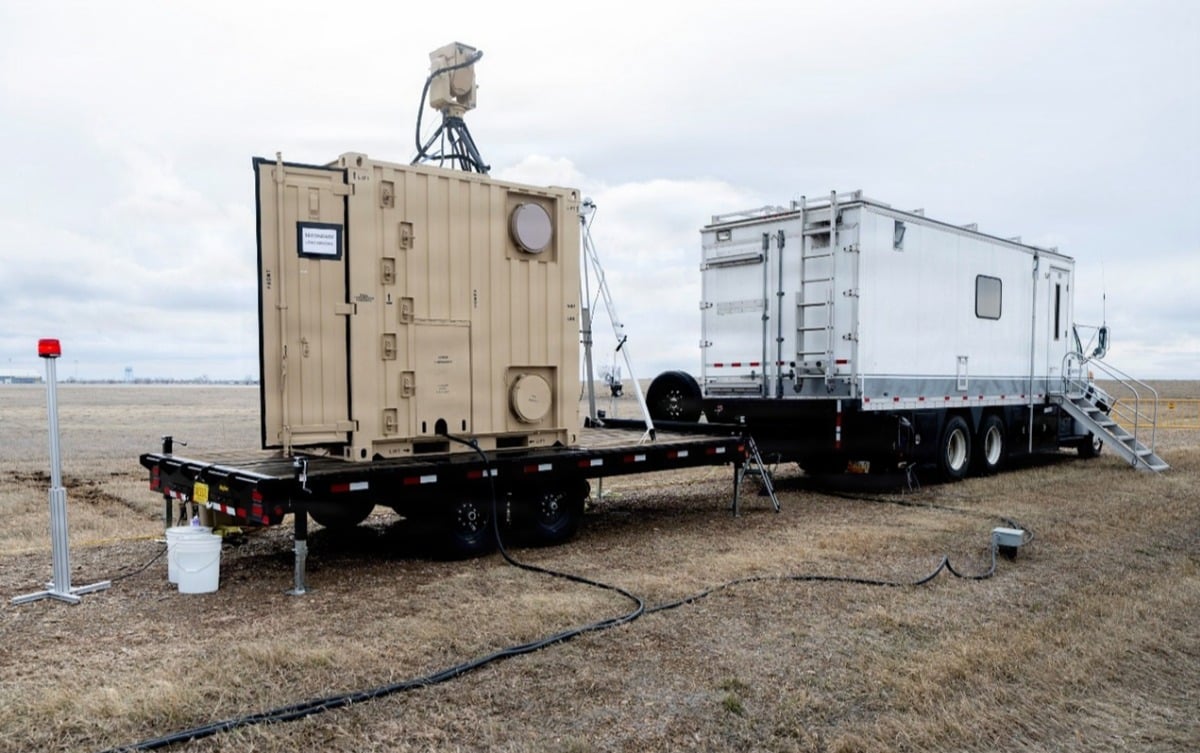
That is why the team in the desert is looking at a massive, matte-black shipping container. Inside it is a weapon that makes no sound, uses no ammunition, and leaves no shell casings.
Suddenly, the drone drops from the air like a stone. No explosion. No flash. Just a sudden, violent surrender to gravity.
The Weight of the Invisible
To understand what just happened on that test range, we have to look at the twin crises facing modern military logistics: the tyranny of the battery and the threat of the cheap sky.
Consider a hypothetical soldier named Marcus. He is stationed at a remote outpost, the kind of place where roads are dangerous and resupply lines are thin. Marcus is carrying sixty pounds of gear, and an uncomfortable percentage of that weight is batteries. His radio, his night-vision goggles, his GPS, his drone detection equipment—all of it drinks electricity. When those batteries die, Marcus is blind. Keeping him supplied with fresh power requires convoys, helicopters, fuel, and risk. People die just trying to deliver AA batteries to the front line.
Now look at the sky above Marcus’s outpost. A buzzing sound cuts through the night. It is a drone. To knock it out of the air using conventional weapons, Marcus’s unit has to fire kinetic rounds. Every bullet fired is a bullet that needs to be replaced. Every missile launched is a gap in their defense that requires a dangerous resupply mission.
The U.S. military’s recent testing of directed-energy systems aims to solve both of Marcus’s problems at the exact same time, using the exact same piece of hardware.
The technology is a high-energy laser system designed to do two seemingly contradictory things: destroy and sustain. In one moment, the system can track a hostile drone, lock onto its optical sensors or housing, and cook the electronics until the machine plummets to earth. A fraction of a second later, that same laser can pivot toward a friendly outpost or a friendly drone, dialing down its intensity to beam pure, wireless electrical energy across miles of open air.
It sounds like science fiction. It feels like magic. But the physics are remarkably grounded.
How to Catch a Sunbeam
Think of traditional power distribution like a garden hose. The water flows through the tube, and if you want to water a plant across the yard, you need a longer hose. Wireless power beaming replaces the hose with a spotlight.
The system takes electricity from a generator, converts it into a highly concentrated beam of light—a laser—and shoots it through the air. On the receiving end, a specialized photovoltaic panel (essentially a super-charged solar panel tuned specifically to the laser's exact wavelength) catches the light and converts it back into electricity.
During the recent trials, the military demonstrated this dual-use capability with terrifying precision.
First, the defensive side. The laser system acts as a hard shield. Unlike a missile defense system, which runs out of interceptors, a laser weapon has what engineers call an "infinite magazine." As long as the generator has fuel to create electricity, the laser can keep firing. The cost per shot drops from hundreds of thousands of dollars to the price of a gallon of diesel. The drone threat is neutralized not by brute force, but by economic superiority. You simply out-economy the enemy.
But the real magic lies in the second capability: power beaming.
Imagine a reconnaissance drone hovering over a valley. Typically, it can stay airborne for forty-five minutes before its batteries drain, forcing it to land and recharge. Now, imagine a laser on a ridge five miles away tracking that drone. The laser locks onto a small receiver on the belly of the aircraft. Suddenly, the drone's battery stops draining. It begins to charge while in mid-air. Forty-five minutes turns into forty-five hours. It turns into forty-five days.
The drone becomes a permanent eye in the sky, suspended on an invisible, unbreakable tether of light.
The Fragile Reality of Light
It is easy to get swept up in the techno-optimism of infinite power and silent defenses. But the engineers in the desert know the truth is far more fragile. Light is fickle.
If you have ever tried to use a flashlight in a heavy fog, you know what happens: the beam hits the water droplets, scatters, and blinds you while illuminating nothing. The atmosphere is the enemy of the laser. Dust storms, rain, humidity, and even the natural turbulence of warm air rising from the desert floor can bend, diffuse, and weaken a laser beam.
During testing, a significant portion of the engineering challenge isn't just making the laser more powerful; it is making it smarter. The system must constantly calculate the distortion of the air between the weapon and the target, adjusting its mirrors hundreds of times per second to keep the beam perfectly focused.
If the focus slips by even a fraction of a millimeter, the laser stops being a weapon or a power source. It just becomes a very expensive spotlight.
Then there is the human element. Beaming kilowatts of laser energy through the sky comes with obvious safety concerns. What happens if a bird flies through the beam? What happens if a stray aircraft crosses the path of the light? The system requires automated, instantaneous shut-off mechanisms that can detect an obstruction in microseconds, dropping the power before any damage occurs, and resuming the connection the instant the path is clear.
Shifting the Invisible Grid
The implications of this technology stretch far beyond the perimeter of a military testing range. We are looking at the foundational pieces of a world where energy is decoupled from infrastructure.
Right now, our society is built on the tyranny of wires. We string copper across continents, dig trenches through cities, and pack heavy lithium blocks into our pockets just to keep our lives running. The ability to beam power through the air, even under strict military parameters, proves that the wire is optional.
Consider a disaster zone where an earthquake or a hurricane has flattened the electrical grid. Hospitals are dark, water pumps are silent, and communication is cut off. Instead of waiting days for heavy generators to clear blocked roads, a power-beaming vehicle could park on a nearby hill, aiming a light beam at a receiver hoisted on a temporary tower. Energy flows instantly, through the air, across the ruins.
Back on the test range, the utility lights are turned off. The desert is dark again. The downed drone is collected, its plastic housing warped and melted from an invisible heat it never saw coming.
The engineers pack their gear into laptops and pelican cases. They aren't shouting or celebrating. They know that this test is just a sentence in a much longer, quieter argument about who controls the sky.
The true measure of this technology won't be found in the violent crash of a countered drone. It will be found in the silence of an outpost where the lights stay on, the batteries stay full, and the sky stays clear, all because of a quiet beam of light cutting through the dark, unnoticed by everyone except the machines it keeps alive.