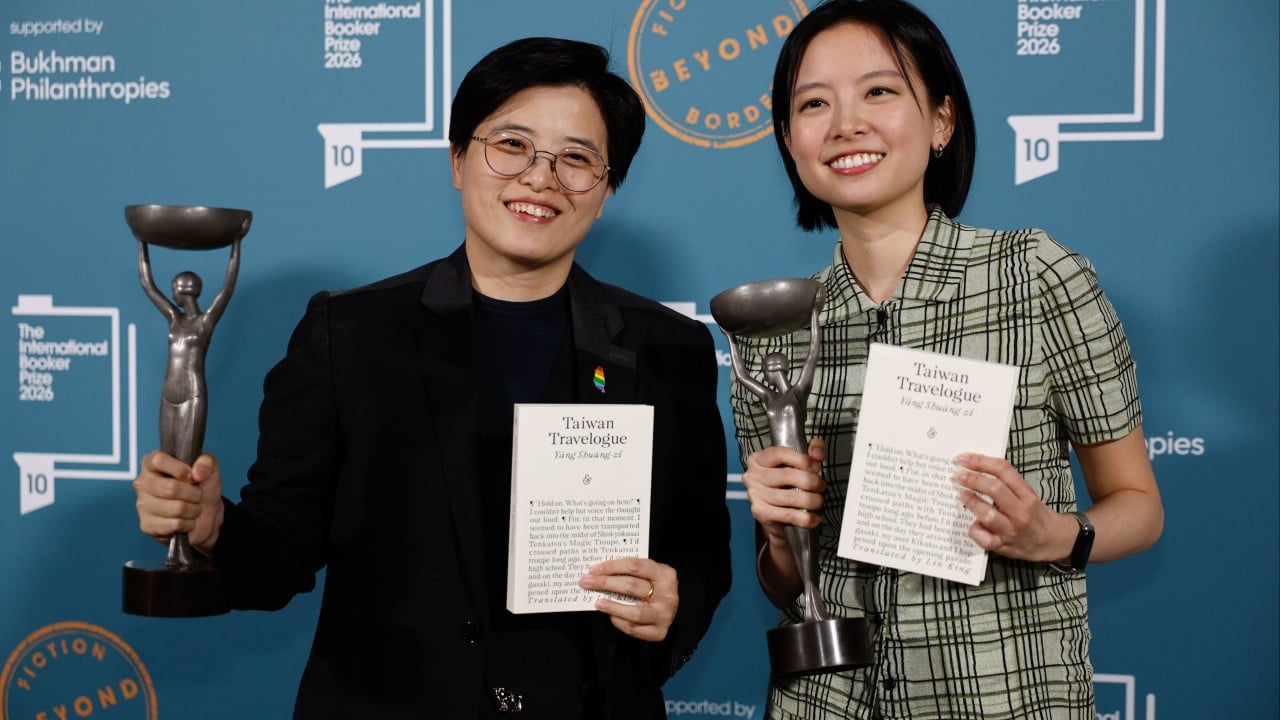
You don't usually see literary awards causing frantic damage control in major political offices, but that's exactly what happened when author Yang Shuang-zi and translator Lin King took the stage in London. Their novel, Taiwan Travelogue, just won the International Booker Prize. It's the first time a book written in Mandarin Chinese has snagged the honor.
For readers in London or New York, it's a beautifully layered, queer historical romance set in 1938 colonial Taiwan. For the Chinese Communist Party in Beijing, it's a political nightmare wrapped in a dust jacket.
The book's massive international breakout hits right at a bruising raw nerve for China's leadership. Beijing spends billions trying to convince the world—and the people living on the island—that Taiwan has always been an organic, inseparable part of the Chinese motherland. Then a fictional story about a Japanese writer and her local interpreter comes along, sweeps the global literary scene, and reminds everyone that Taiwan's history is incredibly messy, deeply distinct, and completely unaligned with Beijing's preferred script.
The Fiction Threatening a National Narrative
The book isn't a dry political manifesto. It is sly and experimental. It frames itself as a "fictional translation" of a rediscovered 1954 Japanese memoir written by a novelist named Aoyama Chizuko, who traveled across Japanese-ruled Taiwan in the late 1930s. As Chizuko eats her way through the island, she falls for her enigmatic Taiwanese translator, Chizuru.
Every chapter is named after a local dish. The food serves as a brilliant metaphor for the island itself—a distinct cultural blend shaped by indigenous, Dutch, Chinese, and Japanese influences, without ever being fully defined or swallowed by any single one of them.
This layered identity drives Beijing wild. When asked directly about the book's global success, mainland China's Taiwan Affairs Office didn't offer congratulations. Instead, they issued a stern public warning, urging Taiwanese writers to "face squarely the history of Japanese aggression" and focus on works that promote "national rejuvenation" and cross-strait integration.
Over on mainland social media apps like Bilibili, nationalist vloggers went into hyperdrive. They slammed Yang for supposedly glorifying the Japanese colonial era at a time when the mainland was suffering under brutal wartime invasion.
But these critics completely miss the point of the book. The novel doesn't ignore colonial exploitation. It explicitly highlights the sharp, uncomfortable power imbalances between the Japanese colonizer and the colonized local. The real threat to Beijing isn't that the book praises Japan; it's that the book treats Taiwan as its own distinct historical ecosystem.
The Battle for the Taiwanese Mind
The timing of this literary explosion couldn't be worse for the mainland. Beijing's strategy for peaceful unification relies heavily on appealing to a shared ancestry and a common language. The narrative is simple: You look like us, you speak like us, so you belong with us.
A book like Taiwan Travelogue blows a hole in that logic by showing how decades of separate historical experiences create an entirely different identity. Taiwanese political scientist Huang Rui-ming notes that neither the intense Japanization policies of the colonial era nor the subsequent decades of hardline Chinese nationalist rule under Chiang Kai-shek managed to turn the island's population into purely Japanese or traditionally Chinese citizens. They became something else entirely.
Taiwan's sense of self has become fundamentally Taiwanese. You can see this vividly in how the book's creators view their work. At the award ceremony at London's Tate Modern, Yang didn't shy away from the geopolitical elephant in the room. She stated flatly that literature cannot be separated from the soil in which it grows, noting that Taiwanese writers have been asking the same questions for a century: What kind of future and what kind of nation do the people of Taiwan want?
Translator Lin King took it a step further, revealing that Russia's invasion of Ukraine convinced her to stop translating general Sinophone literature and focus exclusively on projects from Taiwan. She described the island's vibrant culture not as a unified, state-directed chorus, but as a beautiful, democratic "cacophony."
Why the West Kept Reading
Western audiences have fallen hard for this book, and it's worth examining why. Beyond the brilliant translation and the gripping narrative structure, the novel taps directly into modern cultural touchstones. It's a queer romance featuring two Asian women, a narrative rarely explored in mainstream Western historical fiction.
Furthermore, Taiwan has spent the last decade intentionally positioning itself as a beacon of progressive values and LGBTQ rights in Asia—a deliberate move to contrast its open political culture with mainland China's authoritarianism. The book naturally aligns with that global image, making it highly attractive to international juries.
For Beijing, watching the West celebrate a distinctly Taiwanese identity through a prestigious global platform feels like a dangerous step toward international validation. If global readers begin to see Taiwan's history as entirely separate from China's historical trajectory, the mainland loses its moral and historical justification for sovereignty in the court of world opinion.
The mainland's current playbook of using economic incentives and military posturing to win hearts and minds looks increasingly outdated against this kind of cultural shifts. Younger generations on the island are growing up with a mainstream consensus deeply rooted in local identity. They don't see themselves as a missing piece of a mainland empire. They see themselves as an independent people with their own literature, their own history, and their own future.
If you want to understand where the cross-strait conflict is actually being fought, look past the fighter jets buzzing the median line in the Taiwan Strait. The real trench warfare is happening over memory, identity, and who gets to tell the story of the island.
To see this cultural friction play out firsthand, look at how the global literary community received this historic milestone. The International Booker Prize announcement ceremony captures the exact moment the novel made history on the world stage, showing the deep emotional and political resonance of the win.
To truly understand this shifting dynamic, stop looking at Taiwan through a purely military or economic lens. Grab a copy of Taiwan Travelogue. Pay close attention to the footnotes and the subtle power plays between the characters. The ultimate takeaway isn't about weapons or trade balances—it's that a well-told story can completely disrupt a superpower's grand strategy.