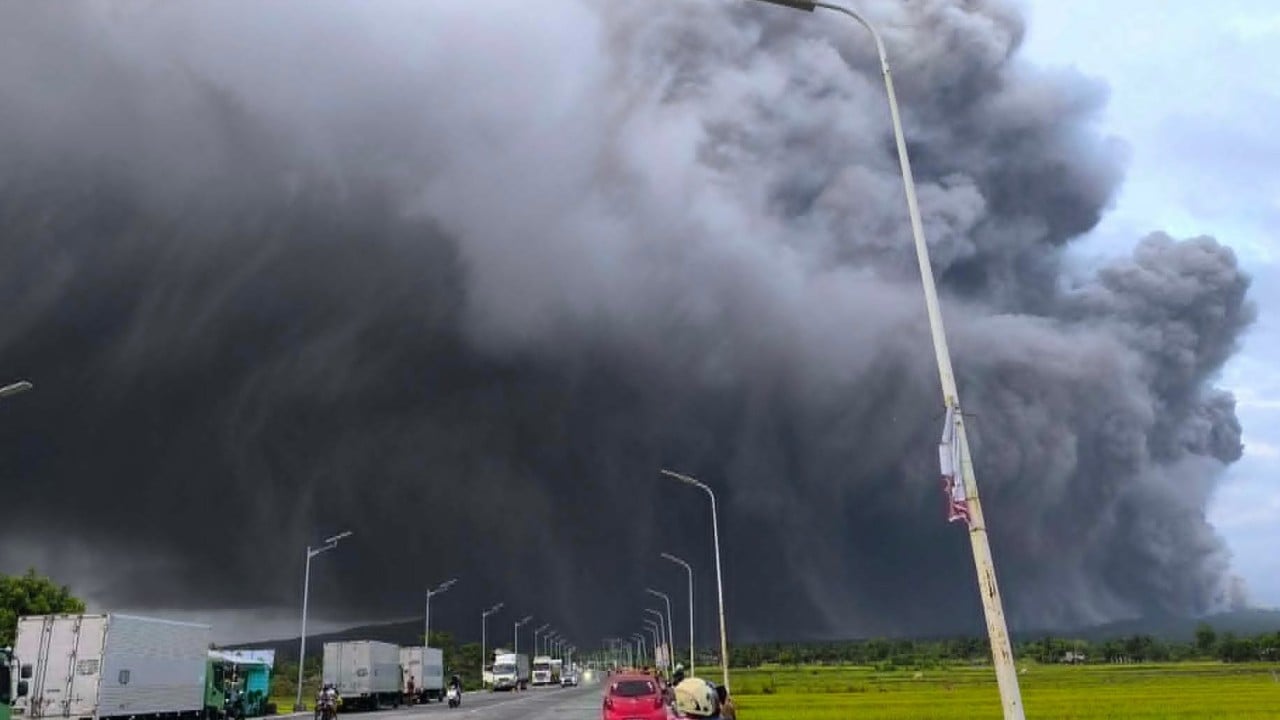
The sun was supposed to rise at 5:45 AM over Albay. Instead, the world stayed bruised and indigo, then faded into a suffocating, unnatural charcoal. In the shadow of Mayon, the most perfectly symmetrical volcano on earth, "morning" had become a theoretical concept.
Imagine standing on your porch in a small village like Camalig or Guinobatan. You expect the smell of damp earth and woodsmoke. Instead, your nostrils sting with the sharp, acidic bite of sulfur. You reach out your hand, and it disappears into a curtain of falling grit. This isn't smoke. It isn't rain. It is pulverized rock, ancient and angry, falling from a height of five kilometers to reclaim the land.
The Weight of Silence
For the people living in the danger zones of the Philippines, Mayon is not a tourist attraction. It is a temperamental neighbor. When she breathes, the earth shudders. But the current crisis isn't just about the fire in the mountain’s throat; it is about the silence that follows the ash.
Ashfall is a heavy, ghostly thief. It steals the light first. Then it steals the breath.
In the towns blanketed by the recent eruptions, the transformation was instantaneous. Streetlights, sensors confused by the midday gloom, flickered on, casting eerie, weak halos through the haze. Drivers pulled to the side of the road, their windshield wipers scraping uselessly against a substance that has the consistency of flour but the abrasive power of industrial glass. To drive in this is to destroy your engine; to breathe in this is to scar your lungs.
Consider a mother in a rural evacuation center. Let's call her Elena. She isn't thinking about tectonic plates or the Volcanic Explosivity Index. She is looking at her seven-year-old son, who is coughing into a damp rag. She is thinking about the three hectares of chili peppers and rice she left behind, now likely buried under a gray shroud that will turn to concrete the moment it rains.
The stakes are invisible until they aren't. We talk about "displacement" as a statistic—15,000 people moved, 20,000 masks distributed. But displacement is actually the sound of a plastic tarp flapping in a crowded school gym. It is the smell of a thousand bodies shared in a space meant for a hundred. It is the uncertainty of wondering if your roof will collapse under the weight of the stone falling from the sky.
The Chemistry of a Nightmare
To understand why a town would panic when the sky turns dark, you have to understand what ash actually is. It isn't the soft soot you find in a fireplace.
Under a microscope, volcanic ash looks like jagged shards of broken glass. It is formed when gas trapped in magma expands so violently that it shatters the cooling rock into microscopic fragments. When Mayon vomits this material into the atmosphere, it creates its own weather.
$SiO_2$, or silica, is the primary culprit. When these shards enter the human respiratory system, they don't just irritate; they lodge. For the elderly and the very young in Albay, the "blanket" of ash is a physical assault on the blood’s ability to take in oxygen. This is why the panic isn't irrational. It is biological.
Then there is the structural threat. Dry ash is heavy, but wet ash is lethal. If a tropical downpour hits a town covered in ten centimeters of ash, the weight on a standard tin roof increases exponentially. One minute you are sheltering from the dust; the next, your ceiling is buckling under the weight of several tons of sodden gray slush.
The Economy of a Gray World
The local economy in the Bicol region is built on the green. Abaca hemp, coconuts, and the famous siling labuyo (bird's eye chili) thrive in the fertile soil Mayon has provided over centuries. It is a deal the farmers make with the devil: the volcano gives life, and occasionally, she takes it back.
When the ash falls, the green vanishes.
The immediate loss is obvious—crops are smothered, and livestock choke on tainted grass. But the secondary ripples are what keep the provincial governors awake at night. Tourism, a massive driver for the region, evaporates. The hikers and photographers who flock to see the "Perfect Cone" are replaced by relief trucks and vulcanologists.
For the small shop owner in Legazpi City, the darkness means shutters are down. It means no customers. It means the "invisible" cost of cleaning—hours spent sweeping a substance that just keeps coming back, fine as dust and heavy as lead.
The Long Shadow
The Philippines sits on the Pacific Ring of Fire. It is a country defined by its resilience, a word that is often used so much it loses its teeth. But resilience isn't a superpower. It is a weary habit.
The people of Albay have a complex relationship with Mayon. They call her "Magayon," which means "beautiful" in the local dialect. There is a deep, cultural stoicism here. You clean the ash. You wait for the alert level to drop. You move back to the slopes because that is where your ancestors are buried and where the soil is rich.
Yet, this latest bout of activity feels different to those on the ground. The darkness lasted longer this time. The ash was thicker.
Local authorities have become masters of logistics, moving thousands of people with a precision that would shame most Western disaster agencies. They know the drill. They have the evacuation maps memorized. But you cannot map the psychological toll of living under a mountain that could, at any moment, decide to erase your world.
The panic reported in the headlines isn't a loss of control. It is a hyper-awareness of reality. It is the sound of thousands of people recognizing that they are small, and the earth is very, very large.
The Ghost of Cagsawa
A few kilometers from the current danger zone stands the Cagsawa Ruins. All that remains of a 17th-century Franciscan church is the stone bell tower, rising defiantly from the earth. The rest of the town was swallowed by a 1814 eruption, buried under lahars—volcanic mudflows—that killed over a thousand people.
That bell tower is a constant reminder. It tells the residents of Albay that the "total darkness" they see today has happened before and will happen again. It is a monument to the fact that the ground beneath them is temporary.
When the ash eventually stops falling—and it will—the cleanup will begin. The gray will be shoveled into bags. The rains will wash the streets. The chili peppers will eventually fight their way back through the grit.
But for now, the residents wait. They listen to the low, rhythmic grumbling of the mountain, a sound that vibrates in the chest more than the ears. They watch the horizon for a sliver of real morning.
In the heart of the darkness, there is only the sound of a broom hitting the pavement. Sweep. Sweep. Sweep. A rhythm of survival against a sky made of stone.
The mountain doesn't care about the headlines. It doesn't care about the "Perfect Cone" or the tourism revenue. It only knows the pressure of the deep earth. And as long as that pressure remains, the people of Albay will keep their masks tight, their bags packed, and their eyes turned toward a sun they cannot see.