The modern battlefield is entirely too quiet right before it kills you.
For decades, the armored tank was the undisputed king of ground warfare. It was a massive, rumbling statement of absolute sovereign will. If you sat inside three inches of hardened steel, you felt reasonably safe from anything short of a direct hit from another multi-million-dollar war machine.
Then came the buzzing.
It is a high-pitched, plastic whine, not unlike an angry hornet trapped in a jar. It costs about five hundred dollars to assemble in a basement workshop. To the three-man crew trapped inside a sixty-ton behemoth, that cheap, plastic buzz is the sound of an impending, claustrophobic execution. First-person view (FPV) drones, packed with explosives and steered by a teenager wearing virtual-reality goggles two miles away, have turned the multi-million-dollar pride of global militaries into massive steel coffins. They do not strike the thick front armor. They dive directly into the thin metal plates on top of the turret, or slip quietly into the vulnerable gap between the turret and the hull.
Military engineers are desperate. The latest attempt to solve this existential crisis comes from Russia, where designers have just patented something that sounds less like advanced military hardware and more like a bizarre prop from a dark, steampunk fantasy.
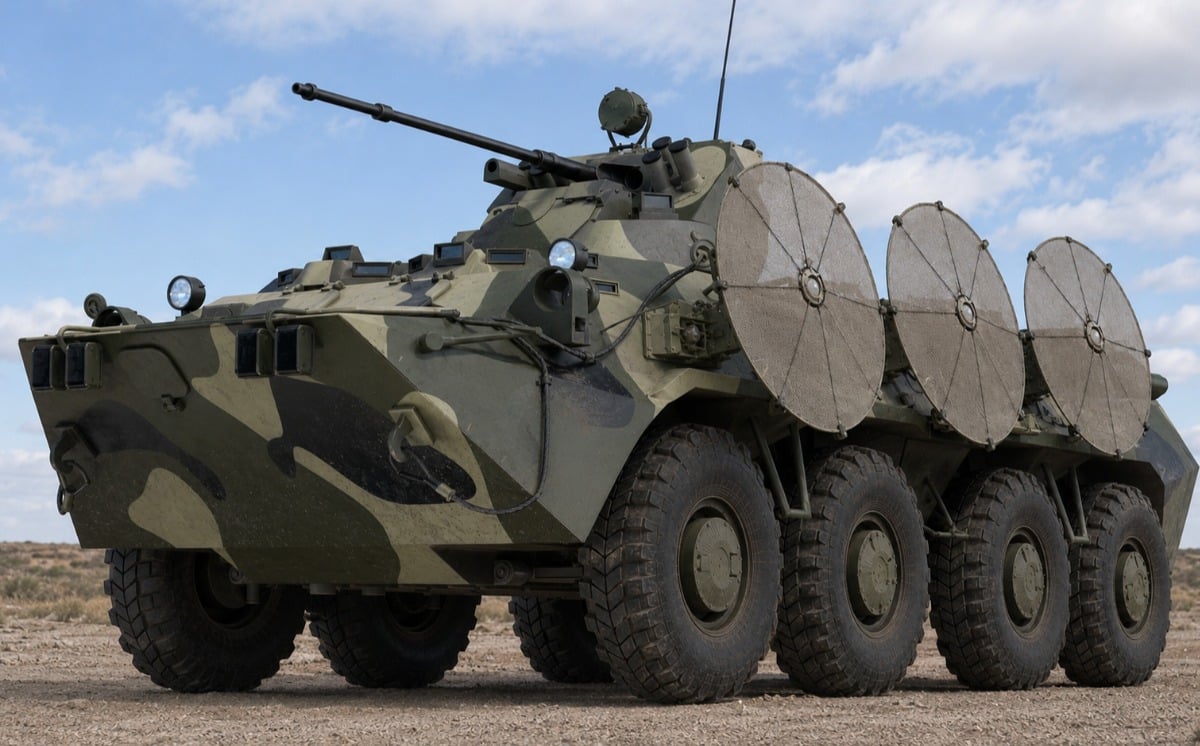
They built a spinning metal umbrella.
The Desperation of the Cage
To understand why anyone would patent a rotating shield that looks like a metallic parasol, you have to understand the sheer panic currently gripping armored warfare doctrine.
Walk through any recent combat zone or scroll through verified defense footage, and you will see tanks covered in improvised, welded steel cages. Soldiers call them "cope cages." They are ugly, heavy, and born entirely of battlefield improvisation. The logic was simple: detonate the incoming drone's explosive charge a few inches before it touches the actual tank armor, dissipating the deadly jet of superheated metal.
But static cages are heavy, cumbersome, and profoundly flawed. They ruin the vehicle's silhouette. They restrict the crew's visibility. Worst of all, drone pilots adapted almost instantly. If a tank has a cage over the top, the pilot simply flies the drone underneath it, or waits for the vehicle to turn, exposing a seam.
Imagine a rainstorm where the raindrops are actively hunting for the dry spots under your jacket. That is the reality of the drone threat. A static shield is no longer enough when the threat can think, pivot, and adjust its flight path in mid-air.
The Russian patent, filed by the main research institute of the automotive forces, attempts to weaponize kinetic motion against this digital precision. Instead of a heavy, fixed roof of steel, the patent describes a conical, umbrella-shaped shield mounted on a central mast atop the armored vehicle.
It does not just sit there. It spins.
Driven by a dedicated electric motor or linked to the vehicle’s exhaust gases, the umbrella rotates at high speed. The conceptual leap here relies on basic physics rather than thick armor plating. When an FPV drone dives toward the tank at forty miles per hour, it does not hit a solid wall. It hits a rapidly moving, angled surface.
The goal is twofold. First, the spinning blades or plates are designed to physically deflect the lightweight drone, striking its plastic propellers or frame and forcing it off course before its contact fuze can trigger the main explosive payload. Second, even if the drone does detonate, the angled, rotating surface is meant to redirect the explosive blast outward, away from the vulnerable top hatches of the tank.
It is an admission of vulnerability. The armored giants can no longer rely on being tougher than their attackers. Now, they have to try and dodge them.
The Illusion of the Technical Fix
It is easy to look at a patent diagram and see a elegant solution to a messy problem. On paper, physics always cooperates. The math balances. The spinning umbrella deflects the threat, the tank rolls on, and the crew goes home.
But the gap between a climate-controlled patent office in Moscow and a freezing, mud-slicked trench is vast.
Consider what happens next when you take this concept out of the abstract and bolt it onto a machine meant to survive the absolute worst conditions on Earth. A tank does not operate in a clean room. It operates in a vortex of choking dust, thick mud, flying shrapnel, and crushing vibrations.
For a spinning mechanism to work reliably, it requires precision bearings, a constant power supply, and an unobstructed rotating axis. A single piece of stray shrapnel from a nearby artillery blast could bend the main mast. A thick coating of frozen mud could unbalance the spinning cone, causing it to vibrate so violently that it tears itself off its mounts or burns out its electric motor.
Furthermore, a spinning metal cone acts as a massive radar and visual signature. In trying to hide from the drone's cameras, the tank becomes a flashing, rotating beacon on the battlefield, practically screaming its location to every thermal sensor and reconnaissance spotter in the area.
The history of military technology is littered with these kinds of over-engineered answers to asymmetrical threats. During the Vietnam War, the US military attempted to use complex acoustic sensors to track troop movements along the Ho Chi Minh trail, only for North Vietnamese soldiers to counter them by hanging buckets of mud near the sensors to trigger false alarms. When one side possesses a cheap, endlessly adaptable weapon, the worst thing the opposing side can do is respond with a complex, fragile mechanism that must work perfectly every single time.
The Human Cost inside the Steel Box
We lose something vital when we talk about military hardware purely through the lens of patents, armor thickness, and rotational speeds. We lose the people.
To truly understand why engineers are willing to try an idea as wild as a spinning umbrella, you have to put yourself inside the hatch of a modern armored vehicle.
You are sitting in a cramped, oily space that smells faintly of diesel fuel, hydraulic fluid, and sweat. The air is deafeningly loud even when the tank is idling. You cannot see the world through a clean windshield; your entire perception of the outside reality is filtered through small, scratched glass periscopes or flickering digital monitors.
You are hyper-aware that you are sitting on top of dozens of highly explosive tank shells. If a drone breaches the top armor and ignites that ammunition, the entire vehicle explodes from the inside out in a fraction of a second. The turret, weighing several tons, is launched into the air like a discarded bottle cap. Soldiers call this the "jack-in-the-box" effect.
Living with that knowledge does things to the human psyche. It creates an atmosphere of ambient, suffocating dread.
Every soldier inside that hull knows that the millions of dollars spent on their vehicle’s front armor cannot save them from a hobbyist drone bought online and modified in a kitchen. The psychological weight of knowing that your enemy can kill you with a weapon that costs less than your boots is paralyzing.
That is why soldiers weld bedsprings, sheet metal, and logs to their vehicles. It is why commandrs are willing to greenlight patents for spinning umbrellas. It is not necessarily because they are certain the technology will work flawlessly. It is because the alternative—sitting quietly in a steel box waiting for the buzzing to start—is utterly unendurable.
The End of the Invincible Machine
The spinning umbrella patent is a symptom of a much larger, irreversible shift in the nature of human conflict. The era of the industrial-age armored titan is drawing to a close, or at the very least, undergoing a brutal mutation.
For a century, Western and Eastern military doctrines alike were built on the idea that mass, steel, and firepower could shock and awe an adversary into submission. We believed that complexity and cost equaled invincibility.
The cheap drone shattered that illusion. It democratized air power. It took the most expensive, highly engineered land weapon ever created by human ingenuity and turned it into prey.
A spinning metal canopy may or may not ever see mass production. It might remain a curious footnote in the archives of military engineering, a bizarre testament to a moment of geopolitical desperation. But the fact that it exists on a patent blueprint tells us everything we need to know about the future.
The giants are afraid of the insects.
The next time you see a picture of a modern tank, ignore the massive cannon. Look instead at the roof. Look at the frantic, ugly, creative arrays of metal shielding covering its top. That is where the real war is being fought—not for territory, but for the survival of the very concept of armored warfare, one spinning, desperate shield at a time.