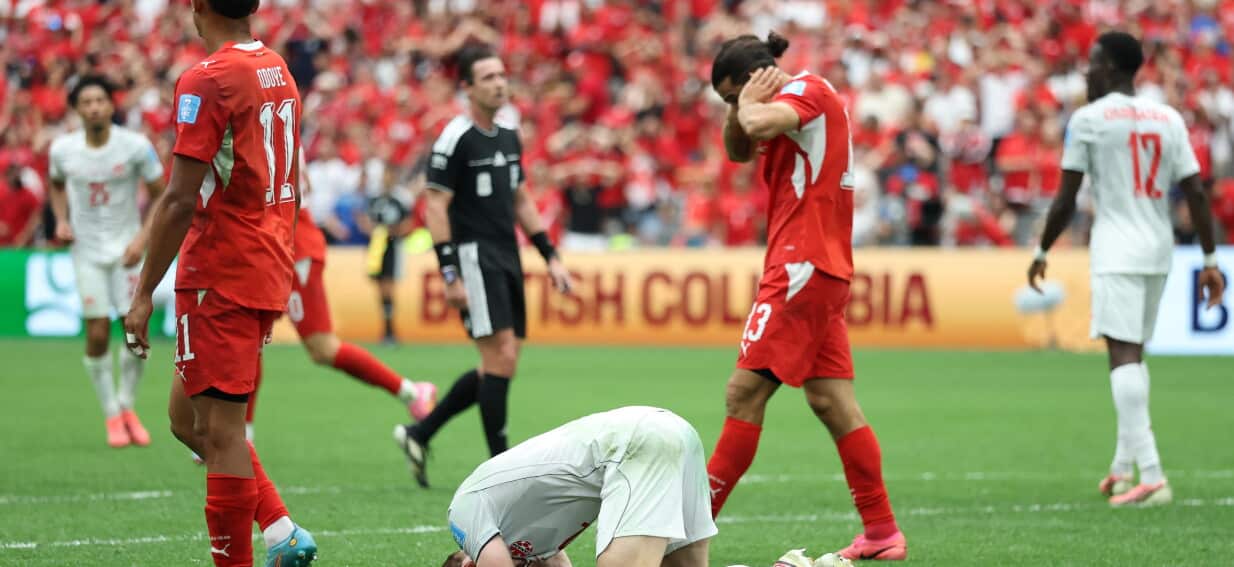
The plastic seats in the technical area are never comfortable. They are cold, rigid, and entirely unsuited for the volatile bursts of human emotion they are forced to contain. For ninety minutes, these small squares of molded polymer become the epicenter of a pressure cooker.
When Vinicius Jr. slalomed through the defense and sent the ball into the back of the net, the Brazilian bench ceased to be a collection of professional athletes and coaches. It became a singular, roaring organism. Substituted players leaped over the barriers. Assistants threw their arms toward the stadium lights. In that fleeting fragment of time, everything made sense. The tactics, the grueling training sessions under a merciless sun, the suffocating expectations of a nation that views football not as a pastime, but as a birthright—all of it validated.
Then, the whistle blew.
Not for a goal. For a review.
The human soul is not built to reverse its emotional momentum instantly. You cannot run at a full sprint into a brick wall without shattering. When the referee raised his hand, signaling the dreaded video review, the collective ecstasy on the Brazilian sideline turned into something raw, volatile, and dangerously uncontainable.
The Anatomy of the Disallowed Joy
Football used to be a game governed by the flawed, beautiful immediacy of the human eye. A linesman raised a flag, or he didn't. You cursed the sky, you moved on, or you celebrated. Today, the sport exists in a strange, purgatorial state where joy is routinely put on ice.
As the referee stared into the monitor, studying pixelated lines drawn by an unseen official in a dark room miles away, the tension on the bench warped into pure fury. Dorival Júnior, usually a stoic figure of calculated calm, paced the edge of his designated white rectangle like a caged animal. Behind him, players who had been laughing seconds earlier were now screaming at the fourth official, their veins bulging, eyes wide with the frantic disbelief of people witnessing a robbery in broad daylight.
It is easy for an observer watching on a television screen from the comfort of a couch to judge this reaction. We see millionaire athletes losing their temper over a game, and we label it unprofessionalism. We call it a lack of discipline.
But consider what happens next: the referee walks back onto the pitch, makes the television gesture with his hands, and points the other way. The goal is gone. Erased.
The fury that erupted from the Brazilian dugout wasn't just about a point on the scoreboard. It was the primal scream of a group of men realizing that in the modern era, even perfection can be retroactively edited out of existence. The invisible stakes of international football are crushing. For Brazil, a country where a draw feels like a national tragedy, a disallowed goal is a psychological earthquake. The bench didn't just complain; they raged against the cold, unfeeling machinery of modern officiating.
The Quiet Art of Stopping a Riot
We talk endlessly about tactical formations, high presses, and expected goals. We rarely talk about emotional triage.
As the assistant coaches threatened to spill over onto the pitch, pushing the boundaries of what the referee could tolerate before issuing a wave of red cards, a shift occurred. It didn't come from the manager. It came from the older heads on the squad, the veteran players who understand that anger is a luxury a team under pressure cannot afford.
Marquinhos moved through the chaotic crowd on the sideline. He didn't shout. He didn't join the protest. Instead, he gripped the jerseys of the younger, more hot-headed players, pulling them back, forcing them to look at him. His eyes weren't fixed on the referee; they were fixed on the remaining minutes on the stadium clock.
Silence can be louder than a stadium of eighty thousand screaming fans. In the middle of the storm, the veteran defender’s calm intervention served as a physical anchor. He knew what the rest of the bench had momentarily forgotten in their rage: if you spend your energy fighting the ghost of a goal that no longer exists, you will inevitably concede the one that does.
Leadership in these moments is not about inspiring speeches. It is about physical intervention. It is a hand on a shoulder, a firm shove away from an official, a collective deep breath taken under the most intense scrutiny on earth. Slowly, the shouts subsided into bitter murmurs. The players climbed back into their plastic seats. The storm passed, leaving behind a cold, focused determination.
The Residual Cold
When the final whistle eventually sounded, the disallowed goal remained the defining ghost of the match. The history books will record the final score, the statistics, and perhaps a footnote about the VAR decision. They will miss the entire point of the evening.
The real story wasn't the ball crossing the white line, nor was it the technicality that ruled it out. The real story was the terrifyingly brief distance between absolute euphoria and toxic resentment, and the immense psychological discipline required to bridge that gap without collapsing.
The Brazilian bench left the stadium with a draw, their faces grim, their answers to the press guarded and diplomatic. But the image that lingers is not of Vinicius Jr. striking the ball, nor is it the referee pointing to the center circle. It is the sight of twenty grown men, momentarily driven mad by a software decision, being pulled back from the edge of chaos by the sheer force of mutual accountability.
Modern football has successfully quantified every movement, every heartbeat, and every blade of grass. It still has absolutely no idea what to do with the human heart when it breaks in real time on the touchline.