The chalk cliffs above the Siverskyi Donets River do not just hold up the earth. They hold a thousand years of quiet. If you stand at the base of the Holy Dormition Sviatohirsk Lavra, the white walls of the monastery seem to grow directly out of the limestone, a limestone carved out by centuries of monks who wanted nothing more than to disappear into the silence of the rock.
Then the iron rain falls, and the silence shatters.
When a blast wave hits ancient masonry, it does not sound like a firecracker. It sounds like a groan from the center of the earth. The glass from the 19th-century windows does not just break; it atomizes, turning into a glittering dust that settles over the icons of saints and the faces of the terrified families huddled in the cellars below.
To read a headline about a missile strike on a Ukrainian monastery is to process a data point in a war of attrition. We see the numbers, the dates, the standard expressions of international outrage. But a number cannot capture the smell of burning beeswax mixed with cordite. It cannot describe the sight of a monk, his black robes covered in white plaster dust, sweeping up the fragments of a fresco that survived the Bolsheviks, survived the Nazis, but could not survive a Tuesday afternoon in the 21st century.
We are watching the systematic erasure of a shared human inheritance. To understand what is being lost in places like Sviatohirsk, we have to look past the military maps and look at the limestone itself.
The Underground City of Silence
Long before the modern state of Ukraine existed, before the Romanovs, before the borders of Europe were drawn and redrawn with blood, there were the caves.
Around the 11th century—though some historians argue it was even earlier—hermits dug themselves into the soft chalk hills of Donetsk. They were looking for an absolute isolation that is almost impossible for a modern mind to comprehend. No light. No sound except the dripping of water through stone. They lived in cells barely larger than a coffin, praying for the world outside.
Over the centuries, those solitary caves expanded into an subterranean labyrinth. The monks built churches inside the mountain. They carved altars out of the living rock. Above ground, magnificent blue-domed churches eventually rose, crowned with gold that caught the morning sun across the river valley. The Lavra became one of the three most sacred monastic sites in Ukraine, a place where millions of pilgrims over a millennium sought a moment of peace.
Consider the sheer physics of survival. This complex withstood the Mongol invasions. It survived being shut down by Catherine the Great. When the Soviet Union declared war on God, the monastery was turned into a sanatorium, its altars defaced, its bells silenced. Yet, the moment the totalitarian grip loosened, the monks returned. They cleaned the soot from the walls. They lit the candles again.
The monastery is not just a collection of buildings. It is a living archive of human resilience.
When the Sanctuary Becomes the Target
Let us name the reality of what happened when the shells began to fall during the escalation of the conflict. The Lavra was not a military base. It was a refugee camp.
As the surrounding towns of Sviatohirsk and Izium came under fire, local citizens did what their ancestors had done for a thousand years: they ran to the church. Nearly a thousand civilians—including hundreds of children and elderly people—packed into the monastic cellars. They slept on concrete floors, surrounded by the bones of saints resting in underground crypts.
Imagine the psychological landscape of that cellar. Above you, walls of three-foot-thick brick. Around you, the murmur of ancient prayers mixed with the crying of toddlers. And outside, the rhythmic, terrifying thud of artillery getting closer.
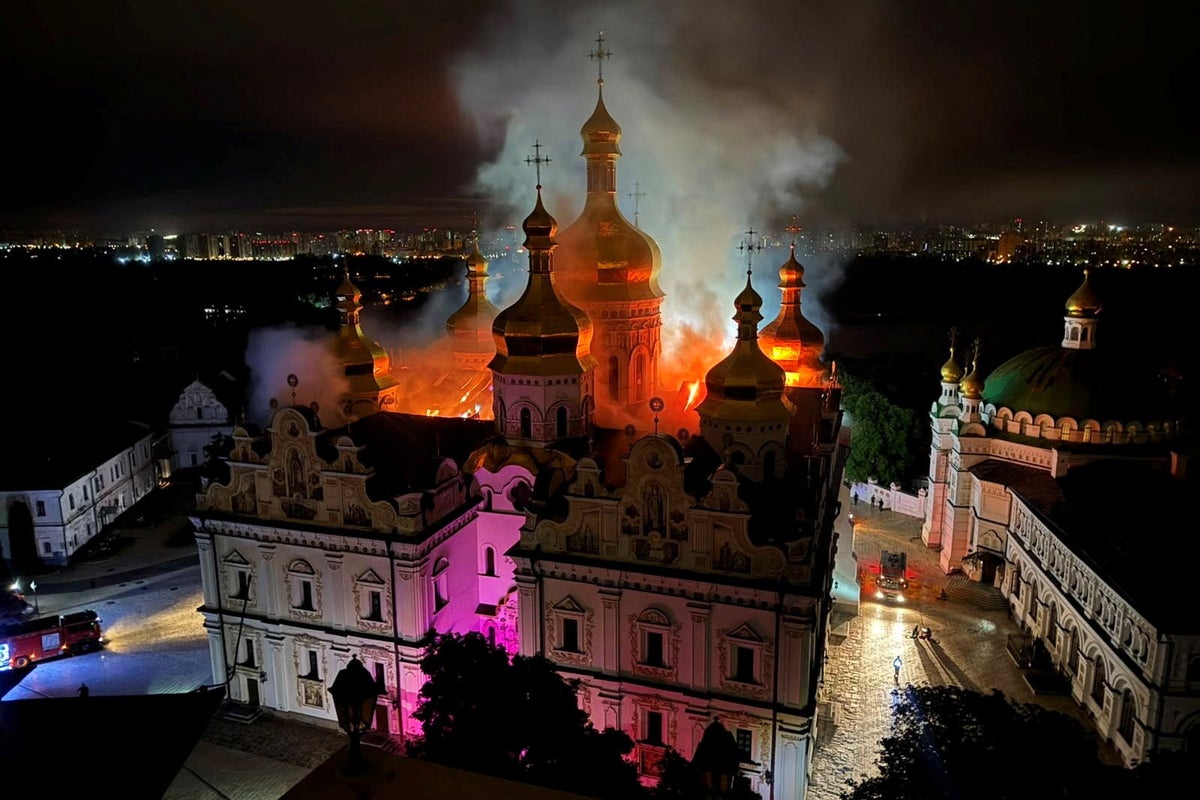
The shockwave of a heavy blast does strange things to old structures. It shakes the foundations so deeply that the mortar between the bricks begins to turn back into sand. A building that has stood for three hundred years can survive a near miss, but its skeleton is permanently weakened. When the wooden skete of All Saints—a masterpiece of traditional Ukrainian timber architecture, built without a single nail—caught fire after a strike, it did not just burn. It vanished. In a matter of hours, centuries of craftsmanship became a pillar of black smoke against the summer sky.
Some commentators have compared these strikes to the burning of Notre-Dame in Paris. The comparison is structurally accurate but emotionally incomplete. When Notre-Dame burned, it was a tragedy of neglect and accident. The world wept for the roof of Europe. But the destruction at Sviatohirsk is something different. It is intentional. It is the weaponization of history against the future.
The Invisible Costs of Cultural Erasure
There is a technical term used by international lawyers: cultural property. It sounds sterile. It sounds like something kept in a museum display case under temperature-controlled glass.
But cultural property is the glue that holds a community’s identity together. When you destroy a people's temples, their libraries, their ancient burial grounds, you are telling them that their ancestors never existed. You are telling them that they have no right to a future because their past can be wiped out with a coordinate entered into a missile guidance system.
The loss cannot be measured in the currency of reconstruction loans. You can rebuild a wall. You can buy new timber. You can even hire skilled artisans to paint new icons in the neo- Byzantine style. What you cannot replace is the continuity of devotion. You cannot manufacture the patina of ten centuries of human breath, human tears, and human hope that had settled into the very grain of the wood.
The monks who remain at the Lavra refuse to leave. They move through the debris with a quiet, stubborn defiance that is more powerful than any military rhetoric. They patch the roofs with plastic sheeting. They collect the shrapnel from the courtyard like strange, heavy pebbles.
During one of the heaviest periods of bombardment, a journalist asked an elderly monk why they did not evacuate to the west, away from the front lines. The monk looked at the shattered windows of his church, then at the river below.
"The rock does not leave," he said. "Why should we?"
The Shared Weight of the Shattered Glass
It is easy for those living thousands of miles away to view these events through a lens of detached pity. It is happening over there, in a geography that sounds foreign, in a conflict that feels endless.
But the destruction of Sviatohirsk is not a local tragedy. Every time an ancient monument is smashed by modern warfare, a piece of our collective human story is erased. We are all slightly poorer, slightly more disconnected from the long line of human striving that brought us out of the dark.
The true horror of modern warfare is not just that it kills the living. It is that it attempts to kill the dead. It tries to break the link between what was and what will be.
As the sun sets over the Donetsk region, the shadows of the chalk cliffs lengthen across the Siverskyi Donets River. The gold domes of the Lavra, scarred and dented by metal fragments, still manage to catch the last rays of light. The bells, though cracked, still ring out across the empty valley. They do not ring for victory, and they do not ring for defeat. They ring to remind anyone listening that despite the smoke, the fire, and the iron, the stone is still there.
It is still holding up the sky.