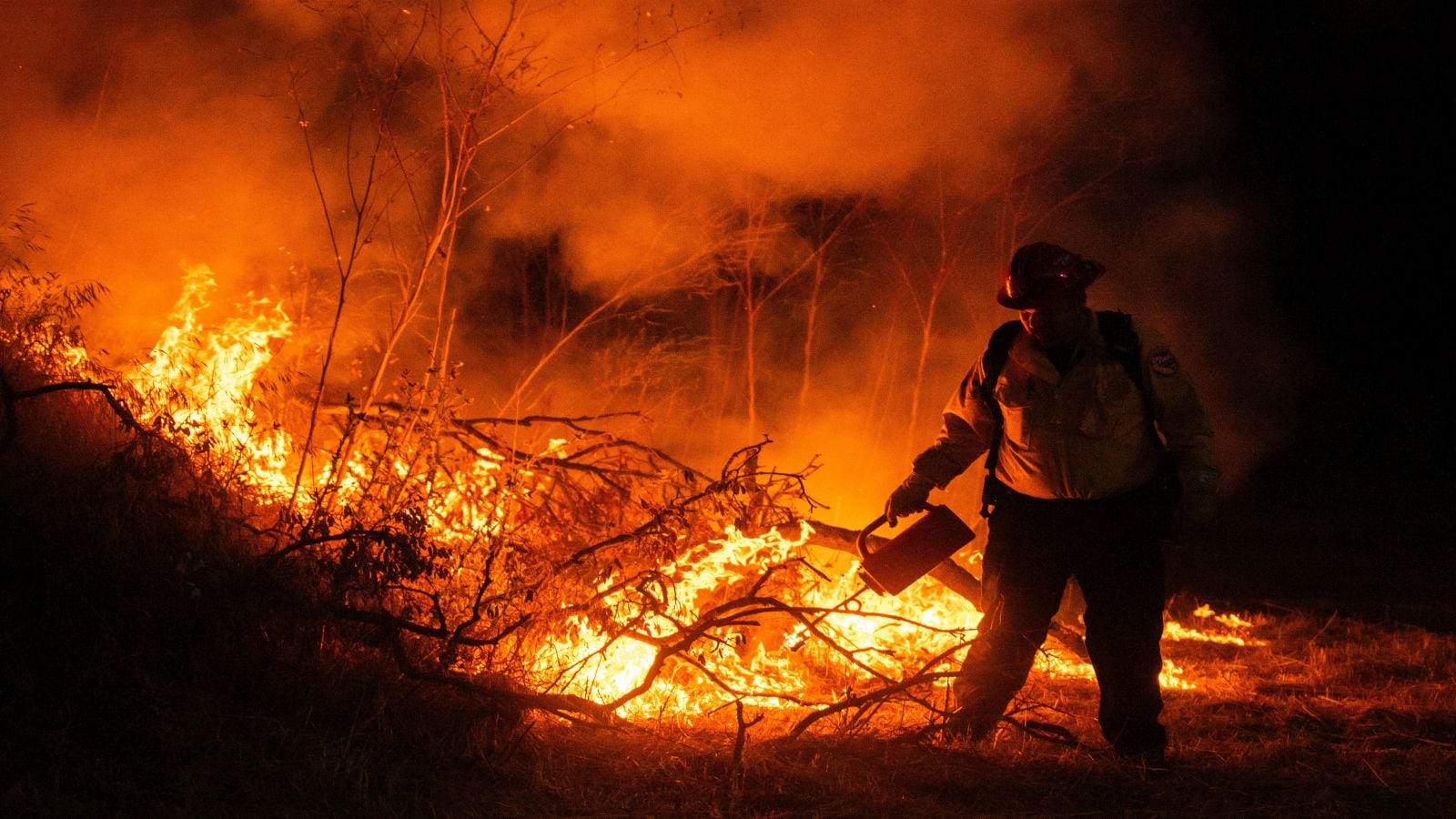
Every summer, the media runs the exact same script. Heavy, dramatic photojournalism captures glowing orange skies, columns of smoke creeping toward pristine vinyl-sided subdivisions, and fleets of bright red fire engines lined up like soldiers in a doomed game of tower defense. The narrative never changes: nature is an invading monster, suburban homes are the innocent victims, and total suppression is the only moral option.
It is a comforting, dramatic story. It is also entirely wrong.
The lazy consensus driving mainstream coverage of California’s wildfire crises treats these events as unprecedented, unpredictable anomalies. We look at photos of thousands evacuating near suburban fringes and blame climate change or bad luck. But if you spend decades studying land-use economics and fire ecology, you realize the real culprit isn't a spark in the brush. It is a fundamental refusal to accept the geography of the American West.
We are not fighting natural disasters. We are subsidizing real estate delusions.
The Myth of the Innocent Suburb
The media loves to showcase the Wildland-Urban Interface (WUI) as a frontier under siege. In reality, the WUI is a zone of self-inflicted vulnerability.
For nearly a century, local governments across the Western United States have permitted aggressive residential expansion into ecosystems that are biologically designed to burn. Chaparral and mixed-conifer forests are not static backdrops for luxury housing; they are fire-dependent landscapes. Trying to eliminate fire from these regions is like trying to ban rain from the Pacific Northwest.
When developers build a master-planned community deep into the canyons of Ventura County or the foothills of the Sierra Nevada, they are ticking a countdown clock. Yet, when the inevitable happens, the public treats it as an act of God.
Consider the basic physics of modern suburban construction. We build homes out of highly combustible materials, pack them tightly together, and surround them with ornamental, non-native vegetation that acts as kindling. Then we act surprised when a single ember carried by the Santa Ana winds turns a cul-de-sac into an oven.
The photos of firefighters standing on roofs with garden hoses are heroic, but they mask a brutal reality: we are burning through billions of taxpayer dollars to defend properties that should never have been built in the first place.
The Fire Suppression Trap
To understand why the status quo is broken, look at the concept of the "fire deficit."
By aggressively extinguishing every single ignition for more than a century—a policy popularized by the U.S. Forest Service’s historic "10 a.m. rule," which mandated that every fire be suppressed by the morning after it was reported—we have created an artificial landscape.
Historically, low-intensity fires regularly cleared out underbrush, dead wood, and small trees. This natural grooming kept the fuel load manageable. Because we stopped those smaller, healthier burns, our forests and hillsides are now choked with unprecedented amounts of dry biomass.
When a fire finally escapes containment today, it is no longer a manageable surface burn. It becomes a catastrophic canopy fire, burning so hot that it sterilizes the soil and vaporizes communities.
[ century of total suppression ] ➔ [ massive accumulation of dry fuel ] ➔ [ uncontrollable megafires ]
When the media panics over thousands of people fleeing suburban homes, they are looking at the bill coming due for a century of ecological debt. Suppressing fires to protect suburban investments only ensures that the next fire will be larger, faster, and more destructive. We are trading short-term property protection for long-term regional catastrophe.
Who Actually Pays for the Ashes?
The economics of California wildfire management are fundamentally warped by moral hazard.
Local municipalities reap the benefits of expansion. They get increased property tax revenues from shiny new hillside developments. However, they do not bear the full cost of defending those developments from fire. When a megafire threatens a subdivision, the financial burden of fighting that fire falls primarily on federal and state agencies—meaning taxpayers across the entire country are footing the bill to protect a handful of high-risk homes.
If local governments were forced to pay 100% of the cost to deploy air tankers, hotshot crews, and emergency management infrastructure for WUI developments, building permits in high-risk zones would dry up overnight.
Instead, state-backed insurance programs step in to artificially stabilize the market when private insurers inevitably flee. This shields homeowners and developers from the true financial risk of their geographic choices. We have created a system where risk is socialized, and profit is privatized.
Dismantling the Ignorant Questions
When a fire breaks out, the public and the media ask the wrong questions. Let's dismantle the most common ones.
How do we stop these fires from reaching our communities?
You don't. The premise is flawed. You cannot stop wind-driven ember blizzards in a Mediterranean climate. Instead of asking how to stop the fire, we must ask how to build communities that can let a fire pass through them without burning down.
This requires strict, retrofitted building codes: mandated ember-resistant vents, completely non-combustible roofing, and the mandatory removal of all vegetation within five feet of any structure. If a home cannot survive a wildfire without a fire truck parked in the driveway, that home is a failure of engineering.
Why can't we just clear all the brush around suburban areas?
Defensible space matters, but clearing brush at the edge of a subdivision does nothing when wind-blown embers can jump two miles ahead of the main fire front. Mechanical thinning and prescribed burns are highly effective tools, but they require massive scale across millions of acres, not just a thin strip of cleared grass behind a backyard fence. Furthermore, aggressive clearing often replaces native, fire-adapted chaparral with highly flammable invasive grasses, actually increasing the speed at which fire spreads.
The Cost of the Counter-Intuitive Truth
Admitting the truth about California’s wildfire reality is painful. It requires acknowledging that certain geographic regions are fundamentally incompatible with high-density suburban living.
The hard, contrarian solution isn't popular. It involves:
- Instituting permanent bans on new residential development within high-severity fire zones.
- Phasing out state-subsidized insurance programs that artificially lower the cost of living in danger zones.
- Implementing managed retreat—buying out property owners in chronically impacted fire corridors and returning that land to nature.
This approach has clear downsides. It exacerbates housing shortages in an already expensive state. It depresses property values for families who invested their life savings into hillside homes. It hurts the tax base of rural and suburban counties.
But the alternative is worse. The alternative is continuing to watch the same slow-motion disaster play out every season, pretending each time that it's a shock, while putting the lives of emergency personnel on the line to defend indefensible real estate.
Stop looking at the evocative evacuation photos as tragedies of fate. Start looking at them as balance sheets of bad policy. We need to stop fighting nature and start managing our own boundaries. If we refuse to build intelligently, we need to get out of the way and let it burn.