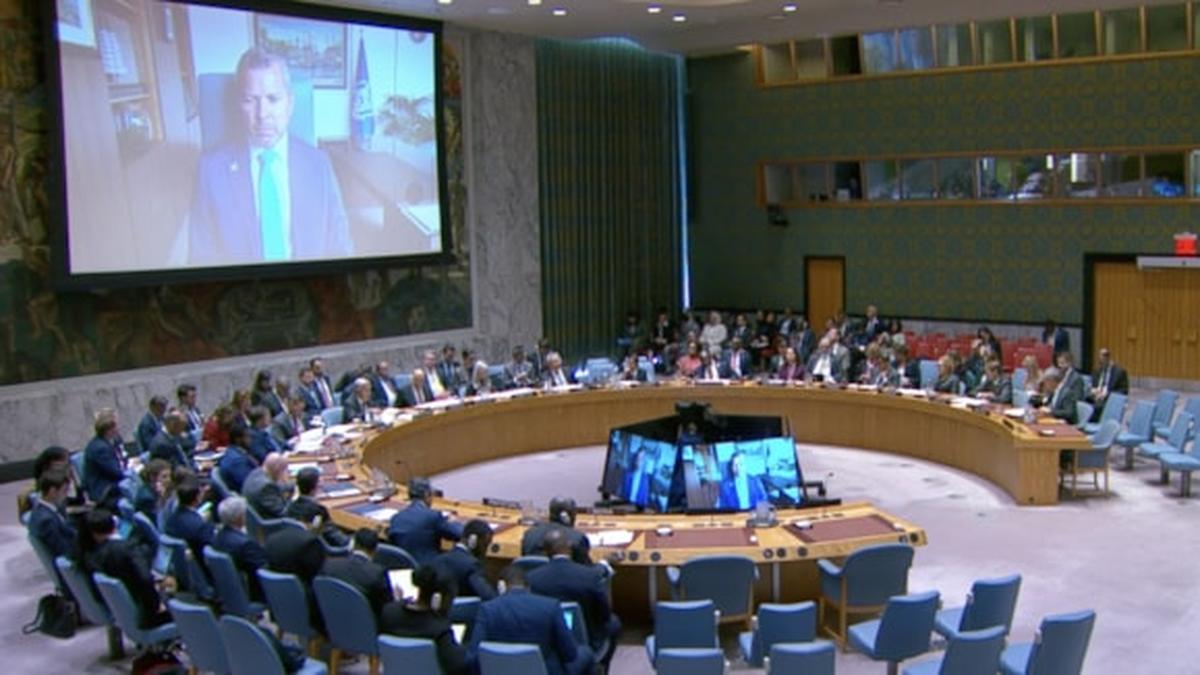
The International Maritime Organization (IMO) just spent a week at the UN Security Council clutching pearls over "non-negotiable" freedom of navigation in the Strait of Hormuz. It is a charming sentiment. It is also a lie. Navigation in the world’s most volatile chokepoint has never been "free." It is a leased privilege, paid for in blood, insurance premiums, and the quiet acquiescence of global powers to a status quo that hasn't existed since the 1980s.
If you believe the official briefings, the Strait is a global commons protected by international law. In reality, it is a 21-mile-wide toll booth operated by geography and enforced by asymmetrical drone swarms. The "lazy consensus" dictates that if we just wag a finger at regional bad actors and cite the UN Convention on the Law of the Sea (UNCLOS), the tankers will keep sliding through. For another look, consider: this related article.
They won't. The era of the "global maritime police" is over. We are entering the age of the Maritime Mercantilist.
The UNCLOS Fallacy
The industry loves to cite UNCLOS like it is the Ten Commandments. Here is the problem: Iran has signed it but never ratified it. The United States hasn't even signed it. We are basing the entire security of the global energy supply—roughly 20% of the world’s petroleum—on a legal framework that the two primary antagonists in the region don't fully acknowledge. Similar coverage on this trend has been shared by MarketWatch.
When the IMO talks about "maritime safety," they are using 20th-century vocabulary for a 21st-century kinetic reality. You cannot litigate a sea-mine. You cannot "address" a loitering munition with a subcommittee report. The maritime industry’s reliance on international norms is a dangerous hedge against the fact that we have outsourced our logistics security to hope.
The Insurance Racket is the Real Regulator
Forget the UN. If you want to know who actually controls the Strait of Hormuz, look at the Lloyd’s Market Association’s Joint War Committee.
When a "security incident" occurs, the IMO issues a statement. The insurers, however, redraw the boundaries of the "Listed Areas." Once a vessel enters those coordinates, the owner pays a "war risk" additional premium. These premiums don't just reflect risk; they dictate the viability of global trade.
We saw this in 2019 after the attacks on the Front Altair and Kokuka Courageous. Rates didn't just tick up; they spiked tenfold in some cases. The "freedom" of navigation is actually a variable-rate subscription model. If you can’t pay the premium, you don't sail. If you don't sail, the "non-negotiable" right to passage is irrelevant. The industry is currently pretending that risk is an anomaly. I’ve seen shipping giants hemorrhage cash trying to maintain schedules in "high-risk" zones while their C-suite treats the crisis as a temporary political flare-up. It isn’t. It’s the new overhead.
The Myth of Naval Supremacy
The maritime establishment operates on the assumption that a carrier strike group can "keep the lanes open." This is a fundamental misunderstanding of modern naval architecture.
A billion-dollar destroyer is a magnificent piece of engineering. It is also an inefficient tool for swatting away a $20,000 fiberglass speedboat packed with C4 or a swarm of low-cost Shahed drones. We are witnessing a massive disparity in the "cost of denial" versus the "cost of protection."
To protect a single VLCC (Very Large Crude Carrier), a navy must be right 100% of the time. An aggressor only has to be lucky once. By focusing on "freedom of navigation" as a military objective, we are playing a game of attrition that the West is designed to lose. The math doesn't work.
$$Cost\ of\ Defense \gg Cost\ of\ Attack$$
When the cost of defending a chokepoint exceeds the economic value of the cargo passing through it, the "freedom" of that route expires. We aren't there yet, but the gap is closing.
Stop Fixing the Strait, Fix the Supply Chain
The "People Also Ask" sections of maritime forums are filled with variations of "How can we make the Strait of Hormuz safer?"
That is the wrong question. The right question is: "How do we make the Strait of Hormuz irrelevant?"
The obsession with keeping this specific 21-mile stretch "free" has blinded the industry to the necessity of radical diversification. We see this in the slow-walked development of the East-West Pipeline in Saudi Arabia or the lack of investment in the Habshan–Fujairah pipeline. The industry would rather complain to the UN than build the infrastructure required to bypass the chokepoint entirely.
True "freedom of navigation" isn't the right to sail through a gauntlet; it’s the ability to choose a different path.
The Drone Shadow
The IMO’s rhetoric completely ignores the democratization of sea-denial technology. It used to take a nation-state with a sophisticated navy to close a strait. Now, it takes a motivated group with a 3D printer and basic GPS guidance.
The "security" of the Strait is currently being managed by AIS (Automatic Identification System) spoofing and "dark fleets." This isn't a solution; it’s a symptom of a broken system. When tankers have to pretend they are in the Indian Ocean while they are actually loading at Kharg Island, the concept of a "regulated maritime environment" has already collapsed.
The Brutal Reality of "Safe Passage"
Let’s be clear about what "non-negotiable" actually means in 2026. It means that the U.S. Fifth Fleet and its allies will continue to expend millions of dollars per day to provide a subsidy to the global oil market.
If the IMO were honest, they would admit that freedom of navigation is a subsidized luxury. If the true cost of securing the Strait were added to the price of a barrel of oil, the global economy would pivot to renewables or nuclear overnight. We maintain the "freedom" of the Strait because the alternative—admitting that we are hostage to geography—is too terrifying for the markets to digest.
The Strategy for the New Maritime Disorder
- Accept the Risk Premium: Stop treating war risk premiums as a "black swan" event. They are a permanent feature of the Hormuz logistics model. Price your contracts accordingly.
- Asymmetrical Defense: Shipping companies need to stop waiting for a naval escort that may never come. Investment in non-kinetic, on-board electronic warfare and advanced sensing is no longer optional.
- Diversification or Death: If your entire business model relies on the "freedom" of a chokepoint controlled by a hostile regime, you don't have a business; you have a hostage situation.
The IMO's address to the UN was a funeral oration for an era that ended years ago. The Strait isn't a highway; it's a contested alleyway. Stop pretending the law protects you. Only your ability to navigate the chaos does.
The "freedom" you’re looking for doesn't exist. Get used to the price of the toll.