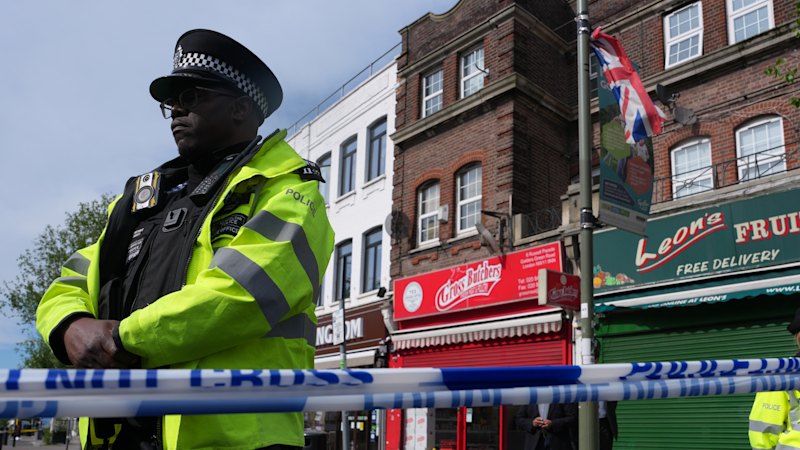
The decision by the Joint Terrorism Analysis Centre (JTAC) to elevate the UK national threat level from "Substantial" to "Severe" represents a shift in the calculated probability of an attack rather than a mere reaction to a localized event. While the stabbing of two Jewish men serves as the immediate catalyst, the internal logic of this escalation is rooted in a three-factor assessment: the shift from organized cells to self-directed actors, the compression of the radicalization timeline, and the contagion effect within polarized domestic environments. A "Severe" rating indicates that an attack is highly likely, moving the operational posture of the state from monitoring to active disruption.
The Triad of Threat Assessment Logic
Threat levels are not determined by public sentiment or political optics. They are the result of a rigorous intelligence methodology that weighs specific variables against the current security environment. In related developments, take a look at: The Hidden Cost of the Ultimate Deal.
1. The Intent-Capability Vector
Security services measure threat through the intersection of intent and capability. In the context of the recent attacks, the intent is identified through ideological alignment and target selection—specifically the targeting of the Jewish community. The capability, however, has become increasingly difficult to quantify. Unlike legacy terrorism which required "hard" capabilities like explosives or sophisticated weaponry, the current threat landscape relies on "soft" capabilities. The use of bladed weapons or vehicles creates a low barrier to entry, making the intent-capability gap almost non-existent. When the tools for an attack are everyday items, the "flash-to-bang" period—the time between the decision to act and the execution—shrinks to near zero.
2. The Contagion and Mimicry Factor
Violence often functions as a signal to other potential actors. A successful or highly publicized attack validates the methodology and the ideology for individuals already on the periphery of radicalization. This creates a feedback loop where one event increases the statistical probability of a follow-up "copycat" incident. JTAC’s decision to raise the threat level acknowledges that the initial stabbing has likely lowered the psychological threshold for other volatile actors to move from thought to action. NPR has provided coverage on this critical subject in great detail.
3. Intelligence Saturation and Visibility
A "Substantial" threat level implies that an attack is a strong possibility and that intelligence assets have a degree of visibility into known threats. The shift to "Severe" suggests a loss of visibility or an "intelligence gap." When attacks are carried out by individuals with no prior history of surveillance—often referred to as "low-footprint actors"—the traditional signals used to prevent violence disappear. Raising the level is a strategic admission that the current volume of "chatter" or the decentralization of the threat has exceeded the capacity of standard surveillance protocols.
The Economic and Operational Cost of Escalation
Raising the threat level triggers a cascade of mandatory operational changes across the public and private sectors. These are not suggestions; they are structural requirements that incur significant resource costs.
- Police Resource Reallocation: A "Severe" rating necessitates a shift from community-oriented policing to high-visibility tactical patrols. This requires the cancellation of leave and the payment of overtime, straining municipal budgets.
- Critical National Infrastructure (CNI) Hardening: Operators of power plants, transport hubs, and government buildings must activate secondary security tiers. This includes increased physical searches, the deployment of additional K9 units, and the activation of more rigorous access control systems.
- Private Sector Friction: Retail environments and public venues must increase their security spend. The "security tax" on business operations increases as staff are diverted from service to surveillance, and the psychological impact on consumers can lead to a measurable dip in foot traffic in high-density urban areas.
The Specificity of Antisemitic Targeting
The attack on two Jewish men is not an isolated criminal act but a data point in a broader trend of targeted sectarian violence. In threat modeling, targeting a specific demographic serves two purposes for the perpetrator: it ensures a high degree of media penetration and it triggers a predictable counter-reaction from the targeted community and its allies. This tension is a force multiplier for the attacker, as it degrades social cohesion and forces the state to divert even more resources to protect specific sensitive sites, such as synagogues and community centers.
The mechanism at play here is "cumulative radicalization," where the rhetoric of one extreme group fuels the recruitment and aggression of another. By targeting a minority community, the actor intends to create a cycle of grievance that is self-sustaining. For the state, the challenge is to protect these high-risk nodes without creating an environment that feels like a state of siege, which would inadvertently fulfill the attacker's goal of disrupting normal life.
Structural Vulnerabilities in Public Spaces
The recent events highlight a fundamental flaw in modern urban design: the reliance on "soft" targets for economic vitality.
- Permeability: High-street environments are designed for ease of movement. This same permeability makes them indefensible against low-tech attacks.
- Crowd Density: Large gatherings are the primary objective for actors seeking high-impact results with low-tech tools.
- The Response Time Paradox: While the UK's armed response units are among the fastest in the world, the duration of a bladed weapon attack is often measured in seconds. The damage is frequently done before the first 999 call is even processed.
This reality necessitates a move toward "Hostile Vehicle Mitigation" (HVM) and "Security by Design," where the physical environment itself acts as a passive deterrent. However, these are long-term structural fixes that do nothing to address the immediate heightened threat.
The Predictive Failure of "Lone Actor" Theory
The term "lone wolf" is often used to describe these attackers, but from a strategic perspective, it is a misnomer. No actor is truly alone; they are the terminal point of an online ecosystem that provides the ideological framework and tactical encouragement. The failure of intelligence models often stems from treating these individuals as outliers rather than as the most visible nodes of a distributed network.
The data indicates that most "lone" actors have leaked their intentions to friends, family, or online associates prior to the event. The bottleneck is not a lack of information, but the "signal-to-noise" ratio. In a "Severe" threat environment, the state’s primary objective is to lower the threshold for reporting these "weak signals." This explains the aggressive public information campaigns that accompany a threat level rise; the government is attempting to crowdsource the intelligence gathering that its technical systems can no longer guarantee.
Operational Directives for Risk Management
Organizations and individuals must move from a passive awareness to an active defensive posture. This involves a cold-eyed assessment of current vulnerabilities.
- Audit Access Control: Every entry point that is not strictly necessary for operations should be secured. In a "Severe" environment, convenience must be sacrificed for containment.
- Internalize "Run, Hide, Tell": This protocol must be treated with the same rigor as fire safety training. The survival of individuals in a low-tech attack is almost entirely dependent on their immediate reaction in the first 30 seconds.
- Monitor the Information Environment: Disinformation during a period of high threat is a tool used by bad actors to sow confusion. Organizations should rely only on official police and Home Office channels for operational guidance.
The current escalation is a high-stakes recalibration. It signals that the UK is entering a period where the statistical probability of violence has moved from a conceptual risk to an operational certainty. The success of the state's response will not be measured by the absence of incidents—as preventing every low-tech attack is a mathematical impossibility—but by the speed of containment and the resilience of the social fabric under deliberate strain. Effective strategy now dictates a transition toward hyper-vigilance and the hardening of communal infrastructure to minimize the utility of future attacks.