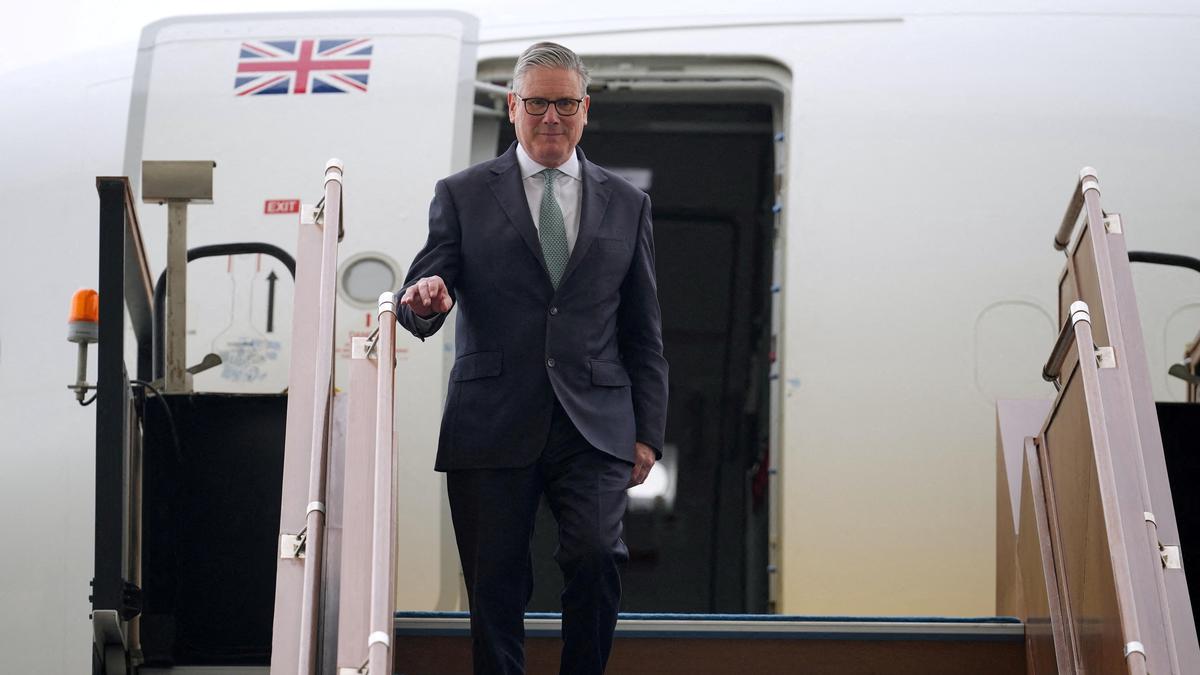
The decision by Prime Minister Keir Starmer to withhold British support for a naval blockade of the Strait of Hormuz is not a gesture of isolationism, but a calculated alignment with the principles of maritime law and global supply chain stability. In the context of escalating regional tensions, the UK government has identified that the marginal security gain of a blockade is outweighed by the exponential increase in insurance premiums, energy price volatility, and the legal erosion of "innocent passage" rights.
The Strait of Hormuz serves as the world’s most significant oil transit chokepoint. Approximately 21 million barrels of oil flow through this 21-mile-wide waterway daily, representing roughly 21% of global liquid petroleum consumption. A blockade, by definition, is an act of war. For the United Kingdom—a nation whose economy is structurally reliant on the "just-in-time" delivery of Liquefied Natural Gas (LNG)—the disruption of this artery would trigger a cascading failure of domestic energy pricing mechanisms.
The Trilemma of Maritime Intervention
To understand the UK's position, one must analyze the strategic trilemma facing Downing Street. The government must balance three conflicting objectives:
- Freedom of Navigation: Upholding the United Nations Convention on the Law of the Sea (UNCLOS), which grants ships the right of transit through international straits.
- Special Relationship Obligations: Maintaining military and diplomatic interoperability with the United States.
- Domestic Economic Insulation: Protecting the British consumer from the "energy shock" transmitted through the Dutch Title Transfer Facility (TTF) and Brent Crude benchmarks.
A blockade violates the first objective, complicates the third, and offers only a volatile fulfillment of the second. Starmer’s refusal to back a blockade suggests that the UK has prioritized the preservation of international legal norms over temporary tactical pressure.
The Economic Physics of the Chokepoint
The Strait of Hormuz is a unique geographical constraint where the navigable channels are only two miles wide in each direction. This physical reality dictates the economic consequences of any military posture.
The War Risk Premium Mechanism
Shipping costs are not static; they are governed by insurance assessments. When a blockade is proposed or implemented, the Joint War Committee (JWC) of the London insurance market reevaluates the "Listed Areas." A formal UK-backed blockade would immediately move the entire Persian Gulf into a high-risk category. This results in:
- Additional Premium (AP): Shipowners are charged a percentage of the hull value for every seven days spent in the zone.
- Freight Rate Spikes: As fewer tankers are willing to enter the Gulf, the supply of available tonnage drops, causing the cost of chartering a Very Large Crude Carrier (VLCC) to decouple from standard market fundamentals.
The LNG Feedback Loop
While much of the focus remains on oil, the UK’s vulnerability lies in LNG. Qatar is one of the UK’s largest suppliers of LNG. Unlike oil, which can be drawn from Strategic Petroleum Reserves (SPR), LNG infrastructure is rigid. A blockade at Hormuz creates an immediate physical shortage that cannot be mitigated by domestic production in the North Sea or imports from Norway in the short term. The resulting price spike would be instantaneous, bypassing the usual 30-day lag seen in retail fuel prices.
Legal Precedents and the Erosion of UNCLOS
The UK's refusal to participate also stems from a long-term interest in the stability of maritime law. Article 38 of UNCLOS dictates the right of transit passage. By endorsing a blockade, the UK would create a legal precedent that hostile states could cite to justify closing other critical waterways, such as the Strait of Malacca or the Bab el-Mandeb.
The distinction between "Maritime Security Operations" (MSO) and a "Blockade" is fundamental. The UK currently participates in MSO via Operation Kipion, providing escorts for British-flagged vessels. This is a defensive posture designed to ensure safety. A blockade is an offensive denial of access. Shifting from the former to the latter would signal a transition from a rules-based enforcer to a kinetic participant, effectively ending the UK's role as a mediator in regional maritime disputes.
Operational Limitations of the Royal Navy
A data-driven assessment of the Royal Navy’s current deployment capacity reveals a "bottleneck of persistence." To maintain a credible blockade, a navy must have:
- Continuous Presence: A 24/7 monitor of all vessel movements.
- Enforcement Capability: The ability to board, inspect, and divert non-compliant tankers.
- Layered Defense: Protection against asymmetric threats such as fast-attack craft, sea mines, and anti-ship cruise missiles.
The Royal Navy’s current escort fleet—primarily Type 23 frigates and Type 45 destroyers—is already stretched across the Atlantic, the Mediterranean, and the Indo-Pacific. Committing the necessary assets to sustain a blockade in the Strait of Hormuz would require the withdrawal of ships from other high-priority missions, creating security vacuums elsewhere. Furthermore, the high-salinity and high-temperature environment of the Gulf places extreme mechanical stress on propulsion systems, specifically the WR-21 gas turbines on the Type 45s, which have historically faced reliability issues in these conditions.
The Failure of "Maximum Pressure" via Blockade
Historical analysis of naval blockades suggests they are rarely effective at changing the behavior of a target state without an accompanying land-based strategy. In the case of the Persian Gulf, a blockade often triggers the "Tanker War" phenomenon seen in the 1980s.
During the Iran-Iraq War, attacks on merchant shipping did not stop oil flows; they merely increased the cost and forced the use of convoys. A modern blockade would likely result in the deployment of "ghost fleets"—uninsured, shadow-market tankers that operate outside of international norms—thereby reducing the visibility and safety of the waterway even further. By rejecting the blockade, Starmer avoids incentivizing the growth of this unregulated maritime sector.
Strategic Alternatives to Kinetic Closure
The UK strategy appears to be shifting toward "enhanced monitoring and collective attribution" rather than physical denial. This framework involves three pillars:
- Intelligence Integration: Utilizing the UK Maritime Trade Operations (UKMTO) office in Dubai to provide real-time data to commercial operators, allowing them to self-correct routes based on risk.
- Diplomatic De-escalation: Leveraging the UK’s unique position as a permanent member of the UN Security Council with historical ties to Gulf monarchies to negotiate "Red Lines" regarding shipping safety.
- Technological Hardening: Encouraging the adoption of automated identification system (AIS) spoofing defenses and increased onboard private security for high-value transits.
The Geopolitical Cost-Benefit Analysis
If the UK were to join a blockade, the diplomatic cost would be measured in the loss of influence within the "E3" (UK, France, Germany) grouping. Both France and Germany have consistently signaled a preference for de-escalation in the Middle East to prevent a refugee crisis and ensure energy security. A unilateral or US-UK blockade would fracture the European consensus, leaving the UK isolated in its trade policy while bearing a disproportionate share of the security burden.
The second-order effect of a blockade is the acceleration of "de-dollarization" and the search for alternative trade routes. China, a primary importer of Iranian crude, would view a Hormuz blockade as a direct attack on its energy security. This would likely drive Beijing to expedite land-based pipelines and the "Polar Silk Road," permanently shifting the center of gravity away from Western-controlled maritime routes.
Quantifying the Risk of Miscalculation
The primary danger in any blockade scenario is the "escalation ladder."
- Step 1: Verbal threats of closure.
- Step 2: Harassment of merchant vessels.
- Step 3: Seizure of a single tanker (the current status quo).
- Step 4: A formal naval blockade.
- Step 5: Kinetic strikes on coastal defense batteries and naval bases.
By refusing to move to Step 4, the UK is attempting to cap the escalation at Step 3. This acknowledges that once Step 4 is taken, the transition to Step 5 becomes almost inevitable as the blockading force must neutralize the target state’s ability to retaliate against the blockading ships.
Strategic Recommendation
The United Kingdom must maintain its current trajectory of "defensive escort" while aggressively expanding its domestic energy storage capacity to reduce the leverage of the Hormuz chokepoint. The strategic priority should not be the closure of the Strait to adversaries, but the hardening of the UK economy against the inevitable volatility that occurs whenever the Strait is threatened.
Future naval procurement must prioritize "high-endurance, low-cost" platforms like the Type 31 frigate to ensure that the Royal Navy can maintain a persistent presence in the region without exhausting its high-end air-defense assets. The Starmer administration’s refusal to support a blockade is a recognition that in modern geopolitics, the ability to keep a trade route open is a far greater display of power than the ability to shut it down.