The dew is still on the ferns when the morning patrol begins. At 6:00 AM, the valley is completely silent, save for the rhythmic crunch of boots on gravel and the sharp, metallic snap of a litter picker opening and closing.
For the rangers who care for the nation’s most cherished landscapes, this is the golden hour. It is the brief window of time before the car parks fill, before the disposable barbecues are lit, and before the beauty spots of the National Trust are transformed into open-air waste bins.
Most people see these places—the rolling hills of the Peak District, the rugged cliffs of Cornwall, the quiet banks of the Lake District—as timeless. We treat them as permanent sanctuaries, untouched by the chaos of modern life. But they are incredibly fragile. Right now, that fragility is being tested to a breaking point. A quiet crisis is unfolding across our countryside, driven not by industrial polluters, but by us.
The Anatomy of an Aftermath
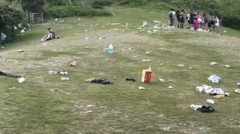
To understand the scale of the problem, you have to look at what remains after a sunny weekend.
Imagine a pristine meadow. Now, look closer.
Underneath a canopy of ancient oaks sits a melted patch of scorched earth. A cheap, single-use aluminum tray rests nearby, its charcoal still smoldering. Scattered around it are the plastic wrappers of burger buns, empty beer cans, wet wipes that will take a century to decompose, and a shattered glass bottle.
This isn't a hypothetical scene. It is the exact inventory collected by National Trust staff on any given Monday morning. During peak summer months, rangers spend up to a third of their working days simply clearing up after visitors. Think about that. One-third of a conservationist's time—time that should be spent repairing dry-stone walls, monitoring endangered wildlife, and planting trees—is swallowed by the Sisyphean task of picking up crisp packets.
The numbers tell a staggering story. Across the properties managed by the Trust, thousands of bags of rubbish are collected every single week. In some of the most popular beauty spots, the volume of waste increased by over 100 percent in recent years. It is a tidal wave of plastic and aluminum choking the very places we claim to love.
But the true cost isn't measured in bags of garbage or hours wasted. The true cost is paid by the creatures that call these spaces home.
The Invisible Casualties
A hedgehog does not understand what a plastic multi-pack ring is. To a foraging mammal, it is just a strange, unyielding obstacle.
When left in the undergrowth, that ring becomes a noose.
Consider the deer that grazes on a hillside, swallowing a discarded sandwich wrapper that smells of food. The plastic blocks its digestive tract. The animal dies slowly, starved from the inside out despite a belly full of synthetic material. Shards of broken glass left in the grass cut through the paws of badgers and foxes, leading to infections that are frequently fatal.
Then there is the fire risk.
A disposable barbecue takes hours to cool down. When a visitor buries it under a thin layer of sand or leaves, thinking they have hidden it, the heat remains trapped. In dry conditions, it acts like a slow-burning fuse. Entire acres of rare heathland, home to nesting birds and rare reptiles, have been wiped out in an afternoon because someone wanted a warm burger in the wild.
It is easy to blame a faceless group of "litterbugs." We like to imagine them as malicious actors, deliberately destroying the environment out of spite. The reality is far more uncomfortable. Most of this destruction is born of apathy and a profound disconnection from the natural world.
The Myth of the Magic Fairy
There is a strange psychological phenomenon that happens when people enter a park or a nature reserve. They see a bin, notice it is completely overflowing, and decide to pile their rubbish next to it anyway. Or worse, they tie a bag of dog waste to a tree branch like a grim piece of fruit.
Why? Because of a subconscious belief in what rangers call the "magic fairy."
We assume that because an area is managed, someone is always right behind us to clean up. We treat the wilderness like a restaurant where we can leave our dirty dishes on the table for the staff to clear. But a National Trust site is not a restaurant. It is a living, breathing ecosystem. When a bin fills up, the wind catches the excess plastic and scatters it across miles of habitat before a ranger can physically reach it. Birds and small rodents rip the bags open within minutes, looking for scraps.
The solution seems agonizingly simple: if you brought it with you, take it home. Yet, this basic tenet of outdoor etiquette is fraying.
The issue lies in how we view our relationship with nature. We have come to see the great outdoors as a consumer product. We travel to a beauty spot to consume the view, take a photograph for social media, and leave once we have extracted its aesthetic value. We take everything we can get, but we feel no responsibility to give anything back, not even our own absence of impact.
Rewriting the Unwritten Contract
We are at a crossroads. The National Trust is appealing to the public because the current trajectory is unsustainable. Budgets are finite. Human resources are stretched thin. If we continue to treat our heritage sites as dumps, the very qualities that make them worth visiting will vanish.
Changing this requires a shift in perspective. We must move from being consumers of the countryside to being its custodians.
The next time you pack a bag for a day in the hills, plan for its entire lifecycle. Bring a dedicated bag for your rubbish. Choose reusable containers instead of single-use plastics. If you see a piece of litter that isn't yours, pick it up. It takes a village to protect these spaces, and every small action ripples outward.
The sun begins to dip below the horizon, casting long, golden shadows across the valley. The crowds have gone, leaving behind a landscape that looks, from a distance, completely untouched. But down in the long grass, the plastic wrappers remain, waiting for the wind, waiting for an animal, or waiting for a tired pair of hands to pick them up.
Nature gives us everything for free. The least we can do is leave it exactly as we found it.