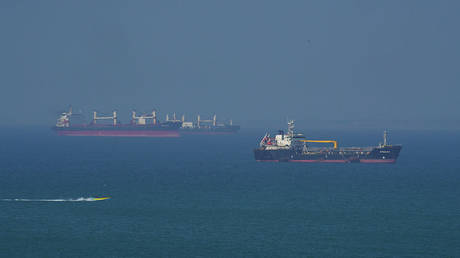
The salt air in the Strait of Hormuz doesn’t smell like adventure. It smells like diesel and anxiety. At its narrowest point, the water is only 21 miles wide. That is a tiny, fragile throat through which a third of the world’s liquefied natural gas and a quarter of its total oil consumption must pass. If you turn on a light in London or start a car in Tokyo, there is a statistical certainty that the energy powering your life once floated through this specific, sun-scorched squeeze of blue.
For decades, the passage has been governed by international law—the right of "transit passage" that allows ships to move through territorial waters so long as they keep moving. But a new, invisible tax is being levied. The United States government recently sounded a klaxon, warning the global shipping industry that paying "transit fees" to Iranian authorities for passage through these waters isn’t just a cost of doing business. It is a violation of international sanctions.
It is a shakedown at the world’s most important gate.
The Captain’s Dilemma
Consider a hypothetical master of a Suezmax tanker, let’s call him Elias. He is responsible for a vessel worth $100 million and a cargo worth even more. He is standing on the bridge, squinting against the Persian Gulf glare. His sensors pick up an Iranian patrol boat approaching. The request comes over the radio: a demand for a "service fee" or "environmental tax" to proceed.
Elias knows the law. He knows that under the United Nations Convention on the Law of the Sea, his passage should be free. But he also knows the reality of the region. He remembers the Stena Impero, seized by the Islamic Revolutionary Guard Corps (IRGC) in 2019. He remembers the drone strikes on tankers and the limpet mines.
If Elias pays, he ensures the safety of his crew and the punctuality of his delivery. If he pays, he also risks putting his company on a U.S. Treasury Department blacklist. The "dry" news reports describe this as a policy clash. For Elias, it is a choice between a jail cell in Tehran or a career-ending sanction from Washington.
The U.S. State Department and the Treasury are not being subtle. They have signaled that any maritime service provider, port agent, or shipping company that facilitates these payments is effectively funding the IRGC—an organization the U.S. designates as a foreign terrorist group.
The Ghost in the Ledger
Money in the Strait of Hormuz rarely moves in a straight line. It doesn't look like a credit card swipe at a toll booth. It is buried in "husbanding services," disguised as fees for fresh water, or hidden in the markup for a local pilot to guide the ship through the shallows.
The U.S. warning targets these shadows. By threatening sanctions, Washington is trying to starve the Iranian military of a lucrative, off-the-books revenue stream. The logic is simple: if you make it too dangerous for global banks and shipping giants to pay the toll, the toll booth eventually becomes a liability rather than an asset.
But logic often fails when it meets the grinding gears of global commerce. The shipping industry operates on razor-thin margins and punishing schedules. A three-day delay while a tanker sits in limbo, refusing to pay a fee, can cost a company hundreds of thousands of dollars. The pressure to "just make it go away" is immense.
This is where the invisible stakes become visible. When a shipping company pays a sanctioned entity to avoid a delay, they aren't just buying time. They are eroding the very international norms that keep the oceans open. They are admitting that might makes right, and that the freedom of the seas is a commodity for sale.
The Ripple Effect
We often think of sanctions as a high-level game played by bureaucrats in grey suits. We assume the impact stays within the borders of the targeted country. That is a comforting fiction.
When the U.S. threatens sanctions over Hormuz payments, the shockwaves hit the insurance markets in London. Underwriters begin to recalculate risk. Premiums for "War Risk" insurance spike. Those costs don't vanish into the ether. They are passed down the line, through the refineries, into the logistics networks, and finally to the consumer.
You feel the tension in the Strait of Hormuz when you look at your grocery bill. You feel it when the price of heating your home ticks upward in mid-winter. The Strait is a choke point not just for ships, but for the global economy's nervous system.
The U.S. stance is a gamble on the strength of its own financial shadow. By telling the world "you cannot pay," they are betting that the fear of losing access to the U.S. dollar is greater than the fear of an Iranian patrol boat. It is a test of who truly owns the keys to the gate.
A Game of Brinks and Buoys
There is a specific kind of silence that happens on a ship when the engines cut out. It is heavy. It is the sound of a multi-billion-dollar supply chain grinding to a halt.
The Iranian authorities argue that they provide security and environmental protection in the Strait, and therefore deserve compensation. The international community views this as a polite word for extortion. If Iran can successfully normalize these payments, they turn one of the world's most vital waterways into a private canal.
Washington’s counter-move—the threat of sanctions—is an attempt to build a wall of paper and law to match the steel of the Iranian navy. They are telling shipping magnates in Greece, Singapore, and Norway that there is no "middle ground." You are either with the system of open commerce, or you are a financier of the IRGC.
The complexity of this standoff is staggering. If a ship is forced to pay to avoid seizure, is it a victim or a collaborator? The U.S. Treasury's Office of Foreign Assets Control (OFAC) is notoriously cold-blooded. They care about the destination of the funds, not the duress of the sender.
The Cost of Sovereignty
The conflict isn't really about the money. The total sum of these "transit fees" is a rounding error in the grand scheme of global GDP. It is about the precedent.
If the world accepts that a nation can charge for passage through an international strait, the map of the world begins to fracture. Other nations with strategic narrows will watch. They will see a new revenue model. They will see a way to weaponize geography.
We are watching the slow-motion dismantling of a post-WWII consensus. For decades, the U.S. Navy has been the guarantor of the "Global Commons"—the idea that the oceans belong to everyone and no one. By moving the fight from the water to the bank ledger, the U.S. is admitting that its warships can’t be everywhere, but its currency is.
The sailors in the Strait don't care about the high-level strategy. They watch the horizon for the white wake of a fast-attack craft. They check their email for directives from corporate headquarters in Oslo or Hamburg. They are caught in a pincer movement between a physical threat and a financial one.
The Long Shadow
Imagine the boardroom of a global shipping conglomerate. The lights are low. The air is filtered. On the screen is a map of the Persian Gulf, dotted with tiny triangles representing tankers. Each triangle is a potential flashpoint.
The executives know that the U.S. is watching the wire transfers. They know that a single "miscellaneous fee" flagged by a compliance officer could trigger an investigation that freezes their assets worldwide. They also know that if their ship is boarded and taken to Bandar Abbas, their reputation—and their insurance—is shredded.
There is no easy way out. The Strait of Hormuz is a geographic reality that cannot be bypassed without immense cost. You cannot move the oil fields, and you cannot widen the gap between the headlands.
The U.S. threat of sanctions is a desperate attempt to maintain order in a place where the rules are being rewritten by the day. It is a declaration that the "invisible" payments that have greased the wheels of trade in the Middle East for years are no longer acceptable. The era of looking the other way is over.
As the sun sets over the Musandam Peninsula, casting long, jagged shadows across the water, the tankers continue their slow, rhythmic crawl. They move with the weight of the world on their decks, navigating a passage that is increasingly defined not by the depth of the water, but by the severity of the law.
The toll is being called. The question is no longer how much it costs to pass, but whether you can afford the price of paying it.
The lights of the tankers flicker like a string of pearls against the dark horizon, each one a gamble, each one a heartbeat in a body that is starting to run a fever.