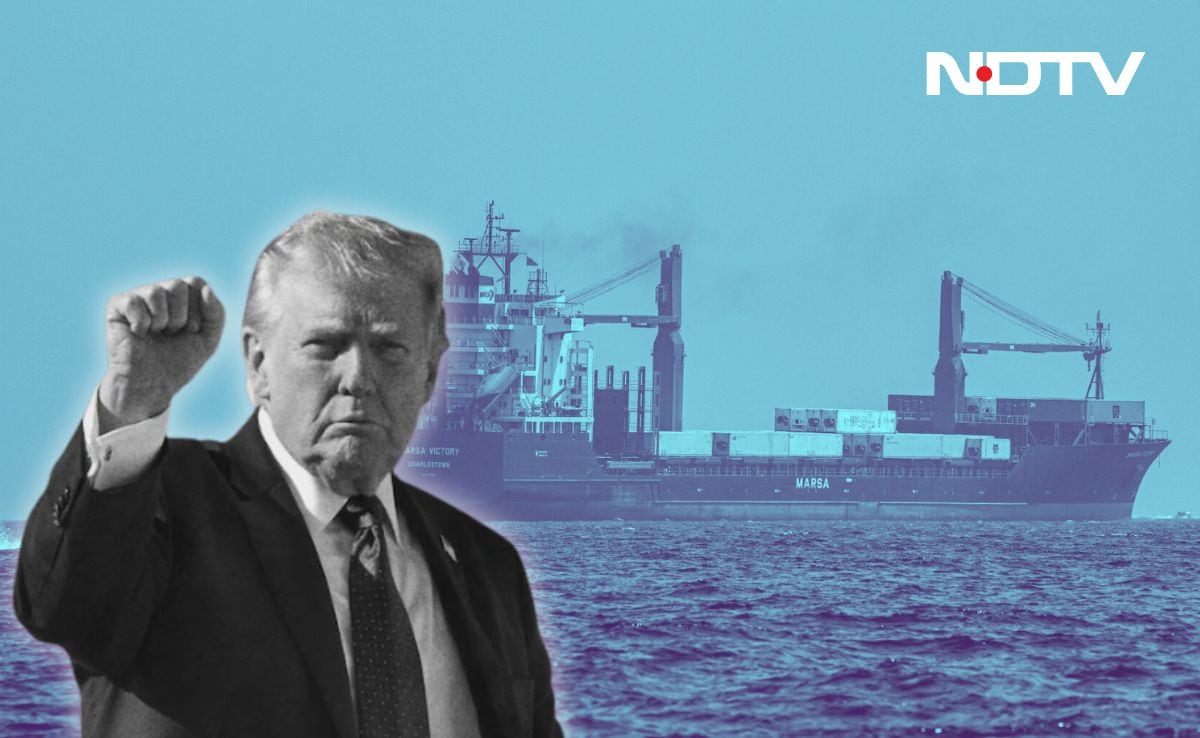
Donald Trump just tossed a hand grenade into the global energy discourse, and as usual, the "experts" are scrambling to check the wrong math. The story is simple on the surface: Trump claims Iran offered him "10 big boats of oil" as some sort of tribute or bribe during his previous tenure. The media is currently obsessed with the literalism of the claim—did the boats exist? Was it 10 or 12? Was it a formal diplomatic cable or a back-channel whisper?
They are missing the forest for the trees. This isn't a story about shipping manifests. It is a masterclass in the weaponization of perceived energy surplus.
The lazy consensus suggests that Iran is a cornered animal, desperate to offload sanctioned crude to anyone with a hull. The reality is far more clinical. When a global power player talks about "big boats" of oil, they aren't talking about commodity trading. They are talking about the collapse of the Petrodollar and the rise of the Shadow Fleet.
The Myth of the "Stranded" Iranian Barrel
Mainstream analysts love to paint Iranian oil as a "distressed asset." They argue that because of US sanctions, Iran has to sell at a massive discount to China, effectively "losing" money on every barrel. This is a fundamental misunderstanding of sovereign survival.
Iran doesn't care about the profit margin in the way an ExxonMobil shareholder does. They care about liquidity and leverage. By offering "10 big boats" to a sitting or future US President, Iran isn't seeking a buyer; they are testing the structural integrity of the Western financial blockade.
A standard VLCC (Very Large Crude Carrier) holds roughly 2 million barrels. Ten of those is 20 million barrels. At $80 a barrel, that is a $1.6 billion "gift." In the world of high-stakes diplomacy, $1.6 billion is a rounding error. The real value is the precedent. If a US President even acknowledges the offer, the sanctions regime effectively evaporates.
The Logistics of a Ghost Fleet
Let's talk about what these "boats" actually represent. You don't just park 10 VLCCs in the Hudson River. To move that much oil under the nose of OFAC (Office of Foreign Assets Control), you need a sophisticated network of:
- Dark Transponders: Ships that "go black" by turning off their AIS (Automatic Identification System).
- Ship-to-Ship (STS) Transfers: Moving oil between three different tankers in the middle of the ocean to scrub the origin of the crude.
- Flag Hopping: Registering vessels in jurisdictions that don't ask questions.
When Trump mentions these boats, he is highlighting the total failure of the current enforcement mechanism. I have seen trade desks in Singapore and Dubai move millions of barrels of "Malaysian" oil that never saw a Malaysian port. The "10 big boats" aren't a mystery; they are the status quo.
The Counter-Intuitive Truth: Oil is Now a Communication Tool
We have entered an era where oil is used more for its signaling value than its caloric value.
The "gift" from Iran was a signal to the Trump administration that the "Maximum Pressure" campaign had reached a point of diminishing returns. It was a move of aggressive submission—an oxymoron that defines Middle Eastern diplomacy. By offering the very thing the US was trying to block, Iran was saying: "Your walls have holes. Would you like to see them?"
The mistake the media makes is treating this as a bribe. It wasn't a bribe. It was a demonstration of futility.
Why the Market Ignores the "Trump Premium"
Wall Street keeps trying to price in the "Trump Factor" regarding oil prices. The consensus is that Trump 2.0 would mean "Drill, Baby, Drill," leading to a supply glut and lower prices.
Wrong.
US production is already at record highs under the current administration. The physical constraints—labor, equipment, and Tier 1 acreage—mean you can't just flip a switch and flood the world. The real "Trump Premium" isn't about US production; it’s about the total reconfiguration of the global supply chain.
If Trump accepts the "10 big boats" mentality—meaning a deal-driven foreign policy rather than a sanctions-driven one—we will see a massive influx of "legalized" Iranian and Venezuelan crude. This doesn't just lower prices; it destroys the leverage of the US shale industry.
The Math of 10 Boats
To understand the scale, let's look at the numbers. If we assume a VLCC capacity of $C = 2 \times 10^6$ barrels, then 10 boats ($N = 10$) equals:
$$V_{total} = N \times C = 10 \times (2 \times 10^6) = 20,000,000 \text{ barrels}$$
At a global consumption rate of roughly 100 million barrels per day (mb/d), 10 "big boats" represents about 4.8 hours of global demand.
In terms of market impact, 20 million barrels is nothing. But in terms of Strategic Petroleum Reserve (SPR) logic, it’s a massive political tool. The SPR has been drained significantly over the last few years. 20 million barrels would be a notable, albeit small, refill.
The "Lazy Consensus" on Sanctions
Most people believe sanctions are a binary: they either work or they don't. This is a fantasy. Sanctions are a tax. They create a middleman economy.
When we sanction Iranian oil, we don't stop the oil. We just ensure that a series of shadowy brokers in the UAE and Malaysia get a $10-$15 cut per barrel for "laundering" the origin. Trump's anecdote about the 10 boats exposes the absurdity of this. Why pay the middlemen when you can deal with the source?
This is the "insider" view that terrifies the State Department. If the US shifts from a policy of "Isolation" to a policy of "Transaction," the entire post-WWII bureaucratic architecture for controlling global trade becomes obsolete overnight.
The Geopolitical Shell Game
Imagine a scenario where the US actually took the oil.
Critics would scream about "dealing with terrorists." But the realist sees a different outcome. Taking the oil removes the supply from China. It creates a dependency loop where Iran looks to Washington for its primary revenue instead of Beijing.
The "10 big boats" offer was Iran trying to pivot. They know the BRICS alignment is a marriage of convenience, not love. China is a predatory buyer; they want Iranian oil at $20 below Brent. Iran would much rather sell to the West at a smaller discount if it meant the end of the "Ghost Fleet" overhead.
Stop Asking if the Story is True
People keep asking: "Is Trump lying about the 10 boats?"
That is the wrong question. In the world of high-level geopolitical posturing, "Truth" is a secondary concern to "Effect." The effect of the story is to signal to the energy markets that the next administration will be transactional, not ideological.
If you are a hedge fund manager or a physical oil trader, you aren't looking for a transcript of the meeting. You are looking at the fact that Iran felt comfortable enough—or desperate enough—to even put that narrative into the atmosphere.
The Real Risk: Not Oil, But the Dollar
The ultimate "counter-intuitive" take here is that the 10 boats aren't about oil at all. They are about the death of the dollar as the exclusive currency for energy.
Iran, Russia, and even Saudi Arabia are increasingly looking at non-dollar settlements. When Trump talks about "deals" for oil, he is implicitly entertaining the idea of bypassing the standard petrodollar structures that have underpinned US hegemony since the 1970s.
If you trade 10 boats of oil for a political concession, you haven't just traded a commodity. You have bypassed the banking system entirely. You have proven that the "Global Policeman" can be a "Global Merchant."
The Actionable Reality
For the average investor or observer, the takeaway isn't about Donald Trump's veracity. It’s about the fragility of the current energy blockade.
- Watch the "Shadow Fleet" counts: As these vessels become more integrated into "legitimate" trade, the price of oil will face structural downward pressure that has nothing to do with demand.
- Ignore the "OPEC+ Quotas": Countries like Iran and Russia are producing well outside the "official" numbers. The 10 boats are just the tip of a very large, very oily iceberg.
- Expect Volatility in Sanctioned Regions: The moment the US shifts to a transactional foreign policy, the "risk premium" on Iranian or Venezuelan assets will collapse, creating a massive buying opportunity for those with high risk tolerance.
The 10 big boats aren't a mystery gift. They are a funeral notice for the way we have managed global energy for the last 40 years.
The status quo is dead. The deal-makers have entered the room.
Stop counting the boats and start counting the days until the current sanctions model becomes a historical footnote.
Go long on pragmatism; short the bureaucracy.
Would you like me to analyze the specific impact of "Shadow Fleet" movements on Brent Crude pricing?