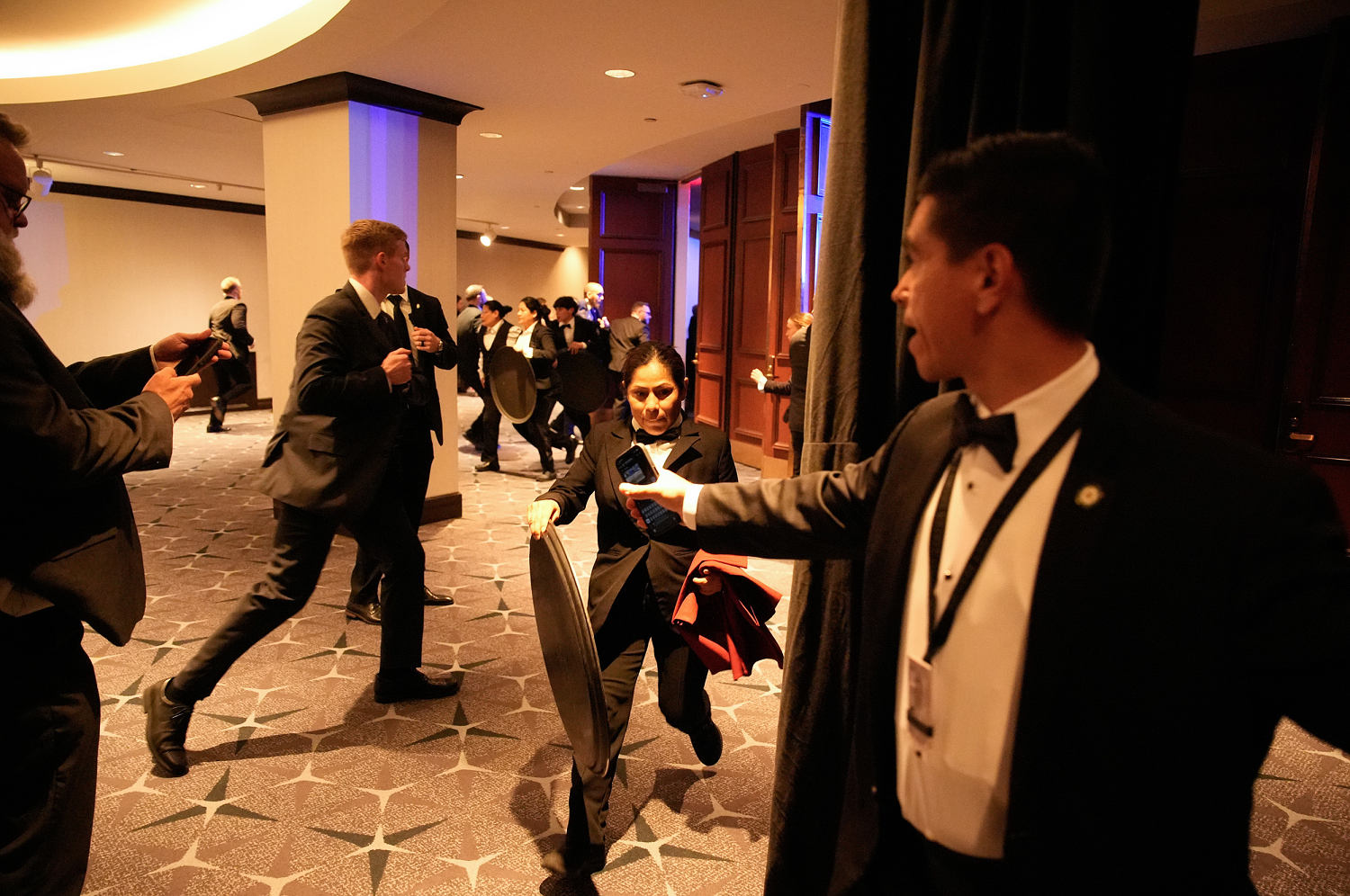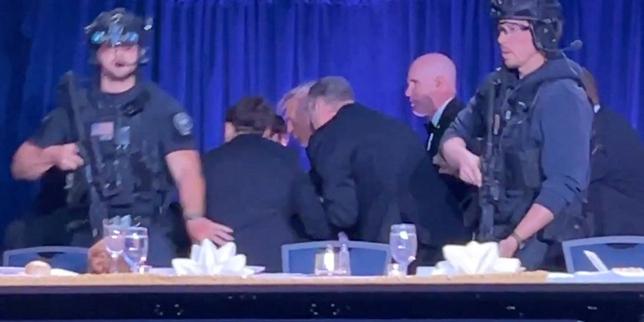
The white linens were still soaked in wine and the echoes of gunfire had barely faded from the Washington Hilton ballroom before the political machinery began its inevitable pivot. Following a chaotic shooting at the annual press gala—an event usually defined by stiff jokes and forced camaraderie—Donald Trump has seized the narrative, framing the violence not as a security failure or a national tragedy, but as a validation of his long-standing grievances against the media. His immediate characterization of the shooter as a "lone wolf" and his dry remark that "nobody told me it was such a dangerous profession" signals a profound shift in how the former president intends to weaponize physical threats against the Fourth Estate during this election cycle.
Security experts are still combing through the wreckage of the evening, trying to determine how a lone gunman managed to breach one of the most heavily guarded rooms in the capital. While the Metropolitan Police Department and Secret Service have yet to release a full profile of the suspect, the political fallout is already concrete. Trump is not just surviving the moment; he is using it to redefine the relationship between the presidency and the press.
The Weaponization of the Lone Wolf Narrative
By immediately labeling the assailant a "lone wolf," Trump bypassed the usual period of official investigation. This isn't just a casual observation. It is a calculated move to isolate the incident from broader systemic issues while simultaneously centering himself as the primary target of a broken society. When a politician uses that specific terminology before the police do, they are attempting to control the "why" before the "how" is even established.
The "lone wolf" label serves a dual purpose. First, it simplifies a complex security breach into a narrative of individual madness, which is easier for a base to digest than a nuanced discussion on domestic radicalization or security protocols. Second, it allows Trump to maintain his stance as a singular figure standing against a tide of hidden enemies. If the attacker is a solitary actor, the danger becomes unpredictable and omnipresent, justifying an even more aggressive posture toward those he deems responsible for the "heated atmosphere"—which, in his view, is the press itself.
Sarcasm as a Shield
"Nobody told me it was such a dangerous profession."
That single sentence, delivered with the timing of a veteran performer, did more than just break the tension. It mocked the very concept of the press gala. For decades, this event has been a symbol of the "truce" between the executive branch and the reporters who cover it. By injecting sarcasm into a moment of literal life and death, Trump signaled that the truce is not only dead but buried.
This rhetorical strategy is familiar to anyone who has tracked his career since 2016. He uses humor to desensitize the public to extreme situations. When the audience laughs at a joke about a shooting, the horror of the event is diminished, replaced by the charisma of the leader. It creates a psychological distance between the event and its victims, making the journalists who were in the line of fire seem like characters in a play rather than people in a workplace.
The Security Vacuum at the Heart of Power
Beyond the rhetoric lies a terrifying reality regarding the logistics of the event. The Washington Hilton’s International Ballroom is a bunker, designed specifically to host the President of the United States. It has dedicated Secret Service routes, magnetometers at every entrance, and a permanent security infrastructure. The fact that shots were fired at all suggests a catastrophic failure of the "onion" layer strategy used by federal protection agencies.
The investigation will likely focus on the perimeter. In recent years, budget constraints and personnel turnover within the Secret Service have been documented by various oversight committees. If the shooter was indeed a "lone wolf" without a sophisticated support network, the breach is even more damning. It implies that the most basic screening processes were bypassed.
We are looking at a scenario where the standard operating procedures for high-level events are no longer sufficient against a decentralized threat. This isn't about one man with a gun; it’s about the erosion of the "Green Zone" mentality that has protected Washington elites for fifty years.
Reversing the Victimhood Hierarchy
Historically, a shooting at a press event would result in a wave of public sympathy for the journalists. Trump is actively working to reverse that hierarchy. By focusing on his own surprise at the "danger" of the job, he positions himself as the observer of a mess created by the media’s own "hostility."
He is essentially telling his supporters that the press has "sown the wind and reaped the whirlwind." This is a dangerous escalation. It moves from criticizing reporting to implicitly suggesting that violence is a natural consequence of the media’s existence.
- The Provocateur Defense: The argument that the media’s "fake news" creates the instability that leads to these attacks.
- The Outsider Advantage: Using the event to prove he is the only one who can "restore order" in a city that can't even protect its own dinner parties.
- The Policy Pivot: Expect a renewed push for restrictive credentials and "reforming" libel laws under the guise of national security.
The Failure of the Institutional Response
While the Trump campaign moves at the speed of social media, the institutional response has been sluggish and predictable. Statements of "thoughts and prayers" and "condemning violence in all forms" are failing to meet the moment. The White House Correspondents' Association is facing an existential crisis: how do you continue to host a "celebration" of the First Amendment when the event itself has become a magnet for political violence and a platform for those who would see the amendment curtailed?
There is a growing sentiment among younger reporters that these galas should be abolished. They argue that the optics of journalists rubbing elbows with the people they cover is already problematic, but doing so in a environment that requires combat-level security is absurd. The "nerd prom" is no longer a harmless tradition; it is a liability.
The Economics of Political Chaos
We cannot ignore the financial incentive behind this brand of crisis management. Every time Trump "defies" a tragedy with a quip, his fundraising numbers spike. The campaign uses these moments to blast out emails about "The Deep State's desperate attempts" or "The Media's lies."
For the industry analyst, the shooting isn't just a news story; it’s a market mover. It shifts the focus away from policy failures, inflation, or foreign entanglements and centers it back on the culture war. In this economy, outrage is the most stable currency, and Trump is currently the most successful central banker in that system.
The Erosion of Civil Discourse
The real casualty in that ballroom wasn't just the physical safety of the attendees, but the last vestige of the idea that some spaces are neutral. If a press gala—a night of tuxedoes and self-deprecation—can turn into a free-fire zone, there is no "safe" space left in American politics.
Trump’s reaction ensures that the divide will only widen. He is not interested in de-escalation because his political lifeblood is the escalation itself. By treating a shooting as a punchline, he signals to his followers that the normal rules of empathy and decorum do not apply to his "enemies."
The "lone wolf" isn't just the man with the gun. In Trump’s narrative, the lone wolf is also the leader himself, standing alone against a corrupt establishment, unharmed by their bullets or their barbs. It is a potent, if terrifying, image that will likely carry him through the convention and into the general election.
The logistics of political reporting will now change forever. We will see more armored glass, more tactical gear, and less access. The distance between the governed and the governors is widening, not just ideologically, but physically. When the "danger" of the profession becomes a talking point for a former and potentially future president, the profession itself must decide if it is willing to continue playing its part in a theater that has turned deadly.
Journalists must stop treating these remarks as mere "outbursts" and start seeing them as the foundational bricks of a new political order where violence is moderated by irony and used as a tool for consolidation. The shooting at the Hilton was a warning. The response from the Trump camp was the blueprint.
The path forward requires a total abandonment of the "both sides" framing that has paralyzed political journalism for a decade. When one side uses a violent attack to mock the victims and consolidate power, there are no longer two valid sides to the story. There is only the fact of the attack and the reality of its exploitation. The media must decide if it will remain a passive observer of its own dismantling or if it will finally address the mechanics of how its own destruction is being sold to the public as entertainment. This isn't about a dangerous profession anymore; it's about the survival of the reality that the profession is supposed to document.