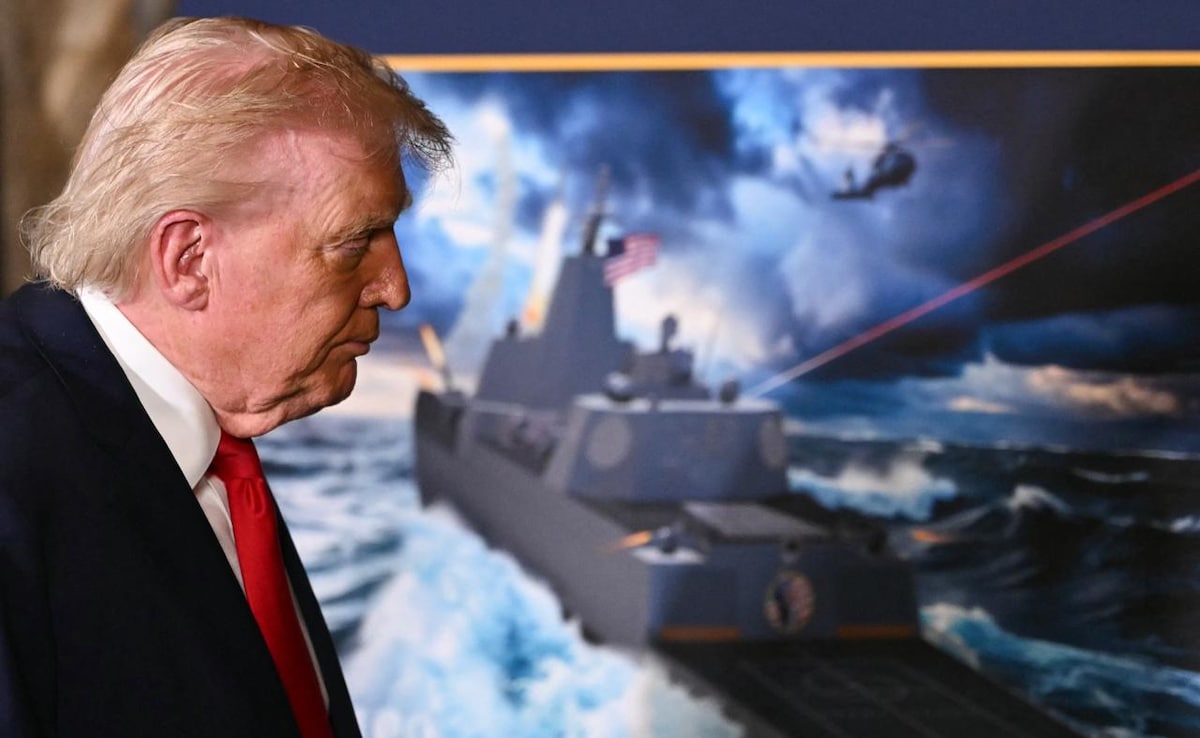
Donald Trump wants to bring back the battleship. Not the rusting relics you see in museums, but a massive, nuclear-powered beast packed with railguns and high-energy lasers. It sounds like something out of a techno-thriller novel, yet the proposal has gained traction in naval circles and political rallies alike. You’ve probably heard the skeptics call it a vanity project. They’ll tell you the age of the big-gun ship died in 1945 at the hands of carrier-based aircraft. They’re mostly wrong.
The logic behind a modern American battleship isn't about nostalgia. It’s about physics. We’re entering an era where missile defense costs are becoming unsustainable. Shooting down a $2,000 drone with a $2 million interceptor missile is a losing game. A nuclear-powered ship with "infinite" energy for directed-energy weapons changes that math instantly. If you liked this article, you should look at: this related article.
Why Nuclear Power is the Only Way Forward
Traditional destroyers like the Arleigh Burke class are cramped. They’re packed with electronics and crew, but they lack the massive electrical surge capacity needed to fire a railgun or sustain a 300-kilowatt laser. If you want to melt an incoming hypersonic missile out of the sky, you need juice. Lots of it.
Current gas turbine engines can’t cut it. A nuclear reactor, similar to those used in the Gerald R. Ford-class carriers, provides a nearly inexhaustible supply of electricity. We’re talking about a ship that doesn't need to refuel for 20 years. That kind of endurance allows the U.S. Navy to stay on station in the South China Sea or the North Atlantic indefinitely. It’s about presence. If you don't have to leave to find a tanker, you own the water. For another perspective on this development, see the recent coverage from Wired.
This isn't just theory. The Navy has been eyeing Integrated Power Systems (IPS) for years. The problem with the Zumwalt-class destroyers wasn't the tech; it was the scale. They tried to cram too much into a hull that was too small. A battleship-sized platform gives you the internal volume for heavy shielding, massive capacitors, and the cooling systems these reactors require.
The Arsenal of the Future
Forget 16-inch shells filled with high explosives. The "Trump Battleship" concept focuses on two specific technologies: Electromagnetic Railguns and Directed Energy Weapons (DEWs).
Railguns use magnetic fields to launch a solid metal slug at Mach 7. There’s no gunpowder. There’s no explosion on the ship. It’s just kinetic energy. A projectile hitting a target at seven times the speed of sound doesn’t need an explosive warhead; the impact itself is like a small meteor hitting a building. This allows the ship to carry thousands of rounds instead of hundreds of bulky missiles.
High Energy Lasers
While railguns handle the offense, lasers handle the defense. A 300kW or 500kW laser can burn through the guidance fins of an incoming cruise missile in seconds. Because it’s powered by the ship’s nuclear reactor, the "magazine" is effectively bottomless.
- Cost per shot: Under $10.
- Speed: Literal speed of light.
- Accuracy: Pinpoint targeting of sensors and engines.
You’re looking at a defensive bubble that’s nearly impossible to penetrate with current saturation tactics. If an adversary fires 50 cheap drones at a modern destroyer, that destroyer runs out of missiles. If they fire them at a nuclear battleship, the battleship just keeps the lights on and keeps firing.
Survival in the Age of Hypersonic Missiles
The biggest argument against large ships is that they're "floating targets." Critics point to Chinese "carrier killer" missiles like the DF-21D. It’s a fair point. If you build a big ship with thin skin, it’s a liability.
But a battleship is defined by its armor. Modern materials science has moved way beyond the heavy steel plates of World War II. We now have ceramic composites, explosive reactive armor, and electromagnetic armor that can disrupt the shaped charges of incoming warheads.
When you combine physical armor with a nuclear-powered electronic warfare suite, you get a ship that can take a hit and keep fighting. Most modern ships are "eggshells armed with hammers." One hit and they’re out of the fight. A battleship is designed to be a "sponge." It draws fire, absorbs it, and stays in the box. That’s a psychological edge you can’t get from a stealthy destroyer that hides in the waves.
The Cost Reality Check
Let’s be honest. This won't be cheap. Building a first-of-its-kind nuclear battleship could easily top $10 billion to $15 billion per hull. People will scream about the budget. They’ll say we should buy 20 smaller frigates instead.
But look at the maintenance and lifecycle costs of our current fleet. We spend billions on fuel and logistics. A nuclear fleet shrinks the "tail" of the supply chain. You need fewer tankers and fewer protected refueling zones.
There’s also the industrial base to consider. America’s shipbuilding capacity has hit a dangerous low. Starting a program of this scale forces an upgrade of our shipyards. It creates a demand for high-end nuclear technicians and specialized welders. It’s an investment in the infrastructure required to stay a superpower. You don't stay at the top by making incremental changes to 30-year-old designs.
Geopolitical Signaling
Warships are tools of diplomacy. When a destroyer shows up off a coast, it’s a message. When a 50,000-ton nuclear battleship shows up, it’s a statement. It tells an adversary that you’re willing to park a massive, near-invulnerable fortress in their backyard.
The psychological impact of a ship that can’t be easily sunk by conventional missiles is massive. It complicates every calculation a rival commander makes. Do they waste their entire missile inventory trying to crack the battleship's shield, or do they ignore it and let it wreak havoc on their coastal defenses?
What Actually Happens Next
Moving from a campaign talking point to a commissioned vessel takes a decade or more. If this plan moves forward, the first step isn't laying a keel. It’s a massive R&D push into miniaturizing the A1B reactor and perfecting the barrel life of the railgun.
The Navy’s current focus is on the DDG(X) program, but that design is already being criticized for being too conservative. A "Battleship" variant could be the radical shift needed to regain a clear lead in the Pacific.
To see if this becomes reality, watch the upcoming Naval Sea Systems Command (NAVSEA) budget requests. If you see line items for "Large Surface Combatant Power Studies" or "Advanced Kinetic Weapon Integration," the battleship is already on the drawing board. Don't wait for a formal announcement. Follow the money into the high-energy physics labs where the real work is being done. The return of the battleship isn't about the past. It’s about dominating a future where energy is the ultimate weapon.