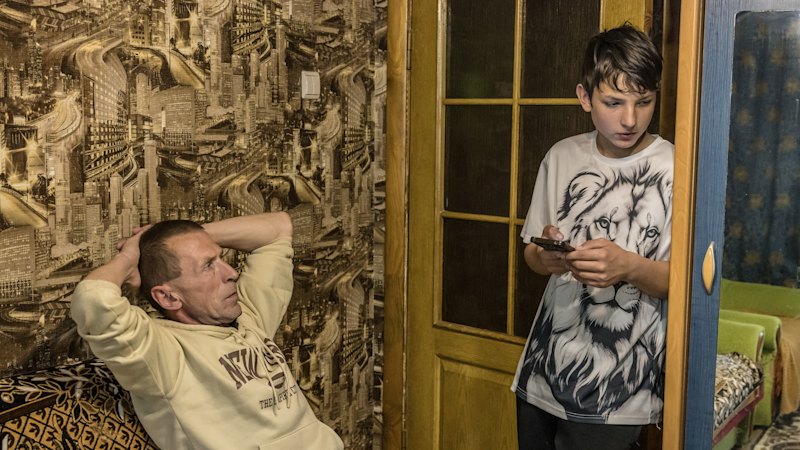
Modern warfare changed forever in the suburbs of Kyiv because a teenager couldn't sit still while his country burned. Most people think of high-tech satellite arrays or billion-dollar stealth jets when they imagine 21st-century defense. They’re wrong. The real shift happened in the hands of a 15-year-old named Andrii Pokrasa. He didn't have a uniform or a rifle. He had a store-bought hobby drone and a sense of duty that should make every military strategist on the planet rethink their playbook.
During the initial push toward the capital in early 2022, the Russian military sent a massive convoy down the E37 highway. It was an intimidating wall of steel designed to crush everything in its path. But they had a blind spot. They didn't account for a kid who knew his neighborhood better than any general in Moscow ever could. Andrii and his father took their small consumer drone out into the fields under the cover of darkness. They weren't just playing around. They were hunting for targets that the Ukrainian military couldn't see from the ground.
The moment a hobbyist became a soldier
Andrii’s story isn't just about a brave kid. It’s about the democratization of surveillance. In the past, if you wanted to see what was over the next hill, you needed a multimillion-dollar Global Hawk or a risky scouting mission. Now, you just need a steady hand and a DJI remote. Andrii was the only one in his region with a functioning drone and the guts to fly it near the front lines.
He took his drone into the "gray zone," the dangerous strip of land between the two armies. The Russian column was moving toward Kyiv, and the Ukrainian forces needed precise coordinates to stop them. A massive line of trucks, tanks, and fuel carriers was snaking through the woods near the village of Berezivka. Andrii found them. He didn't just see them; he provided the exact GPS coordinates that allowed the Ukrainian artillery to rain hell on that convoy.
Think about that for a second. A teenager basically acted as the eyes for an entire artillery battery. He sent the photos and the location data via social media to a territorial defense unit. Moments later, the horizon lit up. The Russian advance on that specific route didn't just slow down. It stopped.
Why consumer tech is terrifying for traditional militaries
The Russian army is built on a Cold War mindset. It’s a top-down, heavy-handed structure that relies on overwhelming force. They weren't prepared for "cellar-dwelling" tech enthusiasts. When Andrii flew his drone, he was essentially invisible. Small consumer drones are hard to track on traditional radar. They're quiet. They're cheap. If one gets shot down, you just grab another one out of the box.
This creates a massive problem for an invading force. How do you hide a tank when every kid with a smartphone and a $500 quadcopter can broadcast your position to the world? You can't. The "fog of war" is lifting, but it’s not the generals lifting it—it’s the civilians.
Andrii’s experience shows that the battlefield is no longer a restricted space for professionals. It’s an open-source conflict. The Ukrainian military recognized this early. They didn't tell Andrii to stay inside and stay safe. They gave him the coordinates of where they thought the enemy was and asked him to go confirm it. It’s a gritty, terrifying reality, but it’s what saved Kyiv from being encircled in those first desperate weeks.
The risks of being a teenage scout
Let's be real about the danger here. If the Russian forces had caught Andrii and his father, they wouldn't have been treated as prisoners of war. They would've been executed as spies or saboteurs. Russian electronic warfare units are getting better at "aeroscope" technology, which can track the location of the drone operator, not just the drone.
Andrii knew this. He and his father had to constantly move. They’d launch, get the shots, and vanish before the Russians could triangulate their signal. It’s a high-stakes game of cat and mouse where the cat has cruise missiles and the mouse has a plastic remote control.
This isn't a feel-good movie. It’s a glimpse into a future where every civilian is a potential combatant and every gadget is a weapon. It blurs the lines of international law and puts people in impossible positions. But when your home is being invaded, those legal abstractions don't mean much. You do what works.
Lessons from the fields of northern Ukraine
What can we learn from a 15-year-old stopping a tank column? First, stop underestimating "cheap" tech. The most effective weapons in Ukraine haven't always been the Javelins or the HIMARS. Often, it's the $1,000 drone that tells those big guns exactly where to aim.
Second, local knowledge is the ultimate force multiplier. Andrii knew the terrain. He knew where the Russians would likely hide their fuel trucks under the trees. He knew which roads were soft enough to bog down heavy machinery. You can't teach that to a soldier who just arrived from a base a thousand miles away.
The bravery of people like Andrii Pokrasa changed the course of the war. If that convoy had reached the outskirts of Kyiv unimpeded, the capital might have fallen. Instead, it became a graveyard for Russian armor.
The next time you see someone flying a drone in a park, don't just see a toy. See a tool that, in the right hands, can topple an empire. The war in Ukraine is proving that a motivated kid with a screen can be more dangerous than a general with a map. If you want to understand where conflict is headed, look at the gadgets in your own backpack. The barrier to entry for defense has dropped to zero, and the world is never going back.
To stay informed on how decentralized tech is shifting global power, pay attention to the "IT Army" and civilian drone units popping up in every modern conflict zone. The era of the "lone wolf" scout is here. Support local initiatives that provide tech education in vulnerable regions, because as we've seen, a little bit of signal can stop a whole lot of noise.