A single flickering light bulb in a rural village outside Ahmedabad does not usually keep policymakers awake at night in Ottawa. It should. Because when that bulb flickers, it is not just a localized failure of the grid. It is a symptom of a massive, global scramble for energy, stability, and technological survival.
For years, the relationship between India and Canada looked like a frozen landscape. Diplomatic ice choked the channels of communication. Headlines traded in grievances. The grand speeches about shared democratic values felt like hollow boilerplate text recited by actors who had forgotten their motivation. But beneath the frost, something else was quietly shifting. The ground was warming up.
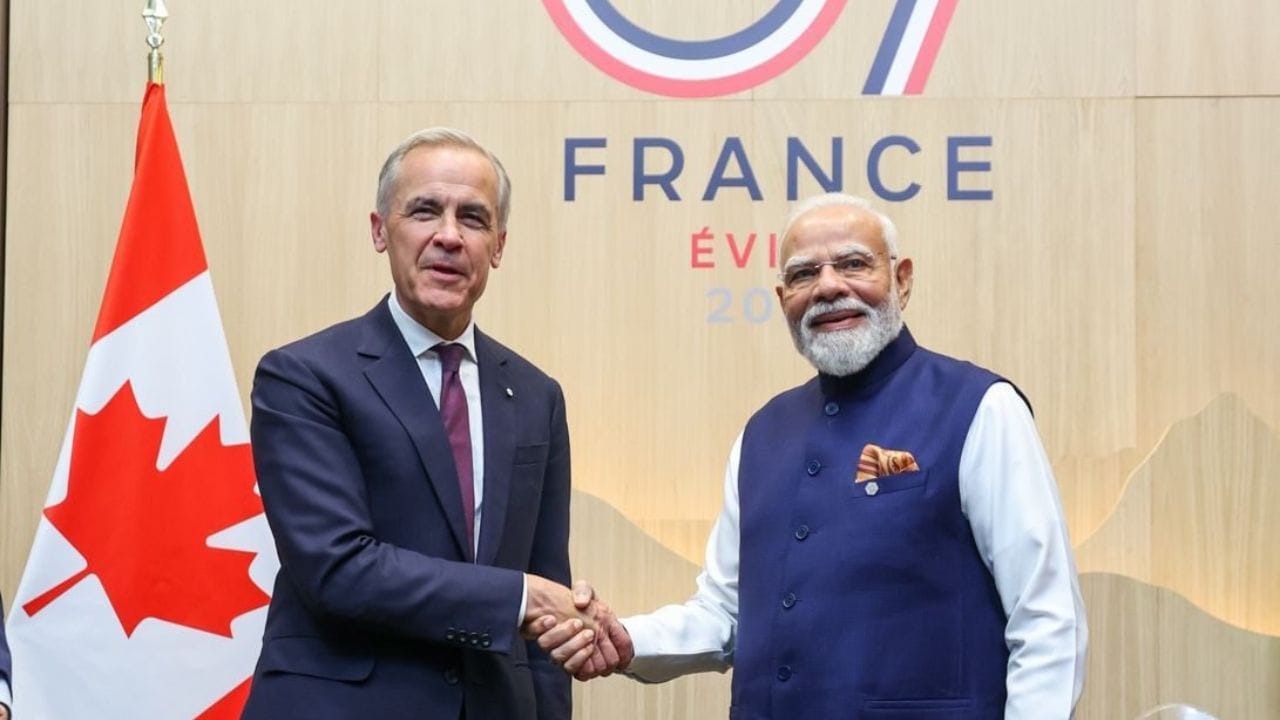
Now, a quiet urgency has replaced the public posturing. Indian Prime Minister Narendra Modi and Canadian official Mark Carney are pushing hard to bind these two massive economies together before the calendar flips past 2026. This is not just another dry bureaucratic handshake. It is a high-stakes rescue mission for a world running out of time.
The Heat and the Cold
To understand why this matters, look at a map through the lens of pure survival. India is home to 1.4 billion people riding an economic tidal wave. The country is building, manufacturing, and digitizing at a pace that defies historical precedent. But that growth requires juice. It demands a torrential, unending supply of electricity and raw power.
Canada, meanwhile, sits on a treasure trove of exactly what India needs. It possesses vast reserves of clean energy, uranium, and traditional fuel resources. Yet, Canada faces its own crisis: a desperate need to diversify its trade beyond its giant neighbor to the south and inject new life into its productivity metrics.
Consider a hypothetical engineer named Priya in Bengaluru. She is working on an artificial intelligence system designed to optimize water distribution across drought-prone farming regions. Her algorithms are brilliant. Her vision is flawless. But her servers require staggering amounts of reliable power, and her team needs advanced computational infrastructure that India is still scaling up to produce.
Now look across the ocean to a clean-tech entrepreneur in Vancouver, let’s call him Robert. Robert has developed a state-of-the-art modular energy storage system. He has the tech, but his domestic market is small. He needs scale. He needs millions of users to prove his system can stabilize a massive national grid.
Priya and Robert have never met. They do not read trade policy briefs. But their entire professional futures are tethered to the pens held by negotiators in New Delhi and Ottawa. If those negotiators fail to ink a comprehensive economic partnership by the end of 2026, Priya’s servers remain throttled, and Robert’s company risks stagnation.
The Silicon Connection
The conversations driving this trade pact are not centered on low-tariff textiles or agricultural quotas anymore. The real battle is being fought over bytes and algorithms. Artificial intelligence has evolved past the point of being a Silicon Valley novelty. It is the new global currency.
India has the human capital. Its universities churn out tech talent at a volume that resembles a manufacturing assembly line. But talent without infrastructure is like a Ferrari without gasoline. Canada possesses deep, historic roots in AI research, housing world-class institutions and pioneers who literally wrote the foundational code for deep learning.
When you fuse Canadian institutional research with Indian scale, the chemistry changes. This is where the trade pact transitions from a business deal into a geopolitical shield. By co-developing AI frameworks, both nations are attempting to build an alternative center of gravity to the monopolistic tech duopoly of the US and China.
It is a scary proposition. Relying on another nation for critical technological infrastructure requires a level of trust that has been conspicuously absent from India-Canada relations in recent years. It means opening up data pipelines, aligning regulatory standards on privacy, and ensuring that intellectual property created in Toronto is protected in Hyderabad.
The skepticism is real. Critics point out that diplomatic trust is a fragile commodity, easily shattered by a single political speech or a domestic electoral cycle. They wonder if this sudden rush toward a 2026 deadline is an act of desperation rather than strategic vision.
Perhaps it is a bit of both. Desperation is a magnificent motivator.
Moving Past the Static
The real friction in making this pact a reality does not lie in the text of the agreement. It lies in the historical baggage. The political static of the past few years created a narrative that India and Canada were fundamentally drifting apart. Business leaders pulled back. Investors grew cautious.
But look at the corporate spreadsheets, and a different story emerges. Canadian pension funds have quietly poured billions of dollars into Indian infrastructure, real estate, and renewable energy over the last decade. They did not do this out of charity. They did it because the long-term returns are undeniable. The money understood what the politicians are only now admitting: these two nations are economically symbiotic.
The push by Modi and Carney is an attempt to force the politics to catch up with the capital. They are trying to build a framework that can survive the unpredictable winds of public opinion.
If they succeed, the ripple effects will be felt far beyond the stock exchanges of Mumbai and Toronto. A successful pact creates a blueprint for how middle powers can cooperate in a fractured global order. It proves that economic necessity can override political pride.
The Clock is Ticking
There are no guarantees in international diplomacy. Trade negotiations are notoriously grueling marathons where deals frequently die on the vine over minor disagreements regarding intellectual property rights or agricultural subsidies. The 2026 deadline is ambitious, bordering on reckless given the recent history between the two capitals.
But the alternative is worse. Failure means a return to the cold shoulder. It means Canadian resources remain locked out of the world’s fastest-growing market, and Indian tech firms face unnecessary hurdles in accessing Western capital and research.
The true test of this partnership will not be measured by the pomp of a signing ceremony or the optimistic language of a joint press release. It will be measured years from now, in the quiet realities of everyday life.
It will be measured when Priya’s algorithms successfully route water to a parched village because her servers are humming on energy stabilized by Robert’s technology. It will be measured when a Canadian factory runs more efficiently because of an AI system co-developed across the world.
The diplomats will continue their arguments in closed rooms, debating clauses and commas under the glare of fluorescent lights. Outside, the world keeps spinning, waiting to see if two reluctant partners can finally find their shared rhythm before the clock runs out.