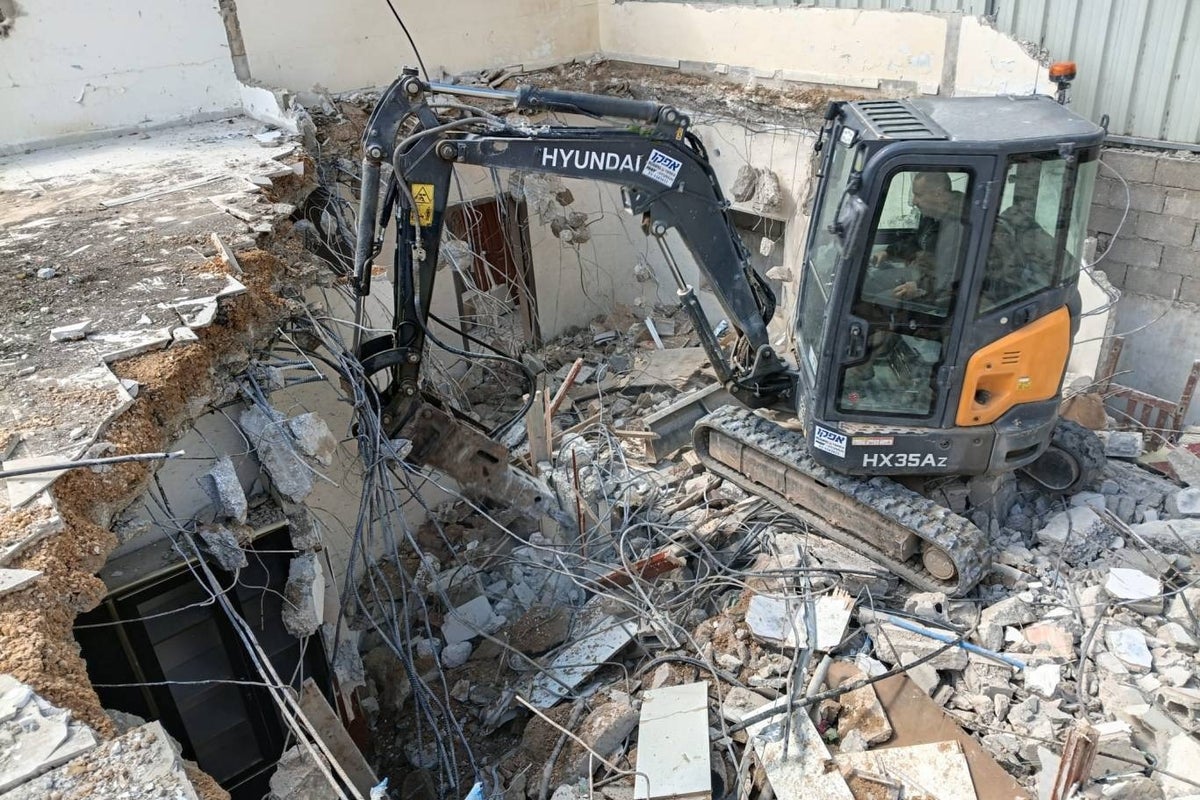
Stop looking at the rubble. Look at the permit.
The standard media narrative regarding "self-demolitions" in East Jerusalem is a masterclass in emotional manipulation over administrative reality. You’ve seen the headlines. They paint a picture of sudden, arbitrary cruelty where families are forced to take a sledgehammer to their own living rooms to avoid "hefty municipal fines." Read more on a related topic: this related article.
It’s a gripping story. It’s also an incomplete one.
The tragedy isn't the demolition. The tragedy is a systemic failure of urban planning that treats building codes like optional suggestions and architectural stability like a luxury. When we strip away the hyperbole, we find a complex collision of Ottoman-era land titles, Jordanian-era zoning, and modern Israeli bureaucracy. Further analysis by Associated Press explores similar perspectives on the subject.
If you want to understand why a man tears down his own house, you have to stop asking "why is this happening" and start asking "who told him he could build it in the first place?"
The False Dichotomy of the "Sudden" Demolition
The public is led to believe that a bulldozer appears out of nowhere because of a whim. In reality, a demolition order is the final stage of a years-long legal marathon.
Most of these structures are built without a single engineering inspection. No soil testing. No seismic checks. No fire safety standards. In any other developed city—London, New York, Tokyo—building a multi-story residential complex without a permit doesn't make you a victim of the state; it makes you a public safety hazard.
Why do owners choose to do it themselves? It isn't just about the "fine." It’s about the logistics of destruction. When the municipality carries out a court-ordered demolition, they bill the owner for the heavy machinery, the police presence, the debris removal, and the administrative overhead. This can run into hundreds of thousands of shekels. By doing it themselves, owners save a fortune and, more importantly, can often salvage materials—windows, doors, rebar—to use again.
It is a calculated financial decision, not a spontaneous act of grief. To frame it as anything else is to ignore the agency of the people involved.
The Ghost of the 1967 Zoning Map
The "lazy consensus" argues that Israel simply refuses to give Palestinians permits. While the approval rates are undeniably low, the reason isn't always "malice." It is land registration.
Much of East Jerusalem operates on a "Musha" system—an Ottoman leftover where land is owned collectively by a clan or family without specific boundaries. Imagine trying to get a mortgage or a building permit in 2026 when your "deed" is a handwritten note from 1920 saying your grandfather owns "the olive grove near the big rock."
- The Bureaucratic Wall: You cannot get a permit for a plot that hasn't been "parcelized" (officially divided into lots).
- The Infrastructure Gap: You cannot build a high-rise where the existing sewage pipes can only handle a single-family home.
- The Legal Loophole: Many builders know they won't get a permit, so they build anyway, betting that the legal process will take ten years to catch up.
By the time the demolition order is finalized, the builder has often lived in the house for a decade. In their mind, the "fine" is just back-rent for ten years of illegal occupancy. It’s a high-stakes gamble that they occasionally lose.
The Professional Architect’s Dilemma
I’ve seen developers in various jurisdictions try to bypass zoning laws. Usually, they get slapped with a "stop-work" order and they stop. In East Jerusalem, the culture of "de facto" construction is so ingrained that stopping isn't even considered an option.
Architects working in these neighborhoods are often forced to choose between professional integrity and communal pressure. If they tell a client, "You cannot build four stories here because the foundation won't hold," the client finds an unlicensed contractor who says, "Don't worry, I've done this before."
When that building eventually gets flagged by a satellite sweep or a municipal inspector, the "insider" truth comes out: the structure was never safe to begin with.
We are not just talking about "illegal" homes. We are talking about unstable homes. If a minor earthquake hit Jerusalem tomorrow, the very neighborhoods currently fighting demolition orders would become mass graves because of the lack of structural oversight.
Is it "humane" to let people live in death traps just to avoid the optics of a demolition?
Dismantling the "People Also Ask" Propaganda
People often ask: “Why doesn't the city just provide more permits?”
The answer is brutal: You cannot provide permits for land you don't legally "see." If the residents refuse to participate in land registration—often due to political pressure not to "recognize" Israeli authority—the city literally cannot issue a permit. You cannot grant a legal right to an undefined space.
Another common query: “Is this a tool for demographic engineering?”
While urban planning is always political, the math doesn't support a one-sided narrative. Illegal construction is rampant across the city, including in ultra-Orthodox Jewish neighborhoods. The difference? Those neighborhoods have the political machinery to retroactively "legalize" their zoning violations through the City Council.
The "contrarian" fix isn't to stop demolitions. It’s to force a massive, rapid land-registration project that bypasses the political stalemate. But neither side wants that. The activists want the "victim" imagery of the self-demolition, and the hardliners want the status quo of legal ambiguity.
The Actionable Reality
If you are an advocate for East Jerusalem residents, your "unconventional" move isn't to protest the bulldozer. It’s to hire a legion of land surveyors and title lawyers.
- Stop the "Wild West" construction: Every unpermitted brick laid is a liability that will be cashed in ten years from now.
- Force Parcelization: Push the municipality to define the lots. If they refuse, you have a much stronger case in the High Court than a "he said, she said" about a permit.
- Audit the Infrastructure: If a neighborhood is denied a permit due to "lack of sewage capacity," sue for the sewage capacity.
The current cycle of "Build-Destroy-Repeat" serves the extremists on both sides. It provides the municipality with a show of "rule of law" and provides activists with a steady stream of heartbreaking content for social media.
The people caught in the middle—the ones holding the sledgehammers—are the only ones losing. They are paying the price for a political refusal to engage with the boring, technical, un-sexy reality of modern urban zoning.
Stop romanticizing the struggle and start demanding a cadastral map.
The sledgehammer isn't the problem. The lack of a blueprint is.