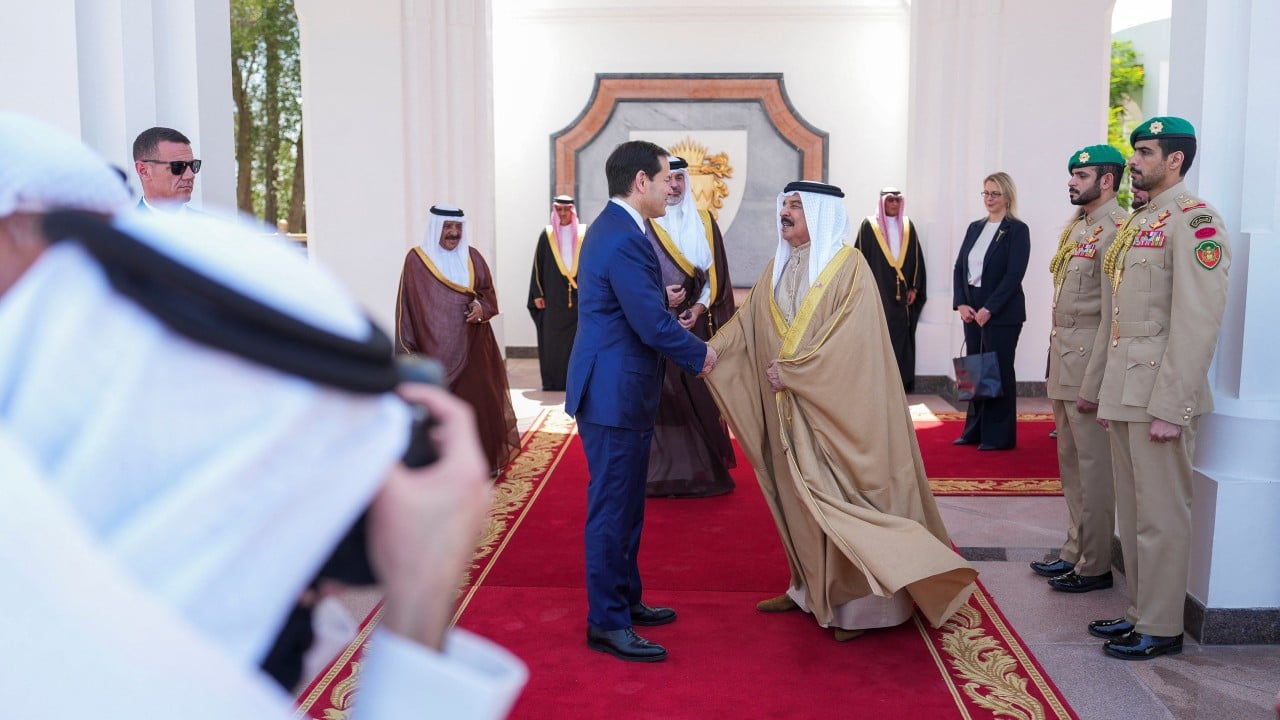
Washington is celebrating what it calls a diplomatic breakthrough, but the mood in the Persian Gulf is pure anxiety. US Secretary of State Marco Rubio just wrapped up a three-day whirlwind tour through the United Arab Emirates, Kuwait, and Bahrain. His mission was simple yet incredibly difficult. He had to convince Washington’s closest Arab allies that the newly signed preliminary peace accord with Iran isn't a betrayal.
If you look at the official press releases, everything sounds smooth. But scratch beneath the surface and you find a massive gulf between Washington's optimism and the harsh reality on the ground in the Middle East. The six nations of the Gulf Cooperation Council—Saudi Arabia, the UAE, Qatar, Kuwait, Oman, and Bahrain—spent the last four months getting pounded by Iranian drones and ballistic missiles during the recent US-Israeli conflict with Tehran. Now, they're watching the Trump administration cut a deal with their primary adversary, and they feel exposed. You might also find this similar coverage insightful: Why the Supreme Court Border Ruling Changes Everything for Asylum Seekers.
The core of the issue is simple. The interim memorandum of understanding signed by President Donald Trump and Iranian President Masud Pezeshkian stops the immediate fighting, but it leaves the region's long-term security completely up in the air. Rubio spent his tour trying to play firefighter, promising allies that the US won't sell them out. But his rhetoric faces an uphill battle against the actual text of the agreement.
The Massive Blind Spots in the Deal
The biggest reason Gulf leaders are losing sleep is what the preliminary accord leaves out. The 14-point memorandum of understanding focuses almost entirely on ending the immediate four-month war and establishing a framework for nuclear inspections. It completely ignores the exact weapons that Iran used to attack its neighbors just weeks ago. As discussed in recent coverage by The Guardian, the effects are widespread.
There is no mention of Iran's ballistic missile program. There is no mention of its sprawling drone arsenal. Most concerning for countries like the UAE and Saudi Arabia, the document completely ignores Iran’s network of regional proxies.
Gulf officials look at this and see a recipe for future disaster. They know that a ceasefire between Washington and Tehran doesn't mean peace for the rest of the region. If Iran is free to continue shipping advanced weapons to the Houthis in Yemen, Hezbollah in Lebanon, and various militias in Iraq, then the threat to the Gulf monarchies hasn't actually gone away. It has just been repackaged.
Rubio tried to spin this omission during his stops in Abu Dhabi and Kuwait City. He argued to reporters that the agreement's call for a complete end to hostilities and conflicts logically requires Iran to stop funding armed groups. You can't have a true end to hostilities while proxies are launching rockets across borders. That was his pitch.
But Gulf diplomats are skeptical. They know how Tehran operates. They know that Iran has perfected the art of plausible deniability through its non-state actors. Expecting Iran to willingly dismantle its proxy network without explicit, legally binding enforcement mechanisms is wishful thinking at best.
That Eye Popping Three Hundred Billion Dollar Reconstruction Fund
Another massive point of contention is the proposed $300 billion reconstruction fund for Iran. The preliminary accord includes provisions for massive financial incentives and the waiver of key economic sanctions in exchange for Iranian compliance on nuclear inspections.
To the Trump administration, this fund is the ultimate carrot to keep Tehran at the negotiating table. To the Gulf states, it looks like a multi-billion dollar cash injection for a regime that wants to dominate the region.
During his meetings in Manama with the GCC foreign ministers, Rubio reportedly avoided deep discussions about the specifics of the fund. But the anxiety in the room was palpable. Gulf states are terrified that a massive influx of cash will allow Iran to rapidly rebuild its military capacity.
The logic is straightforward. If Iran receives billions in sanctions relief and reconstruction money, even if it's earmarked for civilian infrastructure, it frees up other state resources. Tehran can redirect its domestic budget straight back into its military-industrial complex. Within a few years, Iran could emerge from this peace process wealthier, stronger, and more dangerous than before the war started.
Rubio tried to set a hard line here, insisting that the money won't flow unless Iran acts like a normal country instead of a revolutionary movement that exports terror. But that's a vague standard. Gulf leaders remember the aftermath of the 2015 nuclear deal. They remember how sanctions relief back then didn't lead to a moderate Iran, but rather an empowered one. They don't want a repeat of that history.
The Battle lines Over the Strait of Hormuz
If there is one immediate flashpoint that could blow this entire peace process apart, it's the Strait of Hormuz. This narrow waterway is the choke point for a massive chunk of the world's oil and gas shipments. During the four-month war, shipping was severely disrupted, sending global energy markets into a tailspin.
The new memorandum of understanding says Iran must use its best efforts to ensure toll-free passage through the strait, but it adds a terrifying caveat. That provision is only good for 60 days while a final agreement is negotiated.
Iran is already moving to exploit this leverage. Right after the initial technical talks wrapped up in Switzerland, Iranian Parliament Speaker Mohammad Bagher Ghalibaf declared that the administration of the Strait of Hormuz will never go back to the way it was before the war. Iranian state media has been loudly broadcasting that Tehran intends to charge service fees for vessels passing through the strategic waterway.
The Islamic Revolutionary Guards Corps took it a step further, claiming that ships can only use Iranian waters, rejecting the southern transit routes through Omani waters that the US has been promoting.
This looks a lot like a toll booth on international commerce. Rubio spent his entire tour drawing a bright red line on this issue. He repeatedly told the GCC and reporters that Washington will never tolerate any fees, tolls, or attempts by Iran to assert unilateral control over international waters.
Data from maritime intelligence groups like Windward and Kpler shows that shipping traffic through the strait has surged by nearly 50 percent since the ceasefire, hitting some of the highest daily crossing numbers seen all year. The world needs that waterway open. Rubio warned that if Iran tries to block or tax these ships, there will be immediate trouble. The US is judging Iran by the physical movement of ships, not by the fiery rhetoric coming out of Tehran.
Why Rubio Left Israel Off the Itinerary
One of the most telling details of Rubio’s trip wasn't where he went, but where he didn't go. Despite his long record as an intensely pro-Israel politician, the Secretary of State completely excluded Israel from this Middle East tour. He flew right over Tel Aviv to land in the Gulf.
This omission speaks volumes about the growing friction between the White House and Israeli Prime Minister Benjamin Netanyahu regarding the Iran negotiations. The US administration is desperate to lock in this peace framework. They are terrified that any sudden military escalation between Israel and Hezbollah in Lebanon could completely derail the 60-day negotiating window with Tehran.
By skipping Israel, Washington sent a clear signal. They view the Gulf states as essential partners whose quiet backing is needed to make the deal work, but they view the current Israeli leadership as a wild card that might disrupt the process. Former intelligence officials in the region have noted that this snub shows a clear divergence in strategy. Washington wants out of the conflict, while Israel feels the job against Iran and its proxies isn't finished.
The joint statement released by the US and the GCC after their Bahrain meeting reflected this delicate balancing act. They called for a lasting peace that addresses missiles and proxies, but they also pointedly called for separate talks on Lebanon that are not conditional on the outcome of the US-Iran negotiations. They want to decouple the conflicts to keep the main peace track alive.
The Real Power Dynamics in Play
What we're seeing right now is a classic diplomatic pivot. The United States is trying to transition away from active warfare, and Vice President JD Vance has taken a leading role in the high-stakes negotiations with Iranian representatives in Switzerland. Rubio’s role is to handle the collateral damage among America’s traditional allies.
But you can't blame the Gulf states for their deep skepticism. Every single one of the six GCC nations provided critical logistical support to American forces during the recent war. Because of that support, they became direct targets for Iranian airstrikes. Their infrastructure was hit. Their security was compromised.
Now, they feel like Washington is moving the goalposts. President Trump recently claimed that Iran had agreed to nuclear inspections into infinity, a claim that Tehran immediately denied. This public back-and-forth proves just how fragile the current framework really is. Both sides are already spinning different narratives about what they actually agreed to in Switzerland.
Where the Region Goes From Here
The next 60 days will determine the geopolitical trajectory of the Middle East for the next decade. The interim accord is nothing more than a temporary pause, a fragile bridge to a final deal that may never actually materialize.
For businesses, energy analysts, and anyone tracking global security, the PR spin out of Washington isn't the metric to watch. You need to watch the concrete realities on the water and on the borders.
First, track the daily shipping volume through the Strait of Hormuz. If Iran begins harassing commercial vessels or attempting to collect any form of service fee, the US-Iran framework will collapse instantly. Watch the Omani corridor explicitly mentioned by Bahrain’s Foreign Minister. That southern route is the primary alternative to avoiding Iranian waters, and its operational success is critical.
Second, monitor the activity of regional proxies. If Houthi drone launches or militia movements in Iraq quiet down, it means Tehran is genuinely exercising restraint to secure its $300 billion fund. If the attacks continue, it proves Rubio’s theory that proxies are covered by the MOU is nothing more than wishful thinking.
Finally, watch the back-channel communications between the Gulf capitals and Israel. Denied a seat at the US-Iran negotiating table, a quiet alignment of convenience between a skeptical Israel and anxious Gulf monarchies could form behind the scenes to counter any perceived American retreat. The diplomacy has started, but the real struggle for regional dominance has just entered a much more dangerous phase.