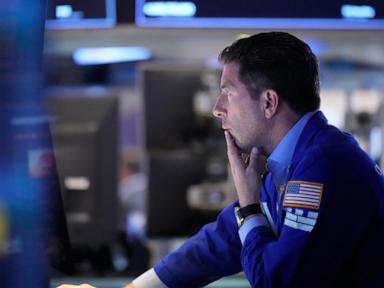
The global markets are currently trapped in a high-stakes guessing game where the valuation of your 401(k) depends more on diplomatic backchannels in Cairo and Doha than on corporate earnings reports. While Wall Street indices recently hit fresh record highs, the celebratory mood across international exchanges remains muted and inconsistent. Investors are pricing in a perfection that doesn't exist. They are betting on a definitive ceasefire that would stabilize energy prices and cool inflation, yet the actual mechanics of such a deal remain fraught with historical grievances and logistical nightmares.
Global shares showed a fractured front this week. While American tech giants pushed the S&P 500 into uncharted territory, Asian and European markets didn't follow the lead with any real conviction. Oil prices dropped significantly as traders anticipated a reduction in the "war premium," but this downward trend is built on a foundation of hope rather than signed treaties. If the talks stall, the rebound in crude will be swift and unforgiving.
The Disconnect Between Indices and Intelligence
Market analysts often fall into the trap of treating geopolitical events as binary—either there is peace or there is war. Professional traders know better. The current "mixed" performance of world shares is a direct reflection of the market’s inability to quantify the risk of a diplomatic collapse.
When Wall Street sets a record, it usually signals confidence in future cash flows. However, the current rally is largely driven by a handful of mega-cap stocks that are perceived as safe havens regardless of what happens in the Levant. Outside of this protective bubble, the broader market is hesitant. Small-cap stocks and international equities are lagging because they are more sensitive to the supply chain disruptions that a failed ceasefire would exacerbate.
The drop in oil prices is perhaps the most telling indicator of this fragility. Crude fell because the market hates uncertainty, and a potential ceasefire offers a path toward a more predictable supply environment. Yet, this sell-off might be premature. The fundamental issue isn't just the immediate conflict; it's the long-term realignment of trade routes. Even with a temporary halt in hostilities, the shipping lanes through the Red Sea remain compromised. Insurance premiums for cargo vessels haven't plummeted just because a meeting was scheduled.
Why the Ceiling is Lower Than It Looks
We have seen this pattern before. A "ceasefire hope" rally is often a "liquidity trap" for retail investors who buy at the peak of the rumor. To understand why the markets aren't moving in a unified upward trajectory, we have to look at the underlying economic data that the headlines are ignoring.
- Sticky Inflation: A drop in oil helps, but it doesn't solve the wage-price spiral or the rising cost of services. Central banks, particularly the Federal Reserve, are not going to cut interest rates based on a tentative peace deal alone.
- The Debt Burden: Government borrowing costs remain high. The fiscal reality in the United States and Europe is that higher-for-longer interest rates are squeezing corporate margins. A record-breaking index doesn't mean the average company is thriving; it means the winners are winning bigger.
- Geopolitical Scarring: Companies have spent the last two years "friend-shoring" and "near-shoring" their production. This process is expensive and inflationary. A ceasefire doesn't magically undo the trillions of dollars spent on restructuring global trade to avoid volatile regions.
The Energy Equation and the Crude Mirage
Energy markets are the most reactive to the headlines, yet they are often the most misunderstood by the general public. The recent slide in oil prices isn't just about the Middle East. It’s a confluence of weakening demand from China and a surge in non-OPEC production, particularly from the United States and Guyana.
If a ceasefire is reached, we might see oil dip further toward $70 a barrel. This sounds like a win for the global economy, but it’s a double-edged sword. Sustained low oil prices can lead to reduced capital expenditure in the energy sector, which sets the stage for a massive supply crunch three to five years down the line. The market is trading the long-term stability of the energy grid for a short-term relief at the pump.
Furthermore, we must consider the role of algorithmic trading. Much of the volatility we see in oil and world shares is driven by high-frequency programs that scan news wires for keywords like "truce" or "agreement." This creates artificial price movements that don't always reflect the physical reality of oil barrels on a ship. When the algorithms hit a "buy" or "sell" trigger simultaneously, it creates the "mixed" and chaotic market snapshots we see on our screens.
Regional Realities and the Asian Drag
While New York celebrates, Tokyo, Hong Kong, and Shanghai are dealing with a different set of demons. The Japanese yen’s historic weakness has made their exports competitive but has hammered domestic purchasing power. In China, the property sector continues to bleed, acting as a massive anchor on the MSCI Emerging Markets Index.
The idea that a Middle Eastern ceasefire will act as a "rising tide that lifts all boats" is a fallacy. For an investor in London or Frankfurt, the primary concern isn't just oil; it's the stability of the Eurozone’s manufacturing core. Germany is already flirting with recession. A slight dip in energy costs isn't enough to fix the structural inefficiencies and the lack of digital investment that has plagued the European economy for a decade.
The "mixed" nature of the market is actually a sign of health—it shows that some investors are finally looking at the fundamentals instead of just following the momentum of the S&P 500.
The Strategy of Skepticism
For those managing real capital, the current environment demands a defensive posture. The record highs on Wall Street are a distraction. When the gap between the performance of the "Magnificent Seven" and the rest of the market becomes this wide, the risks of a correction grow exponentially.
History shows that markets often sell off on the news of a peace deal after buying the rumor. This is the "buy the rumor, sell the fact" phenomenon. Once a ceasefire is signed, the focus will immediately shift back to the grueling reality of high interest rates and slowing consumer spending. The euphoria will evaporate, replaced by the cold math of price-to-earnings ratios.
The smart money isn't chasing the record-high indices. It’s looking at the volatility index (VIX) and the gold market. Gold has remained remarkably resilient even as stocks hit records, which tells you that the "big money" is still hedging against a catastrophe. They aren't convinced that the ceasefire will hold, nor are they convinced that the inflation fight is won.
The Mechanics of a Market Pivot
If the ceasefire negotiations fail, the reversal will be violent. We would likely see a "flight to quality" where investors dump equities and pile into U.S. Treasuries, despite the high debt levels. Oil would spike back above $90 almost overnight.
This isn't pessimism; it's physics. The market has coiled itself like a spring based on the assumption of a peaceful resolution. When you remove the basis for that assumption, the spring uncoils.
To navigate this, one must watch the credit markets. While the equity markets are the flashy storefront, the bond markets are the warehouse. If corporate bond spreads begin to widen while the S&P 500 is hitting records, that is a classic divergence signal that the rally is built on sand. Currently, those spreads are tight, but they are beginning to twitch.
The Hidden Cost of the Peace Premium
The most overlooked factor in this entire narrative is the "reconstruction trade." Analysts are already salivating over the potential for massive infrastructure contracts once the fighting stops. This is a cynical but necessary calculation for the business world.
However, the cost of rebuilding will be astronomical and will likely be funded by more debt in a world that is already drowning in it. This adds another layer of complexity to the global share outlook. Which companies get the contracts? How will they be paid? These questions will determine the winners of the next fiscal quarter, far more than the simple binary of "war or peace."
The drop in oil and the rise in stocks are two sides of the same speculative coin. The market is attempting to front-run a world that doesn't exist yet—a world where geopolitical tension is a relic and cheap credit is coming back.
Neither of those things is true.
The ceasefire, if it happens, is a temporary reprieve in a much larger shift toward a multipolar, fractured global economy. The record highs on Wall Street are a thin veneer over a global financial system that is struggling to find its footing in an era of permanent volatility.
Watch the volume on these record-breaking days. If the market is hitting new highs on low volume, it means the big institutional players are sitting on their hands, letting the retail traders and algorithms bid up the price. That is a classic sign of an exhausted trend. True market strength requires broad participation across all sectors, from banks to utilities to transportation. Right now, we aren't seeing that. We are seeing a narrow, focused rally that is desperately clinging to the hope of a geopolitical miracle to justify its existence.
Position your portfolio for the reality of the stalemate, not the fantasy of the breakthrough. The records will eventually break, and the descent will be governed by the laws of valuation that no ceasefire can ever repeal.