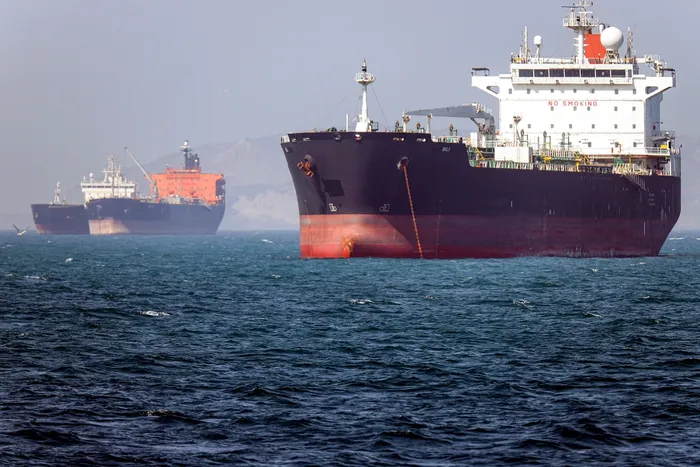
The maritime standoff in the Persian Gulf has reached a boiling point as U.S. naval assets and regional task forces successfully interdicted a massive fleet of nearly 70 tankers attempting to transit Iranian waters. This is not a routine patrol. It is a calculated chokehold on the primary artery of the Iranian economy. By physically preventing these vessels from entering or leaving key terminals, the United States is moving beyond secondary sanctions and into the realm of active, kinetic containment.
The strategy targets the "Ghost Fleet," a sophisticated network of aging tankers that operate under flags of convenience to bypass international trade restrictions. For years, these ships have utilized ship-to-ship transfers and disabled AIS transponders to move millions of barrels of crude to shadow markets. That era of plausible deniability is ending. The presence of U.S. Fifth Fleet assets effectively creates a physical barrier that forces these operators to either risk direct confrontation or remain idle, costing millions in daily demurrage and lost revenue.
The Mechanics of Maritime Interdiction
Modern naval blockades are rarely about firing shots. They are about presence and the implicit threat of seizure. When a U.S. destroyer shadows a VLCC (Very Large Crude Carrier), the insurance premiums for that vessel instantly skyrocket—if the coverage isn't canceled outright. Most of the 70 tankers currently stalled are operating with substandard P&I (Protection and Indemnity) insurance, often backed by obscure entities that cannot withstand the scrutiny of a U.S. Treasury investigation.
The Pentagon is coordinating this effort through the Combined Maritime Forces, a multi-national partnership based in Bahrain. By utilizing advanced drone surveillance and satellite imagery, the U.S. can track a vessel’s "thermal signature" even when its transponder is dark. Once a ship is identified as part of the illicit trade network, it is hailed and warned. If it persists, it faces the prospect of being boarded or forced into international waters where its legal protections evaporate.
The Shadow Fleet Under Pressure
The vessels caught in this net are often decades old. They are the rust-buckets of the sea, maintained just enough to stay afloat but lacking the safety certifications required by major international ports. When the U.S. prevents 70 of these ships from moving, it creates a logistical nightmare. Iranian storage tanks are currently nearing maximum capacity. If the oil cannot leave the country, the wells must eventually be capped—a process that is technically difficult and can permanently damage the productivity of an oil field.
Economic Warfare by Other Means
This surge in naval activity reflects a shift in White House policy. Traditional sanctions on paper have a shelf life; the market eventually finds a way around them. Physical interdiction, however, is a different beast entirely. It creates an immediate supply-side shock for the buyers—mostly small, independent refineries in East Asia that rely on discounted Iranian crude to maintain their margins.
By removing 70 tankers from the equation, the U.S. is effectively stripping hundreds of millions of dollars from the Iranian budget in a single week. This is money intended for internal security and regional proxy funding. The goal is to create a domestic pressure cooker. When the state can no longer pay its bills, the internal friction increases.
Risks of Escalation
The Iranian response has historically involved the use of fast-attack craft and the deployment of sea mines in the Strait of Hormuz. We are seeing a high-stakes game of chicken. If Tehran decides to retaliate by harassing commercial traffic unrelated to the sanctions, the conflict could quickly spiral into a wider regional war that would send global oil prices into the triple digits.
Washington appears to be betting that Iran cannot afford a full-scale naval engagement. The U.S. has bolstered its presence with additional fighter squadrons and an amphibious ready group. This is a show of overwhelming force designed to keep the "Ghost Fleet" anchored and the Iranian leadership paralyzed.
The Role of Technology in the Blockade
Gone are the days when a blockade required a line of ships stretching across a horizon. Today, it is managed via data. The U.S. Navy’s Task Force 59 has been integrating unmanned systems—maritime drones—to provide 24/7 coverage of every square mile of the Gulf. These drones feed real-time AI-driven analytics to command centers, identifying anomalous behavior patterns that suggest a ship-to-ship transfer is about to occur.
When a tanker tries to hide by drifting near the coast, a drone is already there. When it tries to "spoof" its location by broadcasting false coordinates, satellite radar confirms its true position. This transparency makes the illicit trade nearly impossible to sustain at scale.
The Financial Fallout for Private Operators
For the private owners of these 70 tankers, the situation is catastrophic. Many of these ships are owned by shell companies in jurisdictions like Panama or the Marshall Islands. These owners are now facing the reality that their assets are essentially "frozen" in the water. They cannot sell the cargo, they cannot dock for repairs, and they cannot easily find new crews willing to risk imprisonment or blacklisting.
The ripple effect touches the global shipping industry. As these ships are taken out of circulation, the cost of chartering legitimate tankers increases. It also forces a cleanup of the industry. The "Ghost Fleet" has long been a major environmental risk, with several near-miss spills in recent years. By grounding these vessels, the U.S. is inadvertently—or perhaps intentionally—reducing the risk of a massive ecological disaster in the Persian Gulf.
Strategic Realignment in the Middle East
This naval pressure is also a message to regional allies and adversaries. It signals that despite the focus on Eastern Europe or the Pacific, the U.S. remains committed to controlling the flow of energy in the Middle East. It reassures Gulf partners that the U.S. will take the lead in countering Iranian influence, while simultaneously warning buyers that the cost of doing business with sanctioned entities has just gone up.
The bottleneck at the ports is not a temporary fluke of logistics. It is a deliberate application of maritime power. If the blockade holds, the Iranian energy sector faces a terminal decline in its ability to fund the state apparatus.
The ships sit low in the water, heavy with crude that has no destination, while the crews watch the grey hulls of the U.S. Navy on the horizon. It is a quiet, stagnant kind of warfare, where the winner is determined by who has the deeper pockets and the stronger resolve to stay on station. Tehran is running out of both.
The current trajectory suggests that the number of interdicted vessels will only grow. As more ships are identified and neutralized, the cost of the "sanction-busting" business model will become prohibitive even for the most daring smugglers. The sea lanes are closing, and the oil is staying in the ground.