Wayne Rooney was a street footballer. He was raw, instinctive, and fueled by the kind of chaotic energy that doesn't fit into a spreadsheet. So, seeing him line up to defend the latest VAR intervention in an Arsenal match isn't just disappointing—it’s a betrayal of the very friction that made him a legend. Rooney calls it a "really good" call. I call it the clinical sterilization of sport.
The "lazy consensus" among pundits is that accuracy is the only metric that matters. They tell us that if a decision is technically correct by the letter of the law, the system has succeeded. This is a fundamental misunderstanding of why people watch football. We don't tune in for a physics simulation; we tune in for the narrative, the flow, and the human fallibility that mirrors life itself. For another perspective, read: this related article.
The Myth of Objective Truth in a Subjective Sport
The biggest lie told by the PGMOL and echoed by compliant former players is that VAR brings "clarity." It doesn't. It merely shifts the argument from the pitch to a dark room in Stockley Park.
Most footballing rules are built on subjective terminology: "excessive force," "natural silhouette," and "clear and obvious." By introducing slow-motion replays and high-definition freeze frames, we haven't eliminated subjectivity. We have weaponized it. When you watch a tackle at 0.25x speed, every touch looks like an assault. When you zoom in 400% on a striker’s armpit, you aren't finding the truth; you’re searching for a reason to kill a celebration. Related analysis on this trend has been provided by CBS Sports.
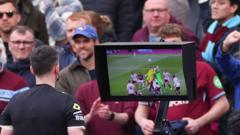
Arsenal’s recent win featured a "correct" VAR call that was technically accurate but emotionally bankrupt. Rooney’s praise ignores the cost of that accuracy. Every time a referee stands with a finger to his ear for three minutes, the stadium’s energy evaporates. You cannot "foster" atmosphere in a vacuum of uncertainty. Fans have stopped celebrating goals in real-time. They look at the referee first. They wait for the green light.
That isn't sport. That’s an administrative hearing.
The Efficiency Paradox
In the tech world, we talk about friction as something to be eliminated. In sport, friction is the point. The injustice of a missed offside or a soft penalty used to be the fuel for a week’s worth of conversation. It created legends and villains. Now, we have replaced that organic drama with a clinical, stop-start process that satisfies nobody.
If we truly wanted accuracy, we would stop at nothing. Why not have sensors in the players' boots? Why not use AI to track every limb movement in real-time? We don't do that because we know, deep down, it would ruin the spectacle. Yet, we accept this halfway house of VAR which provides the worst of both worlds: it’s still prone to human error, but it takes ten times longer to arrive at a mistake.
Let’s look at the data. Despite the "improvement" in decision-making percentages, fan satisfaction is at an all-time low. A 2023 survey of match-going fans showed that a staggering majority believe VAR has made the experience of watching football worse. Rooney, sitting in a comfortable studio or a dugout, isn't feeling the wind-chill while a check takes five minutes to decide if a toenail was offside. He’s looking at the result. The fans are looking at their watches.
The Arsenal Standard and the Fallacy of Fairness
Arsenal fans might be happy today because the call went their way. But "fairness" in football is a rotating door. Today’s benefit is tomorrow’s grievance. The problem isn't which team wins; it’s how the game feels.
When Rooney praises a VAR call for being "good," he’s looking at the outcome. He’s saying, "The right team won." But at what cost?
- The Death of the Moment: The pure, unadulterated joy of a last-minute winner is gone. It’s now a conditional joy, pending a review of a foul that happened forty seconds earlier in the buildup.
- Referees as Spectators: On-field officials are becoming hesitant. They have a safety net, so they stop making the hard calls in real-time. They wait for the machine to tell them what they saw.
- The Micro-Analysis of Contact: Football is a contact sport. VAR has turned it into a non-contact sport judged by people who seem to have never been kicked.
Imagine a scenario where the 1966 World Cup final was played under these conditions. Geoff Hurst’s "ghost goal" would have been scrutinized for ten minutes. The national myth of English football would be reduced to a grainy frame of a ball on a line. Maybe it wasn't over the line. Does it matter? The drama of the uncertainty is what cemented that moment in history.
Dismantling the "People Also Ask" Nonsense
Is VAR more accurate?
Statistically, yes. Spiritually, no. It achieves a 2% increase in accuracy at the cost of a 50% decrease in the game’s rhythm. That is a bad trade in any business.
Does VAR stop players from cheating?
Hardly. Players have just adapted their cheating. They now exaggerate contact because they know the "slow-mo" will make a brush on the ankle look like a snapped bone. It has incentivized diving, not eliminated it.
Why do pundits like Rooney defend it?
Because they are part of the establishment that values the "product" over the "game." A "clean" result is easier to sell globally than a controversial one. They want a predictable, sanitized product that fits neatly into a highlight reel.
The Real Solution
If you want to fix football, you don't need better cameras. You need fewer of them.
We should limit VAR to "Binary Decisions Only." Was it over the line? Was the foul inside or outside the box? These are facts. Everything else—the handballs, the "intent," the "seriousness" of a challenge—should be left to the referee on the pitch. If they miss it, they miss it. That’s football.
We’ve spent millions trying to turn a chaotic, beautiful game into a science experiment. We’ve given the keys to the kingdom to people who value the rulebook over the roar of the crowd.
Wayne Rooney might be happy with the "really good" call, but he’s forgotten what it’s like to be a kid in the street where the only VAR was the loudest kid shouting "it’s a foul." It wasn't always accurate, but it was always alive.
Football is dying a death by a thousand replays. If we don't stop praising the "accuracy" and start defending the "agony," there won't be a game left worth watching.
The system isn't broken because it makes mistakes. The system is broken because it thinks "perfection" is the goal.
Pick up the whistle, throw away the monitors, and let us have our game back.