The air inside Houston’s NRG Stadium carries the distinct, suffocating weight of Texas in June. Even with the roof closed, the heat is a physical presence, pressing down on thousands of packed seats and mixing with the nervous sweat of a fan base that expects nothing less than footballing royalty. For Ronald Koeman, pacing the touchline in his perfectly tailored suit, the temperature was the least of his worries.
Footballing logic is a fragile thing. A week ago in Dallas, the Netherlands held two separate leads against Japan. They watched both evaporate, surrendered to a late, agonizing equalizer that left the Oranje stranded with a single, disappointing point. In the unforgiving ecosystem of a World Cup group stage, one draw is an inconvenience. Two can be a death sentence. To make matters worse, Frenkie de Jong’s fitness was a question mark written in disappearing ink, and Quinten Timber was entirely ruled out with a training-ground concussion.
Koeman needed a gamble. He needed to shake the chalkboard.
So, he benched Crysencio Summerville, the nimble winger who had come to embody the modern Dutch obsession with fluid, intricate possession. In his place, the manager turned to a twenty-four-year-old striker who looks less like a product of the legendary Ajax academy and more like a heavy-weight prizefighter.
Brian Brobbey.
To understand the immense pressure resting on Brobbey’s broad shoulders as he stepped onto the pitch against Sweden, you have to look past the standard stat sheets. You have to look at the invisible lineage of the Dutch number nine shirt. This is the jersey worn by Marco van Basten, Patrick Kluivert, and Ruud van Nistelrooy. It is a position defined by an almost artistic elegance. For years, critics whispered that Brobbey—power-packed, direct, and unbothered by poetic flourishes—did not fit the mold. His club career had been a nomadic journey of searching for identity: rising through Ajax, a frustratingly quiet spell at RB Leipzig, a return to Amsterdam, and finally a big-money move to Sunderland where he scored a respectable but quiet seven goals this past season.
International football, however, does not care about your club logbook. It cares about moments.
Consider what happened next: the referee blew his whistle, and the tactical blueprints of Swedish manager Graham Potter instantly dissolved into the Houston air. Sweden had rolled into town brimming with the arrogance of a team that had just dismantled Tunisia 5-1. They had Alexander Isak and Viktor Gyökeres up front—two of the most terrifyingly in-form strikers in Europe. They only needed one more victory to guarantee a spot in the Round of 32.
Brobbey destroyed that confidence in exactly three hundred seconds.
In the fifth minute of the match, Tijjani Reijnders launched a lethal counter-attack, slicing open the Swedish midfield with a single pass. The ball found Cody Gakpo, who didn’t look for the spectacular. Instead, he drove a low, precise cross deep into the six-yard box.
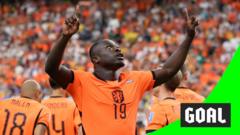
Violence and grace met at the back post. Brobbey, anticipating the trajectory like a veteran fox in the box, lunged forward. A simple tap-in. The net rippled. One-nil.
It was only his second senior goal for his country in fifteen appearances, but the celebration carried the relief of a man who had just thrown a boulder off his back. The Dutch contingent in the stands erupted into a sea of roaring orange, but on the pitch, Brobbey barely paused to breathe. He knew that against a team featuring Gyökeres, a one-goal lead is merely an invitation for chaos.
The Swedes tried to fight back, their yellow shirts swarming forward, but the Dutch defensive line held them at arm's length. Then came the seventeenth minute.
If the first goal was about positioning, the second was pure, unadulterated instinct. Denzel Dumfries, operating with his usual relentless energy on the flank, delivered a looping, dangerous ball into the penalty area. The Swedish defenders looked disorganized, caught between stepping up or dropping back. Brobbey didn't give them time to decide. He read the flight of the ball, adjusted his stride, and poked it past the onrushing goalkeeper before anyone else could react.
Two shots. Two goals. Seventeen minutes.
It was a clinical, brutal exhibition of traditional center-forward play. In less than twenty minutes, Brobbey had completely vindicated Koeman’s tactical gamble and put the Netherlands in total control of Group F.
Sweden was left chasing shadows. Even when they threatened—like a disallowed Gustaf Lagerbielke header just before the halftime whistle that was pulled back for offside—the momentum belonged entirely to the Oranje. Potter’s men tried to orchestrate a response, forcing a couple of sharp interventions from Dutch keeper Bart Verbruggen, but the psychological damage had been done early.
When the teams finally walked off the pitch for the halftime interval, the scoreboard read 2-0. But the numbers didn't tell the real story. The true narrative was written on the face of Brian Brobbey as he walked toward the tunnel, drenching himself in water, completely spent but entirely transformed. He was no longer just the young forward trying to fit into a system. On the biggest stage in the world, he had redefined what it means to be a modern Dutch striker.