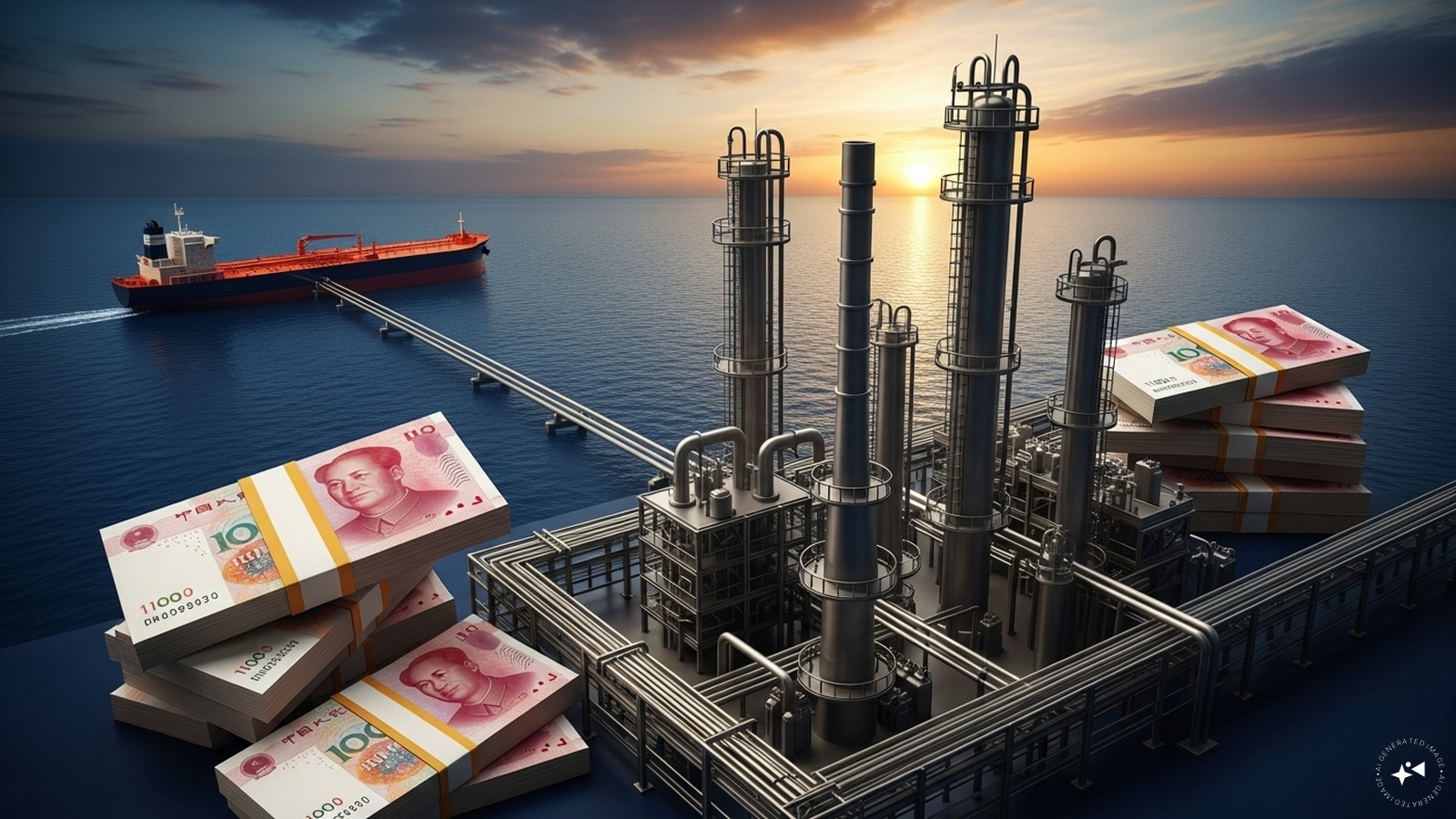
The headlines are screaming about a "shift in global power" because Indian refiners are reportedly using Chinese Yuan to settle Iranian oil debts through ICICI Bank. The analysts are tripping over themselves to call this the end of the dollar’s reign or a desperate pivot by New Delhi. They are wrong. Most of these commentators couldn't tell a Letter of Credit from a grocery list, yet they’re ready to herald a new world order based on a few ledger entries in Shanghai.
Stop looking at the currency. Look at the arbitrage. You might also find this connected article interesting: Why India Russian Oil Party Is Ending in 2026.
This isn't a geopolitical surrender to Beijing. It is a cold-blooded, mercenary calculation by Indian refiners to exploit a fractured global banking system. When you pay in Yuan for Iranian barrels, you aren't "supporting China." You are laundering geopolitical risk into pure profit.
The False Narrative of De-dollarization
The lazy consensus suggests that every time a barrel of oil is bought in a non-dollar currency, the Federal Reserve loses a night of sleep. In reality, the U.S. Dollar remains the apex predator of the financial food chain for one reason: liquidity. As reported in recent coverage by Investopedia, the results are significant.
The Yuan is a controlled, manipulated currency with a closed capital account. You can't just take a billion Yuan and buy whatever you want, whenever you want, wherever you want. It is a tool of the Chinese state, not a free-market instrument. Indian refiners know this. They aren't switching to Yuan because they love the People's Bank of China. They are using it because the U.S. Treasury has turned the dollar into a barbed-wire fence around Iranian exports.
Using the Yuan is a bypass, not a destination.
Refiners like HPCL or BPCL aren't ideologues. They are margin hunters. If they can get Iranian crude at a $10 or $15 discount per barrel compared to Brent, the transaction cost of moving money through a third-party bank like ICICI using Yuan is a rounding error. The "death of the dollar" crowd ignores the fact that these same refiners still price their final products—gasoline, diesel, jet fuel—in dollars. The spread is where the money is made.
ICICI Bank and the Architecture of Necessity
People ask, "Why would a private-sector Indian bank like ICICI get involved in something so radioactive?"
The premise of the question is flawed. It assumes banks operate on moral or nationalistic planes. They don't. They operate on risk-weighted assets and regulatory loopholes. If the Indian government provides a "comfort letter" or if the transaction is structured through a non-sanctioned clearing house, the bank isn't being "bold." It’s being a utility provider.
The mechanics are simpler than the pundits suggest:
- India exports goods to China or runs a trade deficit that creates a pool of Yuan-denominated assets.
- Iran needs to buy Chinese goods but faces its own banking hurdles.
- India uses its Yuan reserves to pay Iran for oil.
- Iran uses that Yuan to buy Chinese machinery, electronics, and infrastructure.
This is a closed-loop barter system wearing a currency mask. It’s an accounting trick designed to keep the lights on in Mumbai without triggering a SWIFT lockout. Calling this "economic alignment with China" is like saying you're best friends with your landlord because you write them a check every month.
The Crude Reality of the "Discount Trap"
I have seen traders celebrate a $5 discount on a cargo only to lose $7 on shipping, insurance, and currency conversion slippage. Dealing with Iran is not for the faint of heart or the mathematically challenged.
The competitor's article likely misses the "Deadweight Loss" of these transactions. When you pay in Yuan, you are subject to the exchange rate whims of Beijing. You are also paying a "sanction premium" to the intermediaries.
However, India has mastered the art of the "Multi-Polar Hedge."
- The Russian Play: Buy in Dirhams or Rubles when the price is right.
- The Iranian Play: Use Yuan or Rupee-Vostro accounts to settle debts.
- The American Play: Continue buying US shale in Greenbacks to keep Washington from getting too litigious.
This isn't a pivot. It’s a diversification of supply chains. By keeping Iran in the mix via Yuan payments, India ensures that Saudi Arabia and Iraq can’t squeeze them on premiums. The very existence of the Iranian option—no matter how messy the payment—forces every other OPEC+ member to negotiate harder.
Why the Rupee-Rial Trade Failed (And Why Yuan Won)
A common question is: "Why can't India just pay in its own currency?"
The answer is brutal: Because nobody wants Rupees.
I’ve sat in rooms where foreign trade officials politely explain that they have enough Rupees to buy every Indian buffalo and tractor for the next decade, and they still have leftovers. Unless India exports something the world must have in massive quantities (beyond services and generic pharma), the Rupee will never be a settlement currency for energy.
Iran tried the Rupee-Vostro route. They ended up with billions of Rupees sitting in Indian banks that they couldn't spend on anything other than Indian rice and tea. Iran needs industrial capacity. China has it. Therefore, the Yuan is the only "non-Western" currency that actually has utility for a sanctioned nation.
India using Yuan to pay Iran is effectively India saying: "We will use our rival's currency to buy our friend's oil so we can outcompete both of them in the global manufacturing race." It is a masterstroke of cynicism.
The Hidden Cost of Compliance
Let's address the elephant in the room: The U.S. Office of Foreign Assets Control (OFAC).
The "insider" truth that nobody wants to admit is that Washington often looks the other way—until it doesn't. There is a silent theater of "Maximum Pressure" where the U.S. allows certain leakages to prevent a global oil price spike that would incinerate a sitting President's reelection chances.
Indian refiners aren't "sneaking" past the U.S. They are navigating a calibrated gray zone. The moment the U.S. decides that a $100 barrel of oil is better for the American economy than a sanctioned Iran, these Yuan payments will be scrutinized with a microscope. For now, the "Yuan via ICICI" route is a pressure valve.
The Counter-Intuitive Truth
The real threat to the West isn't the Yuan. It's the normalization of the "Alternative Infrastructure."
Every time a transaction successfully clears outside of the dollar-dominated SWIFT system, the "sanction hammer" loses a bit of its weight. We are moving toward a bifurcated financial world where one side uses the Dollar/Euro/Yen and the other uses a messy, inefficient, but functional cocktail of Yuan, local currencies, and physical gold.
India is the only country currently playing both sides of the board with equal skill. They are a member of the Quad (pro-US) and a member of BRICS (pro-alternative). They are the ultimate swing state.
If you think this is about a bank in Mumbai helping a refiner in Jamnagar buy oil from Tehran, you’re missing the forest for the trees. This is about India declaring its "Strategic Autonomy." They will use whatever currency, whatever bank, and whatever loophole necessary to ensure their energy security.
Stop Asking the Wrong Question
The question isn't "Is the Yuan replacing the Dollar?"
The question is "How much of a discount is India getting for the trouble?"
If the discount is high enough, India would pay in seashells or vintage comic books. The currency is just the logistical friction of the trade.
To the critics who say India is "empowering" China: Look at the trade deficit. India is using the Yuan it already has—money that would otherwise sit idle or be used to buy more Chinese consumer goods—to secure the energy required to build an Indian industrial base that will eventually compete with China.
It is the ultimate irony. India is using China's own currency to fuel the engine that intends to replace China as the world's workshop.
The next time you see a report about Yuan payments at ICICI, don't fear for the Dollar. And don't cheer for the Yuan. Just recognize the sound of a country buying its way to superpower status at a significant discount.
Stop reading the tea leaves of currency fluctuations and start watching the oil tankers. That is where the real power is being settled.