The first thing you notice isn't the darkness. It is the silence.
In Havana, the air is usually a thick soup of salsa rhythms, the rhythmic rattle of Lada engines, and the persistent hum of window-unit air conditioners fighting a losing battle against the Caribbean humidity. Then, the grid collapses. The hum stops. The silence that follows is heavy, physical, and terrifying. It feels like the island itself has held its breath.
When Cuba’s national power grid failed last year—not once, but in a cascading series of total blackouts—it wasn't just a technical glitch. It was a heart attack. The Antonio Guiteras power plant, a hulking, aging beast of Soviet-era engineering, simply gave up. When that plant goes down, the rest of the island’s fragile energy network follows like a row of scorched dominoes.
For the people living through it, the news didn't come via a press release. It came when the fridge stopped vibrating.
Consider Maria. She is a hypothetical composite of the dozens of grandmothers in Central Havana, but her struggle is the lived reality of millions. When the lights flicker and die, Maria doesn’t curse the government or the aging infrastructure first. She runs to the kitchen. She has a small piece of pork and some milk, luxuries bought with remittances sent from a son in Miami. Without electricity, those luxuries have a countdown timer. In the tropical heat, you have six hours before the meat begins to turn. Twelve hours before the milk is sour.
This is the hidden tax of a failing state. It is the constant, low-grade anxiety of knowing that your meager resources are tied to a copper wire that might snap at any moment.
The Ghost in the Machine
To understand why Cuba goes dark, you have to look at the bones of the country. The electrical system is a Frankenstein’s monster of 1970s Soviet technology and patched-together local repairs. It relies heavily on "thermoelectric" plants. These are massive furnaces that burn crude oil to boil water, creating steam that spins turbines.
The problem is two-fold. First, the plants are old. They are well past their expiration date, surviving on the ingenuity of Cuban engineers who manufacture spare parts out of scrap metal because they cannot buy them on the international market. Second, the fuel. Cuba produces a heavy, sulfurous crude oil that is notoriously difficult to burn. It’s "dirty." It clogs the pipes. It corrodes the boilers. Using it is like trying to run a marathon while breathing through a straw filled with sand.
When the government announces that the grid is being "restored," they aren't flipping a single switch. They are performing a delicate, high-stakes dance. They have to restart small generators to create enough initial power—a "black start"—to jumpstart the larger plants. If they draw too much power too quickly, the whole system trips and falls back into the dark.
It happened three times in forty-eight hours during the last major crisis. Imagine the psychological toll. You wait in the heat for twenty hours. Suddenly, the lightbulb in the hallway glows. You cheer. You plug in your phone. Ten minutes later, the glow fades to an orange ember and vanishes. The hope is more exhausting than the darkness.
The Midnight Kitchen
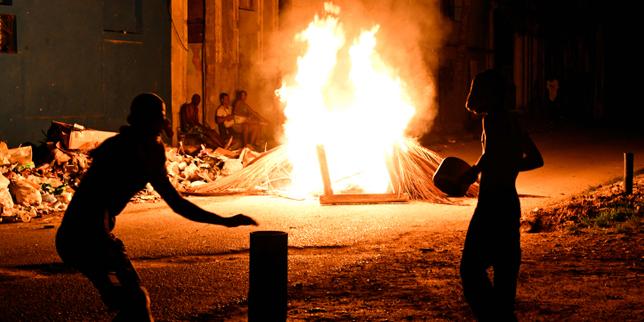
Night in a blackout changes the way a city moves. People migrate. They move from the stifling heat of their bedrooms to the doorsteps and balconies. The streets of Havana, usually vibrant, become a sea of shadows lit only by the occasional passing car or the blueish tint of a cell phone screen.
But phones die. And in Cuba, where the internet is the primary gateway to the outside world, a dead phone is a form of isolation that feels like being buried alive.
The strategy for survival is communal. If one neighbor has a charcoal grill, everyone brings their thawing meat to that porch. You cook everything at once. You eat like kings in the dark because by tomorrow, the food will be waste. There is a grim irony in these "blackout feasts." They are born of desperation, yet they reinforce a social fabric that has been stretched to the breaking point.
However, resilience has its limits. The "human element" isn't just about neighbors sharing pork; it’s about the mother who can’t find bread because the state-run bakeries can’t run their electric ovens. It’s about the hospital where surgeons operate under the glow of handheld flashlights because the backup generator ran out of diesel.
The Geometry of Decay
Why can’t they just fix it?
The answer is a labyrinth of economics and geopolitics. Cuba is broke. The country lacks the hard currency to buy the fuel it needs from the global market, and its traditional allies—Russia and Venezuela—have their own problems. Venezuela, once the island's energy benefactor, has seen its own production crater. Russia is preoccupied with a war.
This leaves Cuba reliant on "floating power plants"—huge Turkish barges moored off the coast that plug into the national grid. They are a literal lifeline, but they are expensive rentals. They are a bandage on a gunshot wound.
The math is brutal. The island needs roughly 3,000 megawatts to meet peak demand. When the plants fail and the fuel runs dry, that capacity drops by half. The result is "programados"—scheduled blackouts. But as the infrastructure decays, the schedule becomes a lie. A planned four-hour outage becomes twelve. A twelve-hour outage becomes a day.
The Sound of the Street
Pressure builds in the dark. In 2021, and again in more recent smaller waves, the lack of electricity became the catalyst for the rarest of things in Cuba: public protest.
When the lights go out, the fear of the state's security apparatus sometimes dims with it. People take to their balconies and beat pots and pans—the cacerolazo. It is a metallic, clattering symphony of frustration. It is a demand for the most basic of modern rights: the right to see after the sun goes down.
The government’s response is usually a mix of frantic repair efforts and an increased police presence. They know that a dark street is a dangerous street, not because of crime, but because of ideas. Discontent grows in the heat. It festers in the silence of a dead television.
The Morning After
Eventually, the grid hums back to life. The Antonio Guiteras plant is patched with more metaphorical duct tape and prayer. The Turkish barges pump electricity into the Havana suburbs.
The news reports will say the "system is stabilized." Journalists will use words like "recovery" and "restoration." But for Maria, looking at her empty fridge and the puddle of melted ice on the floor, nothing has been restored. She knows the silence will return.
She spends her morning washing clothes by hand, catching up while the water pump still has power. She charges every battery she owns. She moves with a frantic, nervous energy, racing against an invisible clock.
The tragedy of the Cuban power crisis isn't the darkness itself. It is the way it forces an entire nation to live in the conditional tense. We will eat, if there is power. We will work, if the grid holds. We will sleep, if the fan turns.
As the sun sets over the Malecón, the orange light reflects off the peeling paint of the colonial buildings. It’s beautiful for a moment. Then, the streetlights fail to flicker on, and the city begins to disappear, one block at a time, into a void that feels less like a technical failure and more like a slow, deliberate erasure.
The shadows grow long, and somewhere in the distance, the first pot begins to clang.